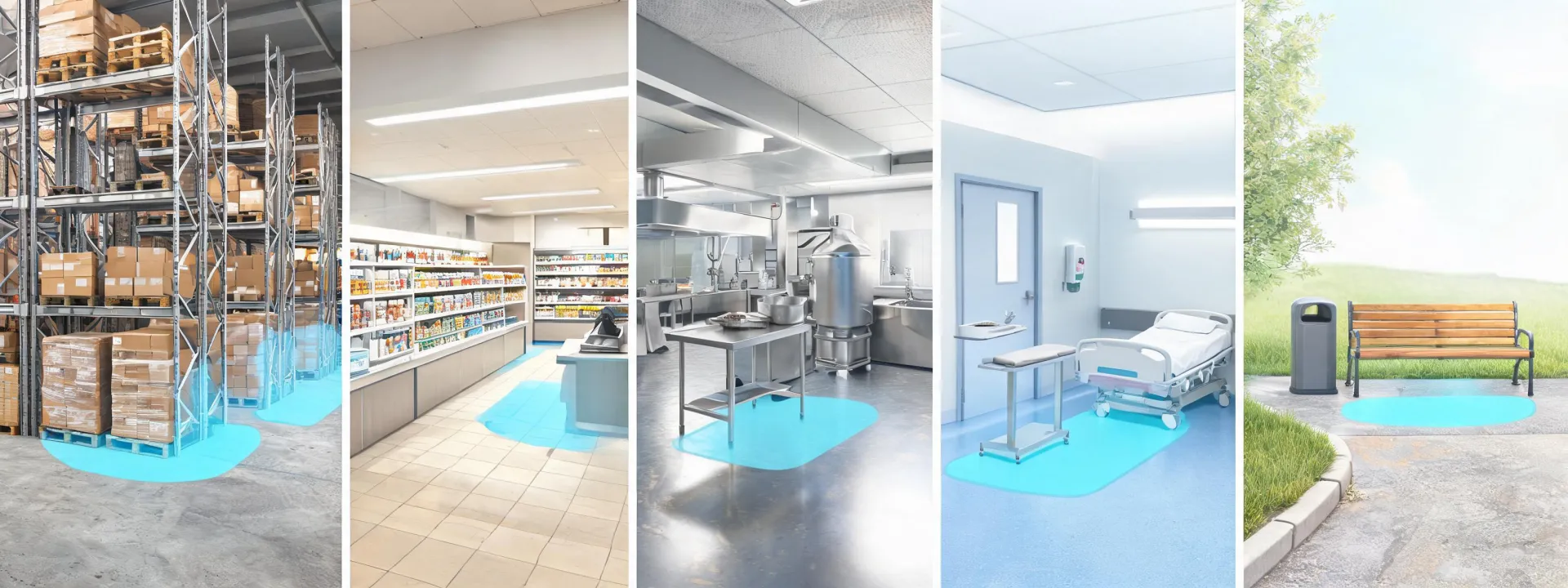
Different industries ask cleaning teams to solve different problems, so machine selection must follow the floor, debris, hygiene expectation and work schedule.
The same product family can perform very differently from one site to another. A scrubber in a grocery store must handle tight turns and customer-facing appearance. A sweeper in a distribution center must collect packaging debris without slowing pallet movement. A dust collector near process equipment must support cleaner air and easier housekeeping around the source.
High traffic lanes, tire marks, pallet wrap and dust call for scrubbers and sweepers that are sized to route width, battery windows and debris load.
Compact machines, low noise expectations and visible floor appearance shape cleaning choices for front-of-house and backroom spaces.
Washable surfaces, wet residue and sanitation routines require attention to recovery performance, material compatibility and predictable maintenance.
Frequent cleaning, quiet operation and easy operator training influence equipment choices in corridors, classrooms, clinics and common areas.
The chart is a planning prompt rather than a universal specification. It shows how different cleaning tasks tend to cluster by environment. A facility may need several machine families because the same building can include public entrances, production spaces, loading areas and maintenance rooms. Nilfisk recommendations should therefore connect each product family to a named area, a residue type and a service habit.
Cleaning-equipment decisions rarely have one correct answer. The honest disputes are about trade-offs, and a facility team is better served seeing both sides than being sold a single position. The industry argument resource for this campaign is intentionally drawn from selection factors rather than fabricated controversy.
| Decision | Option A | Option B | What actually decides it |
|---|---|---|---|
| Power source | Battery: cable-free, quiet, lower running cost; limited by charge window and higher upfront price. | Corded / engine: continuous runtime; trips, fumes or cable management become the constraint. | Shift length vs. uninterrupted runtime needed before a charge or refuel. |
| Operator position | Walk-behind: cheaper, tighter turning, fits congested layouts; coverage rate capped by walking pace. | Ride-on: far higher coverage rate on open floor; needs aisle width and storage and costs more. | Open square footage vs. layout congestion and turning radius. |
| Dry pickup | Industrial vacuum: portable, point cleanup, standard or HEPA filtration. | Dust collector: fixed source capture for continuous dust generation. | Whether dust is intermittent housekeeping or a continuous process source, and the dust class. |
No single machine spans all of these. A scrubber leaves dry packaging debris a sweeper is built for; a standard-filtration vacuum is not a substitute for a HEPA or certified dust-class unit on fine or hazardous powder; a pressure washer needs drainage and is wrong for finished interior floors; battery runtime is finite and does not stretch to fit an unplanned double shift. These are applicability boundaries, not flaws.
How to verify the fit instead of taking a claim on faith: request an on-site walk-through, a timed coverage trial on your own floor with the candidate machine, and a sample-residue test for vacuum or dust-collector filtration before committing. Coverage-rate and runtime figures should always be confirmed against your aisle width, soil load and shift schedule rather than read from a spec sheet alone.
List the spaces, surfaces, debris types and cleaning windows that matter most. Nilfisk can help translate that map into machine categories and support priorities.