How to Buy Cleaning Equipment for Your Facility (3 Paths, Not One)
-
Three Different Situations (And Why "Which Is Best" Is the Wrong Question)
- Path 1: Large Floors → A New Floor Scrubber, But Run the TCO First
-
Path 2: Vehicles and Exteriors → Get the Pressure Washer Math Right
-
Path 3: Dust-Heavy Work → Stop Treating Dust Collectors as Optional
-
How to Figure Out Which Path You're On
When I first took over our facility equipment budget back in 2019, I treated it like any other procurement. Same three vendors on rotation, same comparison spreadsheet, same rule: lowest unit price wins. If two machines did the same job, buy the cheaper one. Simple, right?
It wasn't simple.
It took us about 14 months, one burnt-out motor, and a surprise $4,800 ductwork bill to figure out that industrial cleaning gear isn't one category. A floor scrubber, a pressure washer, and a dust collector might all look like "machines," but they play by completely different economics. Optimize for one and you're usually optimizing wrong for the others.
I currently manage about $470K in annual indirect spend, roughly $65K of which runs through cleaning equipment. Six years, three facilities, two bidding mistakes I'd rather not repeat, and one spreadsheet I now trust. Here's what I wish someone had handed me in year one.
Three Different Situations (And Why "Which Is Best" Is the Wrong Question)
When someone asks me "what's the best cleaning equipment," they're usually asking the wrong thing. It's like asking "what's the best truck" — depends entirely on what you're hauling.
In our facilities, there are really three distinct situations, and each one points at a different answer:
- High-traffic floors — warehouses, production halls, retail floors
- Vehicles, equipment, and exterior surfaces — fleet maintenance, loading docks, facades
- Dust-heavy work areas — woodworking, metal fabrication, precision sanding
Let's walk each one.
Path 1: Large Floors → A New Floor Scrubber, But Run the TCO First
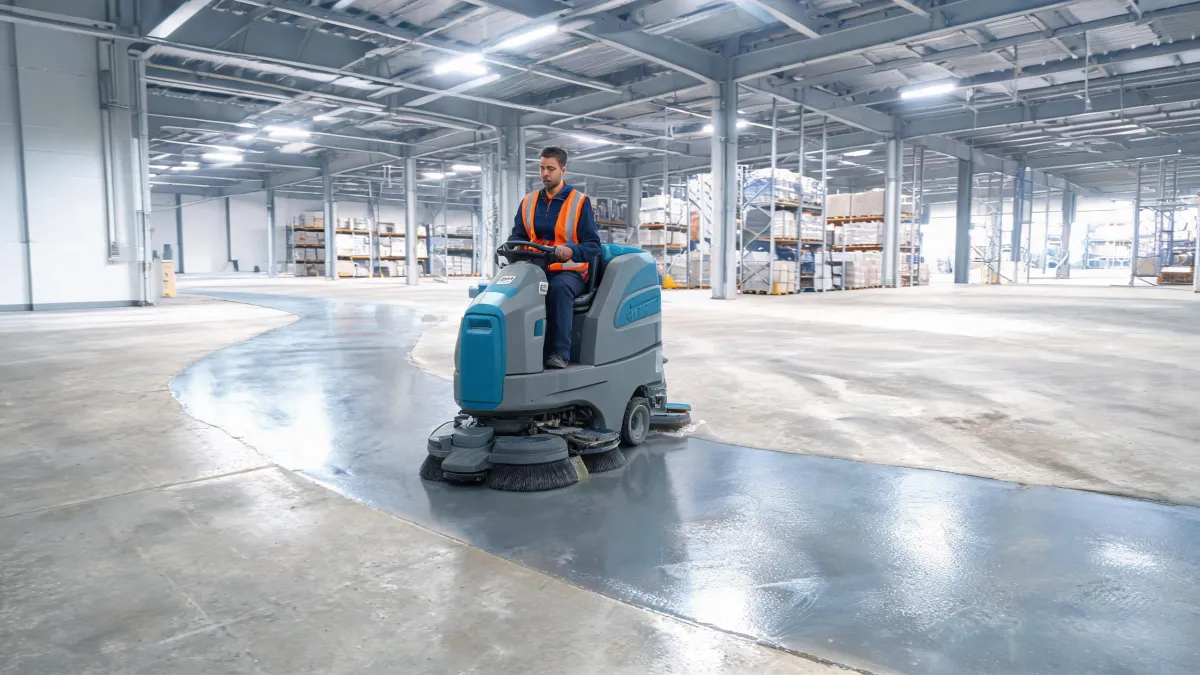
If you've got forklifts and foot traffic crossing concrete or epoxy every day, a floor scrubber is almost always the obvious call. Which one to buy is where most procurement teams quietly lose money.
Our 2022 purchase was a mild disaster dressed up as a win. We bought two cheaper walk-behind units because the unit price was great. The tank capacity, however, was tiny — about 60 minutes of runtime per charge before refills. Operators were topping up four to five times a shift. When our maintenance lead ran the numbers (painfully), we were burning roughly $3,200 a year in extra labor and downtime. The larger-tank model would have cost about $1,800 more upfront. Two-year payback, no brainer.
So when quoting a new floor scrubber, don't stop at the unit price. Build a TCO sheet that includes:
- Runtime per charge / per tank — shorter runtime = hidden labor cost
- Brush pressure adjustability — adjustable = one machine covers more floor types
- Squeegee blade replacement cost — every 6-12 months depending on use
- Battery type and replacement cycle — lead-acid vs lithium changes the math a lot
How to Clean a Floor Scrubber (Which Is Kind of the Whole Point)
This is the part I now write into every procurement brief: no matter how carefully you spec a machine, it dies fast in the hands of an operator who doesn't maintain it.
Our maintenance routine is boring and it works:
- Drain and rinse the recovery tank after every shift — takes about four minutes
- Check squeegee blades daily, wipe them with a damp cloth
- Clear the brush and brush housing of debris weekly
- Inspect battery terminals and water levels monthly
That's it. Simple. But we lost a brush motor at nine months on a unit that should have lasted three years because nobody touched it for a quarter in early 2023. Repair ticket: $1,100. Plus the floor quality dipped in the interim, which we never fully costed out. Live and learn (expensively).
Path 2: Vehicles and Exteriors → Get the Pressure Washer Math Right
If you run a fleet, or you're just keeping loading docks and building exteriors in shape, a pressure washer earns its keep fast. But the spread between good and cheap in this category is genuinely ridiculous.
Our fleet team runs a Nilfisk gun pressure washer — the pistol-grip style you see in most professional setups — because the PSI and GPM combo (impact vs. volume) was documented in the spec sheet, and long-run consumable costs were traceable. Cheap alternatives we trialed cycled through trigger locks and hose fittings every few months. Over two years, we estimated those consumables alone added roughly $600 per unit, before counting the downtime from failures.
On the Nilfisk professional pressure washer car wash use case specifically — this comes up a lot in fleet discussions — here's the per-vehicle math we worked out. A professional-grade unit at working pressure consumes around 45 gallons per vehicle for a full exterior wash, about 8 minutes of active spray time (not counting foam/dwell). A budget machine often takes twice the time and uses more water because the spray pattern is wider and less efficient. Multiply that by your weekly wash count, then by your loaded labor rate. The gap shows up fast.
Three things I always verify before signing off:
- Pump type — axial pumps are fine for light duty, triplex plunger pumps are what you want for heavy, long-life use
- Quick-connect standards — proprietary fittings mean you're locked into one vendor for every future nozzle
- Flow rate (GPM) versus pressure (PSI) match — low pressure with high flow often strips grime better than high pressure with low flow, which surprises people
Path 3: Dust-Heavy Work → Stop Treating Dust Collectors as Optional
This one cost me the most pride.
I ignored it at first. We had a sanding station pulling metal and composite dust, and we just... wiped things down. Vented it and moved on. I didn't clock it as a recurring cost until two operators complained about respiratory irritation, our union rep got involved, and the quote came back at $4,800 for retrofitted ductwork. All from trying to save maybe $600 on a proper dust collector.
Now we run a DSPIAE dust collector in the precision sanding area — a compact, targeted unit, not a full shop system. For small stations and detail work, a compact dust collector is the right shape of answer. It's cheap, the suction is concentrated, and it doesn't hog the electrical circuit we barely had to spare. But it's not the answer for high-volume dust — don't expect a benchtop unit to keep up with a full woodshop. No universal solution here either.
One signal that makes the dust collector decision easier: if you can see dust settling where it shouldn't, it will eventually cost you. Either in equipment failures, compliance headaches, or lost hours from sick staff. I've now seen all three outcomes across different plants.
How to Figure Out Which Path You're On
If you want a quick sorting rule, here it is:
- Floors/walkways dirty, and it's more than half of your complaints → look at your floor scrubber TCO. Replace it, or do an honest maintenance overhaul.
- Dirt is on vehicles, walls, or tools, not on the ground → buy a professional-grade pressure washer. Spec it on PSI and GPM, not on looks.
- Airborne dust and operators are complaining → budget for a dust collector before it becomes a complaint letter.
If two or three of those apply (most facilities), rank them by cost of failure. Dust exposure and compliance usually come before anything else. Floor cleanliness comes next if it's customer-facing; slotted lower if it's internal-only traffic.
Honestly? The thing I'm most satisfied with isn't a slick deal I negotiated. It was Q1 last year, when I sat down with the TCO sheet and we'd cut our per-square-foot cleaning cost by 22% versus the previous year — with the same machines on the floor. No vendor swap, no automation theater. Just maintenance discipline and refusing to buy equipment that couldn't handle our actual operational reality.
That's the real efficiency: not buying more stuff. It's no longer paying twice for the wrong pick.

Elise Marceau
Elise Marceau is an LED display and digital-signage systems analyst covering LED video walls, modular screens, transparent LED, control processors, and indoor or outdoor signage. She applies IEC 62368-1 safety principles while comparing pixel pitch, luminance, contrast, refresh rate, colour uniformity, viewing angle, ingress protection, power density, module serviceability, and signal redundancy. Her specification guides help integrators, venue operators, retailers, and procurement teams align viewing distance, ambient light, content format, installation access, electrical load, and lifecycle support.