How to Source Industrial Cleaning Equipment Without Overpaying: A 7-Step Checklist
-
Who This Checklist Is For (and What It Won't Cover)
-
Step 1: Get Your Actual Facility Numbers Before You Talk to Any Vendor
-
Step 2: Match the Machine to the Actual Job, Not the Brochure
-
Step 3: Ask for the TCO Breakdown in Writing
-
Step 4: Request a Trial Unit or a Short-Term Rental Before You Buy
-
Step 5: Confirm the Service Network Covers Your Zip Code
-
Step 6: Budget for the Consumables Before You Budget for the Machine
-
Step 7: Document the Decision Before You Place the Order
-
Common Mistakes to Keep in Mind
Who This Checklist Is For (and What It Won't Cover)
This is for the person who just got handed the "we need a new floor scrubber and a couple of industrial vacuums" email, and has maybe two weeks to produce three quotes, a recommendation, and a budget line.
I've been that person six times now. As of January 2025, our facilities equipment budget runs about $140,000 a year, and I've tracked every invoice in a spreadsheet I'm mildly embarrassed to open in meetings.
Seven steps. That's it. Follow them in order and you'll have a defensible recommendation plus a paper trail when someone asks why you didn't just buy the cheapest option on the list.
Up front: I'm not an equipment engineer. I can't tell you whether a 245Ah battery is right for your run time, or whether your tile and grout needs a cylindrical brush scrubber or a dedicated floor cleaning machine for tile and grout. That's a question for your Nilfisk rep or your service provider. What I can tell you is how to compare quotes without getting buried in the fine print.
Step 1: Get Your Actual Facility Numbers Before You Talk to Any Vendor
Before you open a single quote, pull these numbers:
- Square footage by surface type (concrete, tile and grout, epoxy, VCT)
- Daily cleaning window in minutes—not "overnight," actual hours
- Number of operators who will touch the equipment
- Existing power access and drainage in the areas you need to clean
I skipped this my first year. A vendor quoted us a ride-on scrubber with a 40-inch deck. Great machine. Our aisles were five feet wide. We ran it twice before it went back. That mistake cost us roughly $1,800 in freight and restocking (which, honestly, they never mentioned on the quote—it showed up on the credit).
If I remember correctly, the whole process took about six weeks. Maybe eight. I'd have to check the log.
Step 2: Match the Machine to the Actual Job, Not the Brochure
Different cleaning jobs need different equipment. Sounds obvious. It isn't — because reps tend to pitch one category well.
Here's how I break it down now:
- Tile and grout floors — you need pressure and dwell time. A standard auto-scrubber won't get grout lines clean without a brush pre-treat. Look at scrubbers with cylindrical brush options, or plan for a separate floor cleaning machine for tile and grout.
- Heavy lint or textile dust (laundry operations) — a laundry dust collector is not the same as a shop vac. It needs filtration rated for lint and fine debris, and it needs to handle continuous runtime without clogging mid-shift.
- Fine particulate or welding smoke — this is where ion dust collectors come in. They're not the right tool for bulk debris. They're for capturing particles that standard filters pass through.
- General wet/dry spills — something like the Nilfisk VT 60CR industrial wet/dry vacuum is a reasonable starting point for mixed debris, but check the tank size against how often your team actually wants to empty it. A 15-gallon tank emptied by hand at end of shift is a different experience than a 60-gallon unit with a drain hose.
If your facility has multiple surface types, you're probably looking at two or three different machines instead of one. That's normal. Anyone selling you one machine that does everything is selling you one machine that does one thing well and the rest badly.
Step 3: Ask for the TCO Breakdown in Writing
This is the step most buyers skip because it feels confrontational. It isn't. It's a data request.
I ask for:
- Unit price
- Freight and delivery
- Setup or commissioning (if any)
- Operator training hours included
- Consumables cost per year (filters, pads, brushes, squeegees, detergents)
- Warranty length and what it actually covers
- Estimated annual service cost after warranty
- Expected battery replacement cost and interval (for battery equipment)
I don't have hard data on industry-wide service cost averages. Based on tracked invoices over the past four years — roughly 40-odd equipment orders, I'd have to check the system — service on scrubbers runs about 6-9% of purchase price annually once you're past warranty. Vacuums tend to be lower, maybe 3-5%, unless you're in a particularly abrasive environment.
If a vendor won't put items 5 and 7 in writing, that's information too.
Step 4: Request a Trial Unit or a Short-Term Rental Before You Buy
This is the step that has saved me the most money — and the one most small operations skip because they assume they can't ask.
You can ask. A rep would rather spend a week renting you a demo unit than process a return in month three. I've had vendors offer a 5-day trial on scrubbers and a 30-day rental credit toward purchase on vacuums. Not every vendor will. The ones that say yes are usually the ones whose equipment holds up.
When I was starting out in this role, I got quoted a minimum order quantity of three units for a small parts order. I asked if I could buy one as a trial. They said no. I went elsewhere. That other vendor got our $200 order then and our $20,000 order four years later. Small doesn't mean unimportant.
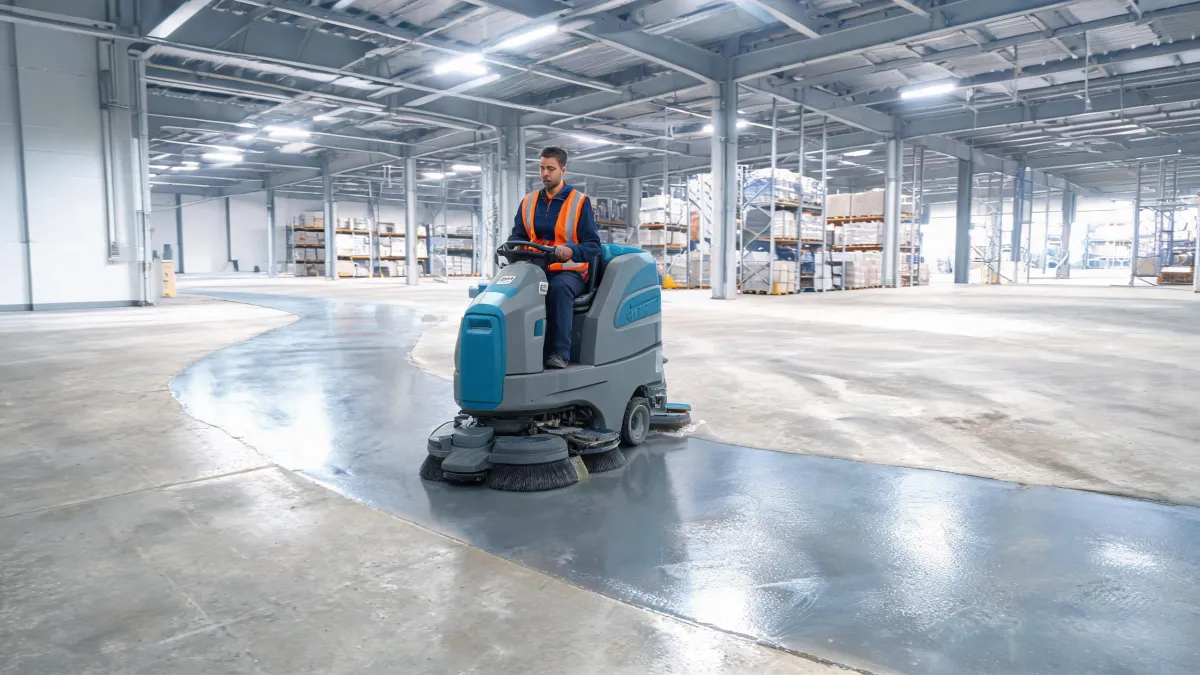
For a ride-on scrubber like the Nilfisk Viper AS710R-245, a trial matters even more — you're committing to a machine your operators will sit on for hours per shift. Seat comfort, steering effort, and real-aisle turn radius are things no spec sheet will tell you.
Step 5: Confirm the Service Network Covers Your Zip Code
I don't know why this isn't standard practice, but here it is: a great machine with no local service is a paperweight with a battery. Before you commit, ask for the name and location of the service provider closest to your facility, and the expected response window for a service call.
I've had two vendors tell me they had "national service coverage" and then struggle to find a technician within 60 miles. The one that gave me an actual name and city up front? We've bought from them four times.
Step 6: Budget for the Consumables Before You Budget for the Machine
This is the step I got wrong early on. I'd get approval for a $12,000 scrubber and then spend the next 18 months fighting for $900 here and $600 there in pads and squeegees. The machine was in the books. The consumables slid into "other."
Now I add a line item to the original request: "Annual consumables: estimated $X." That way, nobody's surprised in month four, and I don't have to explain why the new scrubber costs more to run than the old one did.
Ask the vendor for their consumables price list at the time of quote. Most have one. If they don't, that's a data point.
Step 7: Document the Decision Before You Place the Order
Write a one-page summary. Yes, really. Include:
- What you're buying and why
- What you compared it against
- The TCO numbers for each option
- The top two risks (for example, "service response time unverified" or "freight damage history unknown")
- Trial or rental results, if applicable
This takes 20 minutes. It's saved me from a conversation where someone asks "why didn't you buy the cheaper one?" and I have to reconstruct the argument from old emails. Now I just forward the summary.
Common Mistakes to Keep in Mind
Don't assume bigger is better. Oversized equipment gets parked in a corner. Match deck size and tank capacity to the actual space and shift duration.
Don't compare quotes by unit price. I once almost approved a quote that was $1,400 cheaper until I saw the freight line, the training fee, and a consumables setup charge. The difference disappeared and then some. It's tempting to just line up the top number. Don't.
Don't skip the safety and ergonomics question. Ask if the machine has been evaluated for vibration and noise exposure. Your EHS team will ask anyway. Better to have the answer before they do.
Don't buy based on a demo in a clean showroom. Ask for a demo in your actual facility. I've walked away from two units that performed fine on polished concrete and struggled on our textured tile.
Don't be afraid to start small. A trial unit, a single vacuum, a rental — these are legitimate first steps. The vendors who treat a small order well are the ones you'll want to keep.
One last thing: if you're comparing a Nilfisk against a Karcher, a Tennant, or anyone else, run the same TCO exercise for each. The brand on the side matters less than how the numbers shake out once you include everything. I can't tell you which one is best for your floor. The math will.

Tobias Lindgren
Tobias Lindgren is a digital inkjet systems analyst specializing in UV flatbed, roll-to-roll UV, and general inkjet printers for signage, rigid media, labels, prototypes, and promotional graphics. He references ISO 12647-7 for applicable digital proof evaluation while comparing CIELAB colour difference, resolution, droplet size, pass count, curing energy, adhesion, banding, media flatness, throughput, and ink consumption. His evaluations help print service providers and equipment buyers balance colour control, substrate compatibility, finishing requirements, productivity, maintenance burden, and cost per sellable print.