Buying Industrial Cleaning Equipment: 7 Questions I Ask Before Every PO (Nilfisk, SC250, Dust Collectors, and More)
-
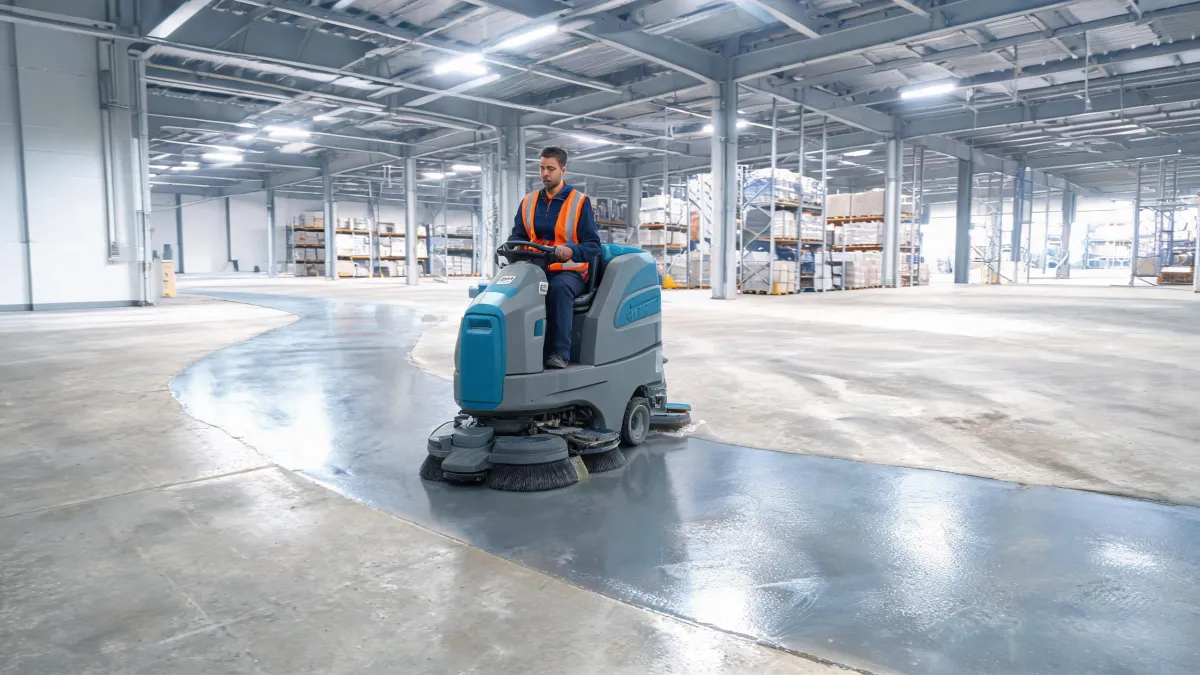
1. Is Nilfisk actually better than cheaper alternatives?
-
2. Does the Nilfisk SC250 battery scrubber dryer fit my facility?
-
3. Why do pharma dust collectors cost 3x more than standard units?
-
4. Where does BAUUSA fit against commodity dust collector brands?
-
5. What should a high-pressure electric washer actually cost?
-
6. Which hidden costs eat the most budget?
-
7. How do I use demo policies without getting played?
-
Final thought
Six years managing industrial cleaning equipment spend. Roughly $180,000 in cumulative purchases. Forty-seven vendors negotiated with, twelve walked away from. What follows isn't a buyer's guide — it's the actual list of questions I run through before any PO gets signed, along with the answers that cost me money to learn.
If you're evaluating Nilfisk, the SC250 battery scrubber dryer, a dust collector for pharma, or a high-pressure electric washer — here's what actually matters.
The questions covered:
- Is Nilfisk actually better than cheaper alternatives?
- Does the Nilfisk SC250 battery scrubber dryer fit my facility?
- Why do pharma dust collectors cost 3x more than standard?
- Where does BAUUSA fit against commodity dust collector brands?
- What should a high-pressure electric washer really cost?
- Which hidden costs eat the most budget?
- How do I use demo policies without getting played?
1. Is Nilfisk actually better than cheaper alternatives?
Yes — but not in the way the spec sheet suggests.
Back in 2022, I bought two imported scrubber dryers for our east warehouse. They quoted about 35% less than an equivalent-spec Nilfisk. Looked like an easy win. Then both batteries died at month 14 — just inside warranty, but only barely. Replacements: $2,400 for the pair. That ate the entire savings from 18 months of ownership. Parts availability got worse. We waited 9 weeks on a water-level sensor that a Nilfisk dealer would have had in their truck.
That's the real "cheaper" math. Not quote price — wait time, replacement cost, and the dealer who shrugs when you call.
Nilfisk isn't the only credible option. But they have a local service network, verified parts supply chains, and dealers who know that one bad job means the next PO goes elsewhere. That's the thing you're actually paying for. Not the logo.
2. Does the Nilfisk SC250 battery scrubber dryer fit my facility?
Walk the route before you read the spec sheet.
People focus on cleaning width and amp-hour ratings. But aisle geometry is what kills deals. A "34-inch" cleaning path means nothing if the machine can't power-turn at the end of your rack aisle.
I learned this the expensive way. In Q2 2023 our east warehouse took delivery of a scrubber dryer — not an SC250, but in that class. $6,200 quoted. It couldn't clear the turn at the end of aisle 7. Return shipping was $800. The swap cost another $400. All told, closer to $7,500 to get the right machine.
So if you're looking at SC250-tier equipment: draw the floor plan first. Aisle widths, turn radii, ramp grades, charging station locations. Get those right, then negotiate. Not the other way around.
Five-year TCO for a good battery scrubber dryer lands somewhere around 0.7–0.8x the sticker price when you factor maintenance, consumables, and downtime. Cheaper units look great on paper until you count the days they sit idle waiting on parts.
3. Why do pharma dust collectors cost 3x more than standard units?
Because the validation paperwork costs more than the hardware.
A dust collector for pharma isn't just a vacuum with a bigger motor. It needs documented filtration efficiency, change-control records, and a calibration traceability chain. Miss that, and you're not saving money — you're building an FDA inspection finding.
What drives the cost:
- ISO 14644-compliant cleanroom compatibility
- HEPA H14 filtration with verifiable efficiency documentation
- Containment and drum-change procedures
- Audit trail capability per FDA 21 CFR Part 11
- On-site qualification and requalification clauses
Add combustible dust requirements (NFPA 652) on top, and you're looking at a completely different compliance budget line.
One pharma client told me a single day of production downtime runs about $40,000. Put that next to a $65,000 dust collector amortized over 10 years, and the math stops being about hardware cost. It becomes about production risk.
4. Where does BAUUSA fit against commodity dust collector brands?
Depends entirely on whether the application is custom or standard.
BAUUSA dust collectors typically appear in highly customized or OEM-integrated installations — the kind of setups where dust characteristics are unusual, the footprint is constrained, and the unit has to interface with existing process equipment. If your application is standard (powder filling, a single grinding station), the savings may come from a careful comparison between BAUUSA and a mainstream commodity brand.
But if the application requires deep integration with an existing line, the generic price advantage tends to disappear into engineering hours and integration surprises.
Questions I ask on every dust collector quote:
- What's the actual CFM at the pickup point — not at the fan?
- What's the cartridge replacement interval and cost?
- What's the lead time on replacement controllers and sensors?
- Who handles on-site commissioning — them or us?
If the vendor has already done a similar installation — one I can call and verify — that's worth something. Drawings don't equal process experience.
5. What should a high-pressure electric washer actually cost?
As of 2025, industrial-grade high-pressure electric washers run from roughly $2,000 to $9,000 depending on PSI, GPM, and configuration.
One warning first: if a "high-pressure electric washer" quotes under $1,200, treat it as consumer-tier. Aluminum pump heads, no service network, disposable. Buying it isn't saving money — it's prepaying for the replacement you'll need in 14 months.
The right question isn't "what's the price." It's "what's the total cost per hour of operation across a 7-year life, assuming no unplanned downtime."
My math: maintenance, consumables, energy, and the labor cost of every breakdown you don't have. Those travel together across every hour of use. So spec the application, then work backwards into the price.
6. Which hidden costs eat the most budget?
Ranked by how often they surprise us:
- Proprietary consumables — look like OEM parts, aren't, and by the time your team notices, three batches have failed QC.
- Serial-number-locked warranties — you paid for the equipment, but warranty only covers the original installation site. Move it? Void.
- "Free installation" — turns into a $300–500 site-condition surcharge unless you sign a scope document that explicitly lists what's included.
- Service call travel fees — the warranty covers parts, but every visit costs $180 in travel. That's not warranty. That's a subscription.
- Training — assumed included, until the fourth-shift operator gets invoiced for a $250 onboarding session.
When I audited our 2023 spending, "free" line items had hidden $3,800 in cumulative charges. Not every vendor — but enough that I stopped trusting the word 2 years ago.
The fix: a 12-point intake checklist. It runs before any quote gets entered into our tracking system. No quote enters without it. Every vendor. Every order.
7. How do I use demo policies without getting played?
Insist on it. But make it real.
Not a half-day demo in a vendor's showroom. A full week on your floor, during your worst shift, with your most careless operator. That's how you find out whether the equipment actually holds up.
While you're at it — test the parts pipeline. Ask them to ship a common replacement directly to your site. Time the delivery. That number tells you more than any spec sheet.
So glad I started doing this. Our first scrubber dryer demo happened in a spotless, empty bay with perfect lighting. The machine performed flawlessly. First week in the real warehouse, it stalled twice on the same aisle. Turns out one vendor chose that empty bay on purpose.
Here's the thing: if a vendor won't agree to a real trial, you've just learned more than any demo would have told you.
Final thought
The worst purchase I made in 6 years would have been avoided by one more question in writing before signing. The equipment worked — technically. But every time the night shift has to walk around it, someone mutters under their breath. That's the tax of skipping a check.
Five minutes of verification beats five days of correction. Sounds obvious. Feels obvious. But it's the one thing I still have to remind myself of every single quarter.

Pavel Novak
Pavel Novak is a commercial floor-care equipment analyst specializing in walk-behind and ride-on scrubbers, sweepers, pressure washers, and combined cleaning machines for retail, hospitality, logistics, and industrial sites. He applies IEC 60335-2-72 to applicable floor-treatment machines while comparing cleaning path, brush pressure, solution and recovery capacity, filtration, runtime, productivity rate, maneuvering envelope, gradient limit, noise, and charging time. His selection guides help facility teams size equipment around floor type, soil load, aisle geometry, shift duration, operator access, and maintenance resources.