The Cheapest Cleaning Equipment Quote Is Almost Never the Cheapest Decision
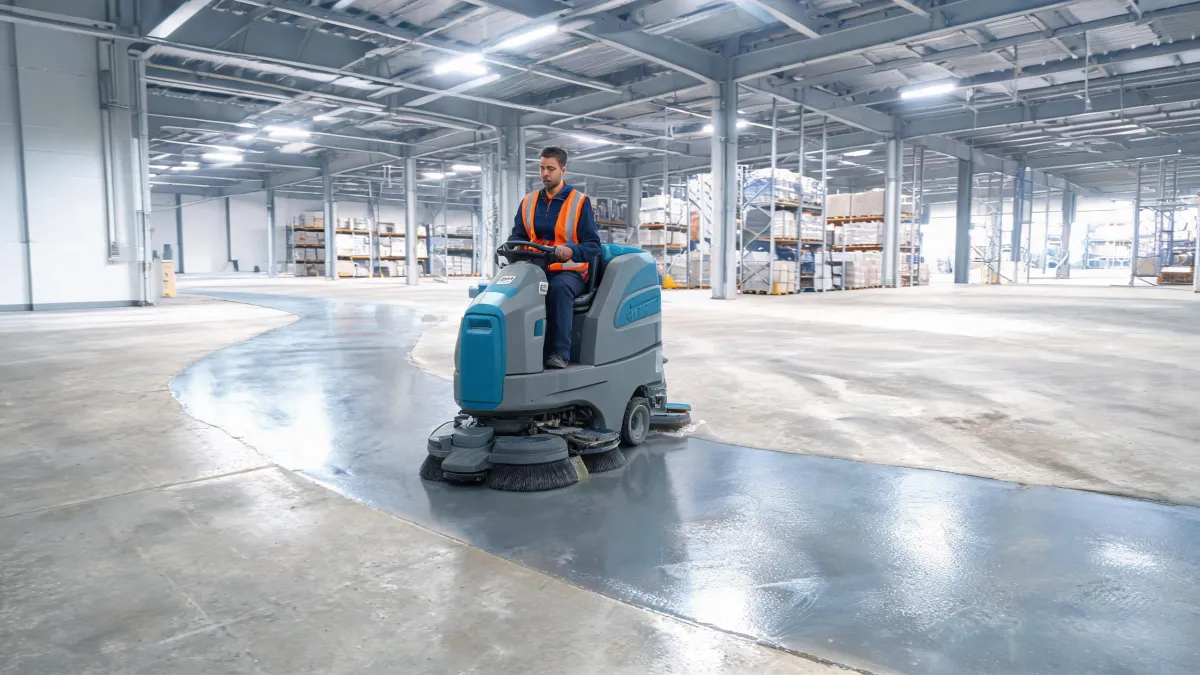
Eight years in procurement taught me one thing the hard way: the lowest quote on a cleaning machine is almost never the cheapest decision.
I'll be honest — I made that mistake early. When I took over our facilities budget in 2019, I treated the quote sheet like a scoreboard. Lowest number wins, right? We bought a no-name scrubber that came in a few hundred bucks under a Nilfisk SC250. Felt like a steal.
Seven months later: main brush worn through, squeegee blade cracked, battery dropping below a single shift. Repairs plus parts ran me over $800. That's before counting the three days the machine sat idle while our floor stayed dirty. And of course, that was the same week our dust-control inspection came around.
I changed my rules after that. Don't look at the quote. Look at the five-year total.
Why "Cheaper" Usually Costs More
Consumables and parts: the second invoice nobody quotes you
Pressure washers are the clearest example. We run three Nilfisk E 145.4-9 X-TRA units. One of them I replaced temporarily with a cheaper alternative to "test the waters." Year one, no difference. Year two, the gap showed up: that cheaper unit needed pump seals replaced roughly every four to five months. The Nilfisk machine made it fourteen months between services. Individual seals are cheap — $30 to $80 a pop. But stacking seals and nozzles across a year added $400-plus (I don't have the exact figure in front of me, but that's the ballpark). Plus half a day of downtime every time.
Downtime: this is where the real money leaks out
We've run a Polivac 18-inch walk-behind scrubber and a Gala long-handle unit on the same floor. The Gala came in from another site, and I'd read the reviews — they're all over the map. Some people love how light it is. Everyone flags the tank. Both are true. It's light. The tank is small.
On the same 2,000-square-meter floor, the Nilfisk SC250 gets it done in a little over an hour. The Gala long-handle takes two and a half passes — narrow wheelbase, small tank, one refill in the middle. Over an eight-hour shift that's roughly 1.5 labor hours difference. Compounded across a year, that's not a rounding error. That's headcount you didn't budget for.
Compliance cost: dust collectors aren't just cleaning equipment
Dust collectors are different. You're not buying one to keep the floor pretty — you're buying it to pass environmental audits, fire inspections, and occupational health checks. I watched a small aluminum grinding shop try to save $3,000 on a domestic unit with similar airflow specs but a lower filter class. Next year's environmental spot check failed. Rework plus downtime plus a filter system swap cost them close to $18,000.
On dust collector applications, airflow is what everyone compares. Filter precision and cartridge lifespan are what actually matter. Nilfisk publishes these specs fairly clearly — HEPA class, airflow, filter replacement intervals are all searchable on nilfisk.com (accessed January 2025). Match your shop's dust particle size against the filter grade before you sign anything.
The TCO Checklist I Now Enforce
Any unit over $2,000 goes through this table before we even compare quotes:
- Purchase price (including shipping, install, commissioning)
- Annual consumables (brushes, squeegees, filters, seals — priced against manufacturer replacement intervals)
- Unplanned downtime cost (estimated per hour of line or labor loss)
- Service response time (is there a local service point? days from parts order to delivery?)
- Residual value and replacement cycle (what's it worth in five years, and can you still source parts?)
When I first built this sheet, someone on my team called it "overkill." Two years of running it, our equipment-related surprise spending dropped roughly 35%. The emergency maintenance budget we didn't spend covered two new machines.
"But What If the Budget Is Tight?"
Fair pushback — I've heard it. "You're telling me a small shop should drop $5,000 on a Nilfisk when they can barely afford a $1,500 unit?"
Here's the thing: the tighter your budget, the less you can afford to skip TCO.
Big operations have standby units. They have another shift to cover the gap. A small shop's scrubber goes down and the whole crew is standing around. Over the same five-year window, small operations are actually more sensitive to reliability and parts availability, not less. That math just never gets done because nobody runs the numbers.
If you genuinely can't afford the full-size unit up front, my advice: buy a smaller model in the right product line rather than a full-size one from a brand with inflated specs. In the cleaning equipment space, fake airflow ratings, fake runtime claims, and fake brush pressure specs are more common than most buyers realize.
Cheap equipment isn't automatically a bad buy. But you need to know what you're actually purchasing — a machine, or the next five years of headaches.

Elise Marceau
Elise Marceau is an LED display and digital-signage systems analyst covering LED video walls, modular screens, transparent LED, control processors, and indoor or outdoor signage. She applies IEC 62368-1 safety principles while comparing pixel pitch, luminance, contrast, refresh rate, colour uniformity, viewing angle, ingress protection, power density, module serviceability, and signal redundancy. Her specification guides help integrators, venue operators, retailers, and procurement teams align viewing distance, ambient light, content format, installation access, electrical load, and lifecycle support.