I Used the Wrong Warehouse Cleaning Equipment for a Year—Then I Switched to Nilfisk Scrubbers
-
It Started With a Flashlight
-
The Machine That Looked Right on Paper
-
Why Dust Is More Than an Aesthetic Issue
-
What a Real Dust Collector Warehouse Strategy Looks Like
-
The Demo That Changed My Mind
-
The Quote Lesson I Still Use
-
The Hard Wait After the Purchase
-
The EGO Pressure Washer Side Lesson
-
The Checklist I Use Before Buying Any Equipment
-
What I Wish I Had Known
-
Bottom Line
It Started With a Flashlight
It was a Tuesday in March 2023. A safety consultant was doing a walkthrough of our distribution center. She stopped near the racking and pointed up. I aimed my flashlight at the top shelf and saw a gray film on the beams, the sprinkler pipes, and the cable trays.
She asked how long that dust had been there. I didn't know. That's when I realized we didn't have a dust problem. We had a dust management problem, and almost everything I'd done up to that point was just moving dust around instead of removing it.
I'm not a cleaning equipment expert. I'm the facilities manager at a 90,000-square-foot distribution center, and I've been responsible for the cleaning budget for about five years. In that time, I've bought the wrong machine, approved the wrong quote, and learned the hard way what actually works.
The Machine That Looked Right on Paper
When I took over, we already had a PowerBoss floor sweeper. It was a serious machine. It picked up broken pallet boards, stretch wrap, cardboard scraps, and random debris from the shipping area. On paper, it was the right tool for warehouse floor cleaning.
But it didn't solve the fine dust. Actually, it made some of it worse. A mechanical sweeper can throw fine particles into the air, and those particles just settle on the racks, the lights, and the electrical panels. I swept more often and convinced myself the problem would get better. It didn't.
I assumed a floor sweeper and a floor cleaner were basically the same thing. I didn't verify. It turned out they're not. A sweeper is for bulky debris. A scrubber with vacuum pickup is for fine dust that needs to be contained and removed.
Here's something vendors won't tell you: the word dust gets used too loosely. If your problem is fine powder, don't let someone sell you a bigger sweeper. Ask for a filtration class, not just a brush speed.
Why Dust Is More Than an Aesthetic Issue
The U.S. EPA (epa.gov) notes that particles smaller than 10 micrometers, especially PM2.5, can be a health concern. That doesn't automatically mean every warehouse dust layer is dangerous, but it does mean I stopped treating the problem as cosmetic.
Fine dust also lands on equipment. It can clog louvers, settle on electrical contacts, and complicate housekeeping audits. The longer it sits, the harder it is to remove without spreading it. That was the exact situation we were in.
What a Real Dust Collector Warehouse Strategy Looks Like
When I started researching, I searched for a dust collector warehouse solution and got a mix of extraction arms, portable vacuums, cyclone systems, and homemade filter boxes. It was overwhelming. What most people don't realize is that dust collector is a category, not a single machine.
I needed to separate the problem into three parts:
- Dust that was already on the floor.
- Dust that was hanging in the air or on upper surfaces.
- Dust that kept coming from the product we handled.
No single piece of equipment could fix all three. That was my first real lesson.
The Demo That Changed My Mind
We invited three suppliers to demo equipment. One of them brought Nilfisk scrubbers. I remember thinking it looked like a fancy floor washer. I was wrong.
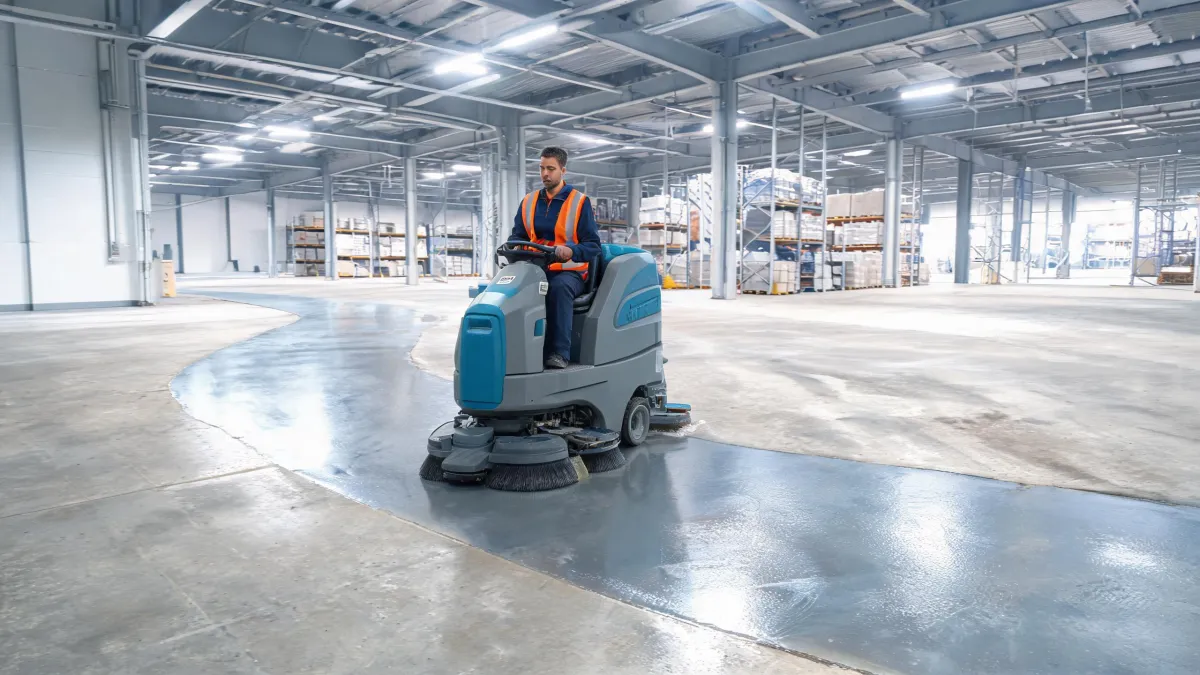
The demo took place in our dirtiest aisle. The Nilfisk scrubber scrubbed the concrete, picked up the dirty water, and left the surface darker and cleaner. More importantly, it didn't fill the air with a dry dust cloud. The fine dust on the floor was captured in the water, not pushed into the room.
That's when I started reading the specs differently. The Nilfisk equipment wasn't flashy, but the rep asked smart questions before showing the machine. He asked about our dust load, floor finish, battery capacity needs, and whether we needed to keep the aisle dry for pedestrians. That's the moment I recognized the difference between selling a machine and solving a problem.
The Quote Lesson I Still Use
The first quote we received was about 30 percent lower than the others. It looked like a no-brainer. Then I asked for line items.
Batteries? Additional. Side scrubber discs? Additional. The larger recovery tank? Additional. The initial low number quietly became the same number as everyone else once I added the things I actually needed.
I've learned to ask what's NOT included before I ask what's included. If a vendor doesn't want to list filters, brushes, batteries, and training clearly, that's a red flag. The vendor who shows all costs upfront, even when the total looks higher, usually ends up being the cheaper option in the long run.
The Hard Wait After the Purchase
Even after I signed the purchase order, I kept second-guessing. What if I'd chosen the wrong brand? What if the cheaper quote would have worked? The weeks between order and delivery were stressful.
I didn't relax until the first full day of use. The operator ran one of the Nilfisk scrubbers through the main aisle, and the recovery tank filled with dark gray water. The floor felt different underfoot, and the dust layer on the racking finally stopped growing. That was the positive signal I needed.
The EGO Pressure Washer Side Lesson
Around the same time, I made a similar decision for the outside concrete. Our grounds guy needed something to clean the dock ramps and the sidewalk. I found the EGO Power+ electric pressure washer HPW3200 and thought it was perfect. It's compact, quiet, and easy to store. It does a good job on the dock ramp. But it would have been useless inside the warehouse.
That's the same mistake I'd made with the PowerBoss floor sweeper: assuming one machine could handle every surface. The EGO unit is a great tool for the exterior, and a scrubber is a great tool for the concrete floor. They're different problems.
The Checklist I Use Before Buying Any Equipment
We didn't have a formal process before this. That was part of the problem. Now I keep a checklist.
- Define the exact dust and debris type in each zone.
- Demand a demo in our facility, not in a showroom.
- Request a line-item quote with filters, batteries, chargers, and training.
- Compare projected five-year costs, not just the purchase price.
- Ask what happens when the machine needs service.
That checklist has already caught two problems. One was a vacuum with a filter that wasn't rated for fine dust. Another was a scrubber that looked affordable until I added the required accessories. Both would have been expensive mistakes.
What I Wish I Had Known
People think the more expensive machine is the better machine. Actually, it's the other way around. A machine that's matched to the task can be worth more because it saves labor, rework, and downtime. Brand name isn't the reason it costs more. The engineering is.
If you're planning a dust collector warehouse setup, start with the floor and the air as two separate problems. The floor needs a scrubber or vacuum that captures fine dust. The upper surfaces need a routine, not just a machine. And the source of the dust needs a process change at the receiving area.
Bottom Line
Our PowerBoss floor sweeper still has a job in the yard and receiving area. The Nilfisk scrubbers are the daily workhorses inside. The industrial vacuum handles the weekly overhead cleaning. And the EGO Power+ electric pressure washer HPW3200 is reserved for the dock concrete. Every machine has a specific job now.
That's the real lesson. Don't assume your cleaning equipment is the problem until you've checked whether it's solving the right problem. Ask the uncomfortable questions, get the full quote, and learn from someone who already paid the price. That's why I still keep my checklist. It's saved me more than once.

Elise Marceau
Elise Marceau is an LED display and digital-signage systems analyst covering LED video walls, modular screens, transparent LED, control processors, and indoor or outdoor signage. She applies IEC 62368-1 safety principles while comparing pixel pitch, luminance, contrast, refresh rate, colour uniformity, viewing angle, ingress protection, power density, module serviceability, and signal redundancy. Her specification guides help integrators, venue operators, retailers, and procurement teams align viewing distance, ambient light, content format, installation access, electrical load, and lifecycle support.