Nilfisk GM80 Industrial Vacuum vs. Floor Scrubbers: Choosing the Right Cleaning Equipment for Your Facility in 2025
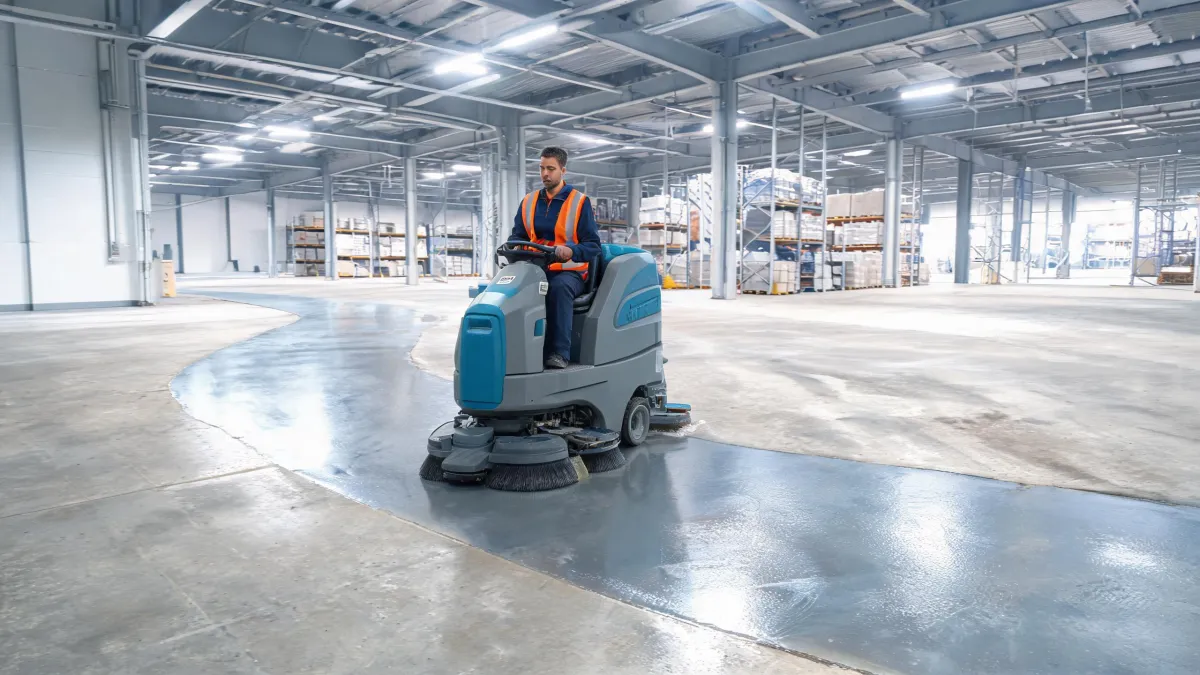
If you're comparing a Nilfisk GM80 industrial vacuum against a floor scrubber rental, you already know the answer isn't a simple 'this one's better.' These are different machines built for different messes.
I coordinate equipment logistics for industrial facilities, and when I'm triaging a client's cleaning equipment needs, the conversation never starts with brand names. It starts with a breakdown of what they're cleaning, how often, and what failure looks like for them. Based on our internal data from 200+ equipment sourcing jobs, here's how to think through this.
There isn't a standard answer because your situation is a mix of three factors:
- Type of debris: Dry dust vs. wet floors vs. hazardous waste
- Frequency: Daily upkeep vs. weekly deep cleaning
- Surface type: Hard floors, carpet, or industrial granulate
Let's break down which scenario you fall into and the actual equipment that makes sense for each.
Scenario 1: The Dust Control & Fine Particle Problem
This is where the Nilfisk GM80 shines. If your facility deals with fine dust from woodworking, drywall sanding, or powder processing, your primary concern is particulate control. The GM80 is a workhorse industrial vacuum designed for continuous operation, not a modified shop vac.
When I see dust collector exhaust points on a premises, I'm checking what's downstream of that collector. Let's be real here: the dust collector gets the bulk of the material, but the fines still escaping can coat every surface in a 10-meter radius. This is where a dedicated machine with proper filtration matters.
I still kick myself for not specifying HEPA filtration on an initial vacuum spec for a cabinet shop in March 2024. We provided a Nilfisk GM80 with standard filters, and while the suction was fine, the fine dust was blowing right through the exhaust in the first week. Retro-fitting the correct HEPA filter after the fact cost everyone time and looked unprofessional. A filtered dust collector exhaust isn't a nice-to-have if you're handling anything that makes your crew sneeze.
Who this is for: Woodshops, construction cleanup crews, pharmaceutical facilities, or anywhere that fines are a safety or equipment hazard.
The 'Kreg Dust Collector' Angle
If 'kreg dust collector' is in your keyword list because you're a solo woodworker or small shop, stop shopping for a massive Nilfisk unit right now. That Kreg system attaches to your tool's extraction port. It captures debris at the source, before it ever becomes a floor dust problem. You might not need a facility-wide vacuum at all if your tools have effective chip collection and you're dealing with occasional floor debris.
The mistake I see with small shops is buying a high-end industrial vac as a catch-all for a direct tool attachment problem. For a one-person operation, you're paying for capacity and continuous-duty ratings you won't use. It's a case of over-investing in a machine when a $200 cyclone separator and your existing shop vac would do the same job—at a fraction of the footprint.
Scenario 2: The 'So Much Floor, So Little Time' Problem
Now we're in the domain of the floor scrubber. If your floor looks like a Jackson Pollock painting by Wednesday afternoon, a vacuum isn't your primary tool. You need effective scrubbing and wastewater pickup.
Specifically, the 'floor scrubber rental janesville' searches tell me there's a need for temporary capacity. Rentals make sense when:
- Yearly maintenance season peaks for 2 weeks.
- Post-construction cleanup where 3 months of crud gets baked into concrete.
- You want to test a machine type before committing to a purchase.
But I've also seen facilities make the rental math work out wrong. Let me give you some numbers. An industrial walk-behind scrubber rental in the Janesville area might run $150–$300 per day, based on my recent logistics quotes. If you need that scrubber for 30 days a year across various projects, that's between $4,500 and $9,000 annually with zero ownership equity.
The numbers said 'just rent.' My gut said 'buy.' In that case, my gut was reading the client's schedule. They had consistent, weekly need, and were just afraid of the upfront cost. A leased or financed scrubber is often the thinking person's solution. That rental cost is dead money if the need is continuous.
Scenario 3: The No-Brainer for Regular Maintenance
Back to the workhorses. Every facility needs a combination, not just one machine.
I had a client managing a 50,000 square foot food processing plant. They were debating between a ride-on scrubber rental for their hard floors and a Nilfisk GM80 vacuum for their daily dust control. We ended up with both, but the rental was a short-term band-aid while we trialed the scrubber for a purchase decision a few months later.
So here's the breakdown for the sticky decision:
- Buy a Nilfisk GM80 (or similar industrial vacuum) for the continuous collection of dry dust, granular debris, and occasional liquid spills. This is a long-term asset.
- Rent a floor scrubber for the periodic deep cleaning of hard floors where soil is bonded to the surface.
The reason I default to a rental for scrubbers is the maintenance burden. A scrubber has squeegees, nozzles, brush pressure, and a wastewater recovery system. If you run it daily and don't have a maintenance plan, your downtime costs will outweigh the rental savings. Vacuums, specifically an industrial unit like the GM80, are simpler in their daily operation—empty the canister, change the filter, and they're ready to go. You can do a two-minute maintenance check to keep it operational.
How to Decide If You're Buying or Renting
Bottom line? It comes down to your facility's utilization rate.
Ask yourself these two questions:
1. How often do you need this tool per week?
If you need it more than once per week, the economics of ownership (or lease) usually beat the rental. Less than once per week, rent it.
2. What's the cost of a machine failure?
If your production line stops when the vacuum dies, you buy the premium machine. You don't hope the rental company has one available at 7 AM on a Monday.
Don't get caught in the trap of thinking a big-ticket item is always a better investment than a rental. A floor scrubber rental is a great way to validate your need without a massive capex surprise. But a dust control problem, like a building-wide particulate issue, is often an operational health issue that demands a permanent solution.
So, take stock of what's on your floor right now. If it's a dust layer that requires daily attention, start with the GM80. If there's a greasy, grimy film that a push broom can't touch, start looking for a scrubber rental and check your maintenance schedule. You might find you need both.

Elise Marceau
Elise Marceau is an LED display and digital-signage systems analyst covering LED video walls, modular screens, transparent LED, control processors, and indoor or outdoor signage. She applies IEC 62368-1 safety principles while comparing pixel pitch, luminance, contrast, refresh rate, colour uniformity, viewing angle, ingress protection, power density, module serviceability, and signal redundancy. Her specification guides help integrators, venue operators, retailers, and procurement teams align viewing distance, ambient light, content format, installation access, electrical load, and lifecycle support.