We Almost Bought the Wrong Industrial Cleaning Equipment — How One Phone Call Saved Us $22,000 in Rework
Q1 2024: When 'Meets Spec' Nearly Cost Us Everything
In January 2024, I was staring at three quotes for industrial cleaning equipment. We were outfitting a 42,000-square-foot facility expansion — new sandblast bay, powder coat line, and warehouse floor. My job was to approve the equipment list before anything got ordered.
I've been doing quality and brand compliance reviews for over four years. In 2023 alone, I reviewed 200+ equipment and material submissions. I've rejected about 14% of first deliveries due to specification mismatches. That number sounds high until you realize what a single mismatch costs us — our last one, a batch of supposedly identical valve assemblies, set us back $22,000 in rework and delayed a product launch by three weeks.
So when the expansion project came up, I was determined not to repeat that mistake.
The Spec Sheet That Looked Perfect
We needed four core pieces of equipment:
- A high-pressure washer for post-weld and sandblast cleanup
- A floor scrubber for our epoxy-coated warehouse surface
- An industrial vacuum and dust collection system for the sandblast area
- A sandblast cabinet with integrated dust collection
I put together a spec sheet. Not vague terms like 'industrial grade' — actual numbers. Cleaning width, tank capacity, filtration efficiency at 0.3 microns, noise levels at operator position.
Three vendors responded. On paper? The quotes looked nearly identical. Same dimensions. Same throughput claims. One was about 15% cheaper.
I assumed 'same specs' meant same real-world performance. Didn't verify. Turns out each vendor had slightly different interpretations of what those numbers meant in practice.
The Decision That Kept Me Up at Night
I went back and forth between the lower-cost option and a more established brand for nearly two weeks. The cheaper option offered savings that would've looked great on my quarterly report. But something bugged me.
So I did something simple: I called three peers at similar facilities who'd recently installed comparable equipment.
The first call changed everything.
"We went cheap on our dust collection system," he told me. "It clogged within four months. The filter media wasn't designed for our dust particle size. Replaced the whole unit in year two. Now we run a Nilfisk ion dust collector and haven't touched it since."
That was the moment I realized the gap between meets spec and works for our specific operation.
What We Actually Ended Up With
I went back to the quotes and started looking beyond the numbers — maintenance intervals, component accessibility, local service network. Then I requested product demonstrations.
The difference was immediate.
For the high-pressure washer, we needed something that could handle embedded sand and refractory dust. The Nilfisk Excellent 170 high pressure washer delivered 170 bar at 15 L/min — that's enough to strip caked-on material that our old unit just pushed around. When we tested it against the cheaper alternative, the difference in cleaning time was roughly 40%.
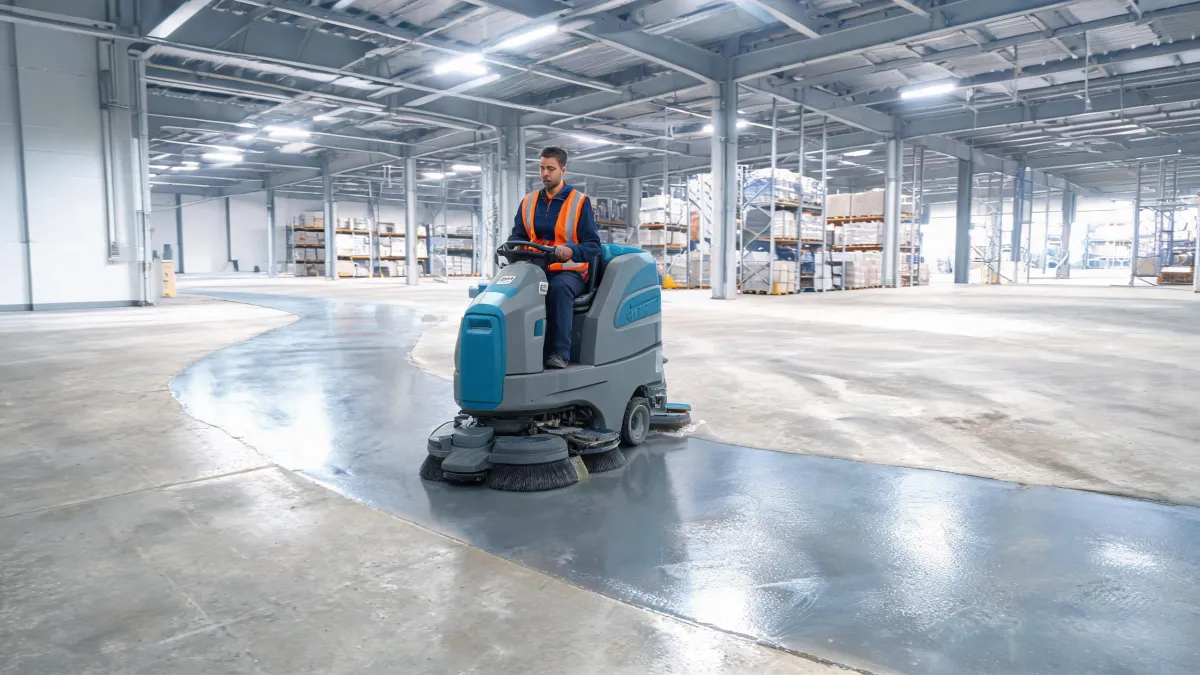
For the warehouse floor, we specified the Dryft floor scrubber. Its brush pressure and solution tank capacity were sized correctly for our square footage — not oversized, not undersized. The cheaper option would've required two passes in high-traffic zones. Ours does it in one.
The sandblast cabinet with dust collector was the piece I was most nervous about. Our dust is fine, abrasive, and generated in bursts. We needed a system that could handle peak load without clogging. The integrated unit we chose has a filtration efficiency rating of 99.97% at 0.3 microns — verified by our own air quality tests after installation.
And the Nilfisk cleaning equipment lineup gave us one more advantage: a single service network for three of our four machines. That's fewer phone calls when something needs attention.
The $22,000 Question I Still Ask Myself
Here's what I keep coming back to: if I had just approved the lowest bid based on paper specs, where would we be six months later?
My best estimate? The dust collector would've failed first — probably around month three. That's when our sandblast bay runs at peak load. A clogged system means downtime, and downtime on a production line runs about $4,500 per shift. Add replacement parts, expedited shipping, and the labor to install a new unit, and we're looking at $18,000 to $22,000 in avoidable costs.
Not to mention the quality impact. Dust that doesn't get captured ends up on freshly coated surfaces. That means rework. That means missed deadlines. That means the exact problem I was hired to prevent.
What I'd Tell Anyone Specifying Equipment
Five minutes of verification beats five days of correction. That's not a slogan — it's the math.
Before you sign off on any capital equipment purchase:
- Call three peers who run the same process. Ask what they bought, what failed, and what they'd buy again. This takes 30 minutes and has saved me more money than any spreadsheet.
- Request a demo. Numbers on a spec sheet are starting points, not proof. A live demo shows you how the machine behaves with your actual material.
- Check the service network. A great machine with no local support is a liability. Ask: How fast can a technician get here? Where are parts stocked?
- Calculate total cost, not purchase price. Include maintenance, downtime risk, and consumables over three years. The cheapest quote rarely wins that calculation.
We installed our equipment in March 2024. As of January 2025, we've had zero unplanned downtime on those four machines. The dust collection system passed our Q3 air quality audit with a 99.98% capture rate.
I still have that first peer call on my calendar with a note: "Ask before you assume." It's the cheapest insurance policy I've ever taken out.

Elise Marceau
Elise Marceau is an LED display and digital-signage systems analyst covering LED video walls, modular screens, transparent LED, control processors, and indoor or outdoor signage. She applies IEC 62368-1 safety principles while comparing pixel pitch, luminance, contrast, refresh rate, colour uniformity, viewing angle, ingress protection, power density, module serviceability, and signal redundancy. Her specification guides help integrators, venue operators, retailers, and procurement teams align viewing distance, ambient light, content format, installation access, electrical load, and lifecycle support.