What a Budget Pressure Washer Test Taught Us About Nilfisk Professional Equipment
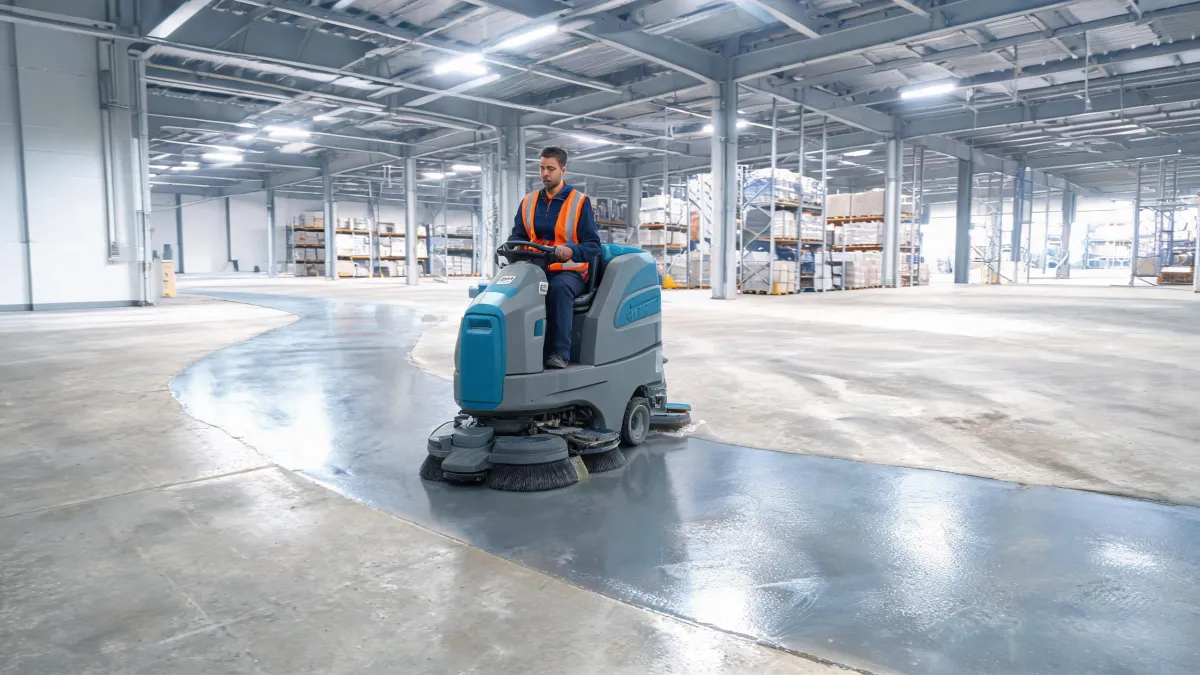
That Thursday in April, I was in the lot behind our shop in Richmond, testing a returned walk-behind scrubber, when Mark called. Mark runs a fabrication plant about twenty minutes from us, and he had that voice people get when they've already made up their mind. He'd just had his production floor reground and coated, the place was covered in a fine layer of concrete dust, and the state audit was scheduled for Monday. He needed the floor clean. And he wanted to buy a pressure washer instead of renting one.
"I found one online for less than $150," he said. A link to a Fanttik pressure washer appeared in the text. I wasn't surprised. I also wasn't annoyed—I'm paid to keep an open mind. Fanttik makes some genuinely clever little tools, mostly for car care and portable cleaning. And for someone who wants to spray off a motorcycle or a couple of patio chairs, a Fanttik pressure washer is a reasonable purchase.
But Mark wasn't washing a motorcycle. He was about to clean a 40,000-square-foot floor that looked like a dust storm had gone through it.
The two-hour test
Normally, I'd handle this the boring way: pressure, flow, duty cycle, warranty, serviceability, total cost over five years. I'd put it in a spreadsheet and send it over. Mark needed an answer by noon so he could pick up equipment before the weekend, and it was already 9:30. So I did what I do with every rental unit before I hand it to a customer. I ran it.
The Fanttik unit looked good out of the box. Nice packaging, solid trigger, neat little hose. We hooked it up to a water supply on the concrete pad out back and let it run, the same way we test a machine that's about to go out on a rental truck.
For the first few minutes, it was fine. The spray was strong enough for light grime. But at around the ten-minute mark, the pressure started to drop. Not dramatically at first, just a slow softening of the stream. By twelve minutes, the pump was cycling on and off. A minute later, the machine shut itself down to cool off. It restarted after a few minutes, then did the same thing again.
Mark watched the whole thing without saying much. Finally he said, "So it overheats."
"It's not designed to run like a rental unit," I said. "There's no duty cycle rating, no replaceable pump, no service parts. If this one dies on a job, you buy another one. If our Nilfisk professional pressure washer dies on a job, our tech can have it running again the same morning."
That's the gap that doesn't show up in product photos. The Fanttik pressure washer is a great tool for short, light tasks. For three or four hours of continuous work in a dusty plant, it's the wrong category of machine. That's not a knock on Fanttik. It's the difference between a commuter car and a delivery truck.
The right tools for the actual job
I walked him over to the bay where we keep a Nilfisk professional pressure washer. It had just come back from a food processing plant, and it wasn't pretty—dented shroud, dust in every crevice, hoses showing their age. But the pump was solid, and we had a complete set of service parts on the shelf. "This one has been in our rental fleet for over five years," I told him. "It goes out almost every week. The upfront cost is higher, but it's built for hours-long operation, and we can fix it instead of throwing it away."
Mark nodded, but I could tell he was still doing math in his head. So I kept going.
"A pressure washer also isn't the best tool for the main floor. It's great for the loading dock, the walls, the equipment, and the greasy spots near the bays. But 40,000 square feet of coated concrete needs scrubbing, not just spraying."
That's where the conversation turned from buying to renting. A decent walk-behind scrubber costs five figures, plus batteries, plus maintenance, plus storage. The floor scrubber rental Richmond shops offer usually starts around a few hundred dollars per day, and that includes the machine, the right pads, the chemical, and a tech on call if something goes wrong. For a one-time deep clean, renting was the honest choice. If Mark needed to scrub that floor every week, I would have told him to buy.
We also solved the dry dust problem. Mark's crew had been blowing dust around with a shop vac, which just made it airborne. The machine we grabbed for that part was a Nilfisk GM80 industrial vacuum. I'm aware that model number doesn't sound exciting—it looks like a hard-working shop vacuum. But it has HEPA-rated filtration, and I can run it for hours on a dusty site without the exhaust smelling like grinding dust. That matters when you're cleaning a floor right before an inspection.
There was one more piece. Mark's crew planned to use a floor buffer on some stained sections, and running a dry buffer without dust control would have filled the air with fine particles all over again. So we fitted a buffer dust collector—essentially a shroud that goes around the pad and connects to a vacuum line. With the GM80 on the other end, the buffing dust gets captured before it has a chance to settle.
Monday morning
The audit was Monday at nine. I drove past the plant that morning, because I'd put my name on that equipment and I wanted to see it hold up. The floor was clean enough that you could see the reflection of the overhead lights. Mark's crew was already back to work, and he called later to say the inspector didn't write a single finding about the facility condition.
There's something satisfying about that. After the rushed decision, the budget pressure, and the little Fanttik sitting on a shelf in his office, the right combination of machines did the job. Mark kept the Fanttik, by the way. He uses it on his truck and his boat. That's the honest ending. It's not a bad tool. It's just not a professional cleaning tool.
What this changed for me
It took me about four years and several hundred inspections to understand that "good equipment" only means something when you define the workload. Over that time, I've come to believe that most buying mistakes aren't about choosing a bad brand. They're about choosing a machine that was designed for a different job. The Fanttik pressure washer is fine for what it is. The Nilfisk GM80 industrial vacuum and the Nilfisk professional pressure washer are built for a different level of demand. Neither one is better in every situation.
Per FTC guidance (ftc.gov), advertised claims have to be truthful and substantiated. I do not mean that loosely. We apply the same rule to how we recommend equipment: any claim that doesn't survive a real-world run is just marketing. A spec sheet can tell you pressure and flow, but it won't tell you how a machine behaves after 45 minutes of continuous use. That's something you only learn by running it, breaking it, and fixing it.
So if you're trying to decide between a budget unit and a professional one, ask yourself one question: what's the duty cycle of your job? If it's 20 minutes a week, buy the budget-friendly unit and enjoy it. If it's 20,000 square feet before lunch, buy or rent the machine that was built to run that long. The cheaper option will cost you more in the end—usually in lost time, clogged filters, and a floor that still doesn't pass inspection.

Elise Marceau
Elise Marceau is an LED display and digital-signage systems analyst covering LED video walls, modular screens, transparent LED, control processors, and indoor or outdoor signage. She applies IEC 62368-1 safety principles while comparing pixel pitch, luminance, contrast, refresh rate, colour uniformity, viewing angle, ingress protection, power density, module serviceability, and signal redundancy. Her specification guides help integrators, venue operators, retailers, and procurement teams align viewing distance, ambient light, content format, installation access, electrical load, and lifecycle support.