A Quality Inspector Explains Why the Cheapest Industrial Cleaning Equipment Is the Most Expensive
-
I Review Industrial Cleaning Equipment for a Living. The Lowest Quote Is Usually the Worst Deal.
-
I Learned This the Hard Way
-
The 'Same Specs' Trap
-
What Vendors Won't Tell You
-
The Total Cost of Ownership Framework
-
Where Nilfisk Equipment Fits
-
What If You Don't Have the Budget?
-
My Rule for Buying Cleaning Equipment
I Review Industrial Cleaning Equipment for a Living. The Lowest Quote Is Usually the Worst Deal.
I'm a quality and compliance manager at a facilities maintenance company. I review roughly 200 pieces of cleaning equipment a year before we deploy them, and in 2024 I rejected 9% of first deliveries because the unit didn't match the spec sheet. Not because the machine was ugly. Because the quote promised one thing and the actual unit delivered another.
So I'll say it plainly: Buying industrial cleaning equipment on the lowest quote is a quality failure. It's not a bold take. It's a pattern I've watched repeat across projects. The cheapest option doesn't fail because it's cheap; it fails because cost is the only thing the buyer compared.
I Learned This the Hard Way
I wasn't always this firm. In my first purchasing role, I approved a lower-priced scrubber because the budget was decided before the spec was finalized. Deck width was close. Tank size was close. The vendor said it was 'within industry standard.'
Eleven months later, the motor failed. The warranty had a clause about 'normal wear.' We patched it twice, then replaced it. When I ran the numbers, the cheaper machine cost us 2.3 times the original price difference in repairs, lost cleaning hours, and extra contract labor. A lesson learned the hard way.
The 'Same Specs' Trap
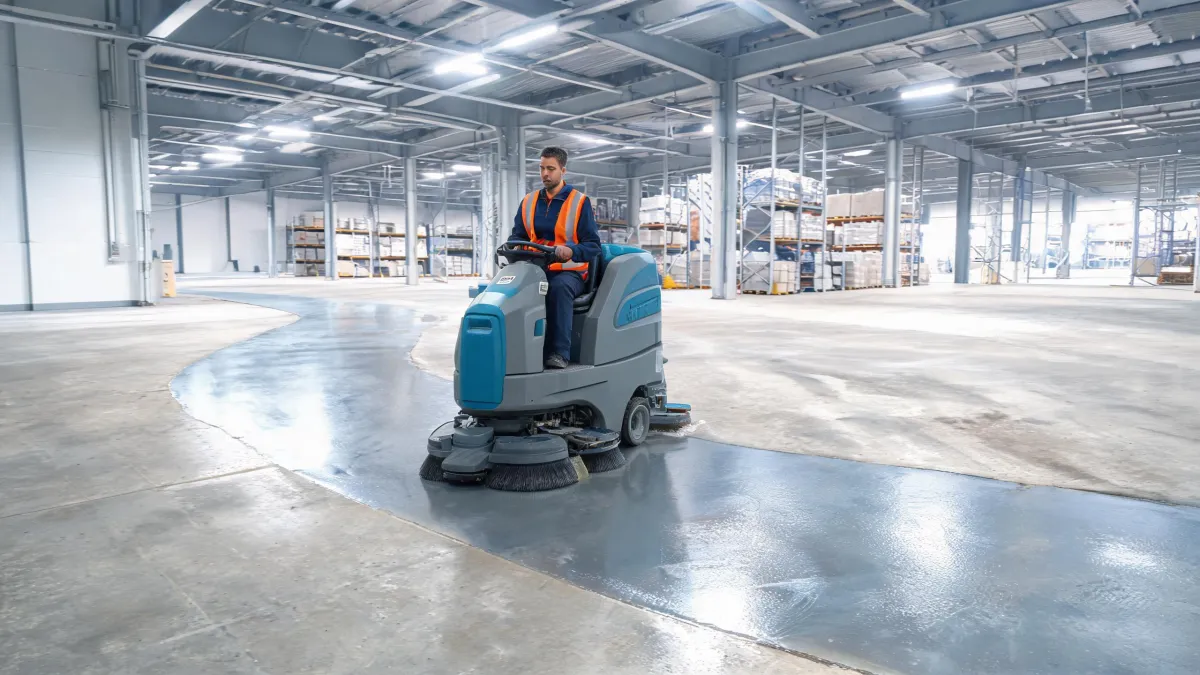
It's tempting to think two scrubbers with the same brush width and tank capacity are functionally identical. The 'just compare specs' advice ignores the details that show up in daily operation. What I mean is this: take the floor squeegee scrubber. The squeegee is what actually dries the floor, but how well it dries depends on water distribution, brush pressure on uneven concrete, and whether the blade is easy to replace when it wears. Those details are not in the headline specs. They show up in the first month of use.
What Vendors Won't Tell You
What most people don't realize is that a spec sheet is an invitation to ask better questions, not a guarantee. The same model number can ship with different batteries, different chargers, and different accessory kits. If you don't specify exactly what you need, you can end up with a machine that's technically right and practically wrong.
Here's something vendors won't tell you: the first quote is almost never the final cost once you add freight, commissioning, training, spare parts, and the risk of downtime. That's not a scam. It's just the structure of the deal. A good quote makes those line items visible. A bad quote hides them until you're three service calls in.
The Total Cost of Ownership Framework
I use a simple TCO framework when I review capital equipment. It is fairly simple: if the purchase decision only looks at the invoice, it's incomplete.
- Purchase price: the quote, but not the final cost.
- Commissioning and training: what it takes before the machine can actually clean.
- Consumables: pads, squeegee blades, filters, hoses, chemicals.
- Servicing: hours between maintenance intervals, cost of parts, and parts availability.
- Downtime: the labor you pay whether the machine is running or not.
- Residual value: what you get back when the equipment is replaced.
According to OSHA's Walking-Working Surfaces standard (29 CFR 1910.22), floors must be kept clean and dry. That makes cleaning equipment a production tool, not an accessory. From my perspective, the only reason a low quote looks attractive is because the rest of the cost hasn't shown up yet.
In Q3 2024, we evaluated four vendors against identical scrubber specifications. Pricing varied by almost 40%. First-pass acceptance varied even more: one vendor passed 100% of our checks; another passed half. The lowest quote was the one with the most documentation gaps and the most service issues.
Where Nilfisk Equipment Fits
This is why I'm comfortable approving Nilfisk equipment when it is not the cheapest quote. The electric pressure washer Nilfisk Premium is a good case: published maintenance intervals, a service network, and spec sheets that matched the units we unboxed. In our 2024 audit, the Premium units we received matched their documentation line by line. That is exactly the kind of consistency a quality inspector is looking for.
Not every purchase needs to be premium. A Tomcat floor sweeper makes sense for dry debris in a smaller footprint because it's easy to train on and cheap to maintain. A Global Industrial magnetic floor sweeper is useful in metalworking areas where fasteners and shavings end up on the floor. But those are specialized tools. They don't replace a floor squeegee scrubber.
What If You Don't Have the Budget?
The objection I hear most is: 'That's fine for big companies, but we don't have the budget.' I get it. I've been in that meeting.
But the tighter the budget, the more a failure costs. The real question is somewhat uncomfortable: if the machine you bought is undersized for the workload, you'll pay for it in overtime, re-cleaning, and emergency service calls. According to Nilfisk's guidance (nilfisk.com), equipment selection should use total cost of ownership, not initial price. In my experience, that advice has held up.
To be clear, I'm not saying every low-priced machine is bad, and I'm not saying every premium brand is good. I'm saying the decision should be based on evidence, not a single number.
My Rule for Buying Cleaning Equipment
If you're comparing pressure washers, floor squeegee scrubbers, or any nilfisk equipment against cheaper alternatives, stop comparing the sticker price and start comparing the total cost over three years. What I mean is that the sticker price is only the beginning.
My rule is simple: I don't care if a quote is 18% cheaper. I care if the machine still meets spec at month 24. If you ask me, that's the only number that matters.

Elise Marceau
Elise Marceau is an LED display and digital-signage systems analyst covering LED video walls, modular screens, transparent LED, control processors, and indoor or outdoor signage. She applies IEC 62368-1 safety principles while comparing pixel pitch, luminance, contrast, refresh rate, colour uniformity, viewing angle, ingress protection, power density, module serviceability, and signal redundancy. Her specification guides help integrators, venue operators, retailers, and procurement teams align viewing distance, ambient light, content format, installation access, electrical load, and lifecycle support.