The Cheaper Scrubber Cost Us More: A Buyer's TCO Story
Last spring, our operations manager walked into my office holding a photo of our warehouse aisle. The floor looked like someone had spilled coffee across the entire facility. He didn't say much. He just set the photo on my desk and said, 'We can't have this.'
That's how I fell into the world of industrial cleaning equipment.
Backstory: I'm the person who orders stuff
I've been the admin buyer for a 300-person company since 2021. I manage offices, maintenance supplies, and the occasional piece of equipment. My annual purchasing budget is roughly $60,000, and I juggle eight or nine vendors depending on the category.
I'm not an engineer or a facilities expert. I'm the person who gets called when the printer jams or the floor looks terrible.
When I took over purchasing in 2021, I quickly learned that the lowest quote doesn't always win. A vendor who couldn't provide a proper invoice once cost us $2,400 in rejected expenses. I ate that out of the department budget. Still, I caught myself falling for the same trap four years later.
The cheap option that looked perfect on paper
We needed a ride-on scrubber for the main warehouse. I got three quotes. The lowest one was about 30% below the others, including Nilfisk. It had a scrub deck, water recovery, battery charger—everything on the checklist.
I was ready to sign. The savings were obvious. My VP would love me.
Then I paused. I'm not 100% sure why. Maybe it was the way the sales rep answered my questions. 'Do you have local service?' I asked. 'Our dealer network covers the whole region,' he said. When I asked for contact details, he went quiet.
That's when I went to the Nilfisk official homepage. I spent an afternoon comparing spec sheets, replacement part lists, and manuals. From what I saw on the Nilfisk official homepage, the product information was organized enough that I could compare battery run times, pad sizes, and service intervals without emailing anyone. That transparency was part of the pitch, even if Nilfisk didn't put it that way.
What most buyers miss
Here's something vendors won't tell you: the first quote is rarely the final price. A low number often excludes freight, installation, training, spare pads, or service response. It's not that vendors are hiding things—it's that they're quoting exactly what you asked for.
The question everyone asks is 'what's your best price?' The question they should ask is 'what's included in that price?'
What most people don't realize is that 'standard lead time' often includes buffer days. It's not a promise about your order. It's an average the vendor uses to manage its own production queue. The low-bid quote said 'ships in 10 business days.' The machine shipped on day 12. The missing squeegee assembly arrived on day 25. When I called, they said the 10 days was an average, not a promise. Average, not a promise. That phrase stayed with me.
My 'budget' decision cost me more
I went with the low bidder anyway. Please don't ask me to explain. I convinced myself it was a pilot project, not a full rollout. If it worked, great. If it didn't, we'd only lose one machine.
The problems started with delivery. The machine arrived without the squeegee assembly. The shipper said it was 'in a separate package.' It wasn't. We waited two weeks for the replacement. In the meantime, I rented a scrubber from a local equipment shop at $450 per day.
Two weeks of rental cost me $4,500. That alone wiped out most of the $6,000 I thought I'd saved.
Then the machine started leaving streaks. I'm not a cleaning expert, but even our night crew could tell. The brush pressure was inconsistent, and the floor scrubber spin speed couldn't be adjusted properly. We called the dealer. No local techs. The closest one was three states away. He walked our maintenance guy through a fix over the phone, but the problem kept coming back.
Within three months, we'd paid $1,175 in service calls and replacement parts. The machine was still under warranty, but the 'warranty' didn't cover travel time or phone support. That was in the fine print. My fine print. I hadn't read it.
I'm embarrassed to write this part. But it's useful. I was so focused on the purchase price that I forgot to calculate the cost of downtime.
The TCO mindset shift
Total cost of ownership is one of those phrases that sounds like consultant nonsense until you've paid for it yourself.
Here's how I think about it now:
Purchase price + freight + installation + training + spare parts + downtime + service + disposal = the real cost.
That formula feels obvious now. But most people don't run it before comparing quotes. I didn't.
When I finally called the Nilfisk rep back, the quote was still higher than the cheap machine. But the price included a site assessment, operator training, and access to local certified technicians. I asked if they'd put the response time in writing. They did. That piece of paper was worth more than the discount I'd chased.
What we actually bought
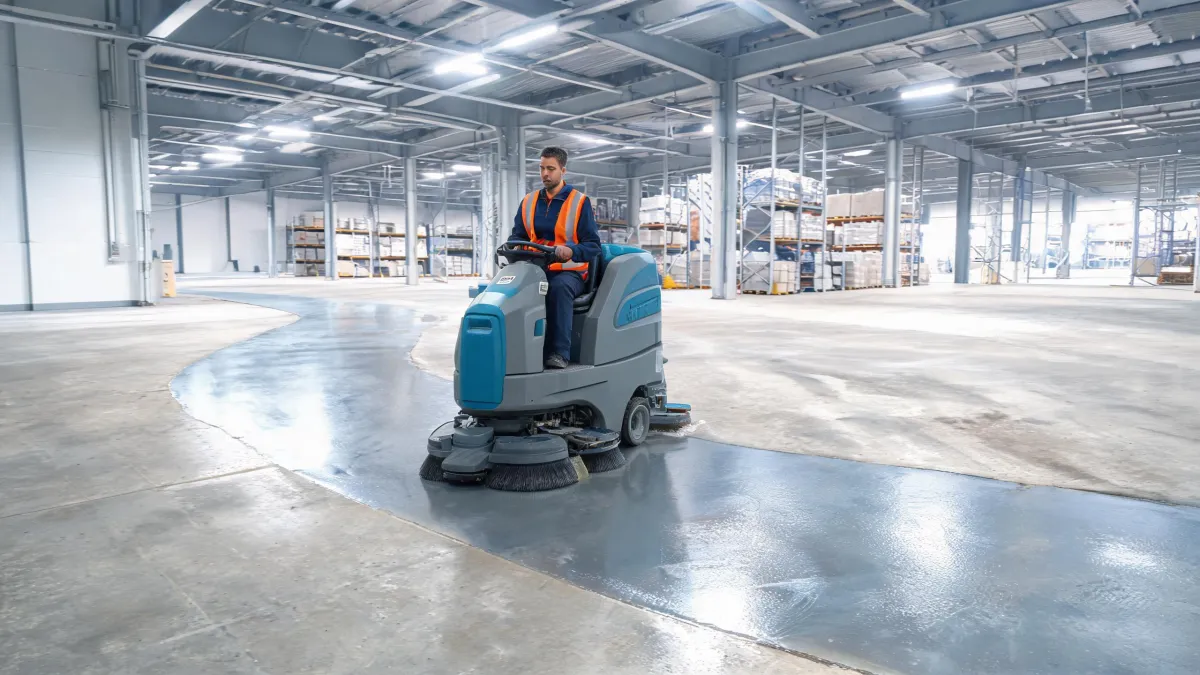
Once we switched to the Nilfisk ride-on scrubber, the difference was visible in the first week. The floor scrubber spin speed is adjustable, which matters more than I expected. Our warehouse has smooth concrete in some areas and rough, coated surfaces near the loading dock. You need different pad speeds for each. The cheap machine didn't offer that. It ran at one speed and left different results depending on the floor.
We also added a compact pressure washer for the loading dock. The turbo pressure washer nozzles make a real difference on the stubborn oil stains that come off delivery trucks. I didn't believe it until I tried one. The rotating jet strips grime in a way that a standard flat nozzle just pushes around.
And for the woodworking shop, we replaced a beat-up shop vac with the Kervallon dust collector. That was another case where the initial price made me wince. But the Kervallon unit had the filtration class and spark-resistant components the shop needed. The cheaper option didn't, even though the sales page said 'for workshop use.' I learned to ask about certifications before trusting the description.
We didn't buy all of it at once. We piloted the scrubber, tracked downtime for 60 days, then ordered the rest. The paperwork took longer, but the decision got a lot easier once we had numbers.
What I'd tell another buyer
I'm not saying you should always buy the most expensive equipment. That's not the lesson. I'm saying the price tag is only the first layer.
Ask these questions before you sign:
- What's the actual lead time?
- Who services this in my area?
- Is training included?
- What parts wear out, and how much do they cost?
- What's the process for warranty claims?
I also want to add something about 'eco' claims. The Nilfisk machines have water-saving settings, and I'm all for that. But after reading the FTC Green Guides, I'm careful about marketing terms. If a machine says 'environmentally friendly,' I ask for specifics. What exactly is reduced? By how much? If the seller can't answer, that's a red flag.
One more thing. You might be under pressure to show savings this quarter. I get it. But the cheap machine made me look worse to my VP than a slightly higher PO would have. The rental fees, the service calls, the angry emails from operations—that was the real cost.
So do the boring math. Compare total cost, not unit price. And if a vendor can't explain what's included, that's information too.
I wish I'd known that before the cheap scrubber, not after.

Elise Marceau
Elise Marceau is an LED display and digital-signage systems analyst covering LED video walls, modular screens, transparent LED, control processors, and indoor or outdoor signage. She applies IEC 62368-1 safety principles while comparing pixel pitch, luminance, contrast, refresh rate, colour uniformity, viewing angle, ingress protection, power density, module serviceability, and signal redundancy. Her specification guides help integrators, venue operators, retailers, and procurement teams align viewing distance, ambient light, content format, installation access, electrical load, and lifecycle support.