How a 'Budget' Floor Scrubber in Brookfield Cost Us $22,000
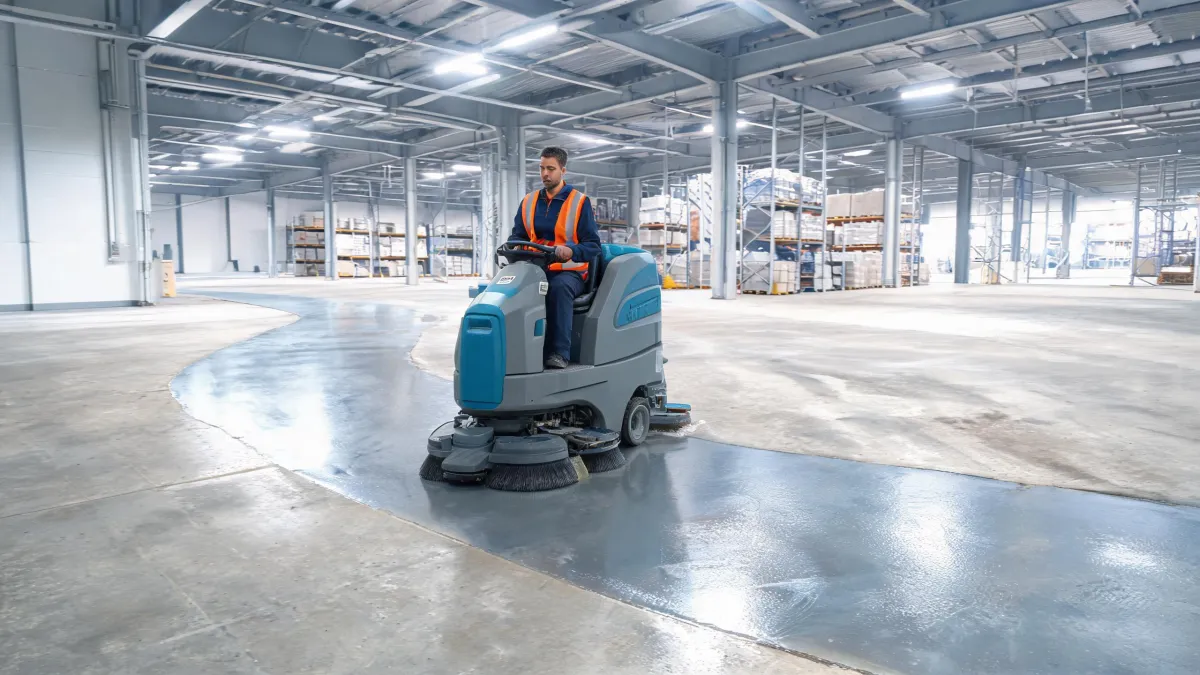
There's a photo from August 2023 that still makes me wince. A floor scrubber sitting dead in our Brookfield warehouse with a hand-lettered sign taped to the handle: "OUT OF ORDER—parts on order (3 weeks)." Someone wrote it in Sharpie. Three weeks later, the sign was replaced with a new one that said the same thing.
I'm the quality and compliance manager for a regional distribution company. The title means I review equipment specs, approve purchases, and set maintenance standards across four facilities. Around that same August, three of those facilities asked for the same thing—floor maintenance equipment. Brookfield needed a reliable scrubber. Boise needed a floor sweeper for a dusty parts storage area. And our facility near Pune, India, needed a pressure washer for production line cleanup. Three purchases, one budget cycle, and a CFO wondering why we kept replacing things.
An Audit Nobody Wanted
Our Q1 2024 quality audit told a predictable story. Equipment ages. People patch it. Performance drops gradually, so nobody files a complaint—they just work around it. The Brookfield used floor scrubber was the poster child. It had been bought secondhand three years earlier as a "great deal." It was not a great deal. The machine ran maybe 60% of the time, and the rest was consumed by troubleshooting, waiting for parts, and arguing with a seller who stopped returning calls sometime around year two.
So when the budget cycle came around, I made the case that we weren't buying new equipment—we were buying the absence of problems. The CFO was skeptical. So was I, honestly. I kept waiting for the catch.
The conventional wisdom in procurement is simple: get three quotes, buy the cheapest that meets spec, and look like a hero. That approach works for office supplies. For industrial floor scrubbers, it's a trap.
Comparing Lavor, Nilfisk, and the Used Market
I started with the pressure washer because it had the tightest deadline. Our India plant manager sent over the nilfisk pressure washer india price list, which—by the way—is noticeably different from what US distributors quote. Same brand. Different country-specific pricing, service contracts, and import duties. You can't compare sticker prices across borders without also comparing what actually shows up locally.
We also looked at a Lavor pressure washer. The lavor washer pressure ratings looked great on paper: high PSI, strong flow rate, low price. To be fair, Lavor builds decent units for lighter duty. The question was whether "lighter duty" described our two-shift production line. I also looked up ANSI/PGMA 100, the standard that covers pressure washer safety and performance. The Nilfisk spec sheet listed it. The Lavor documentation I found didn't mention it at all. Which matters if you care whether the machine was actually tested against a published standard.
Boise needed a floor sweeper. Dry climate, an 18,000-square-foot storage area, dust that settles on every shelf in about 48 hours. We pulled three options: a new Nilfisk sweeper, a refurbished sweeper from a local dealer, and a cheaper imported unit, roughly 30% below the Nilfisk. And then there was the used floor scrubber market. I found two listings near Brookfield, both older machines, both described as "runs well" with "minor issues." One said "needs minor electrical work." Which, in my experience, always costs more than the listing implies.
The Part Where I Was Wrong
Here's the thing: I've been in quality roles for eleven years. But in my first year, I made the classic specification error—I assumed "standard" meant the same thing to every manufacturer and every dealer. It doesn't. And in 2023, I nearly made the same mistake again.
We approved the imported sweeper for Boise. We approved the used floor scrubber from Brookfield. And for India, we went with the cheaper Lavor over the Nilfisk because the nilfisk pressure washer india price was about 22% higher after import duties and local service fees. I hit "approve" on the last purchase order and immediately felt sick. What if the used scrubber failed again? What if Lavor parts weren't available in Pune? What if the imported sweeper's manufacturer vanished—which, it turns out, was a very real possibility.
For exactly one month, the budget looked great. Then the machines started talking.
"It's just a scrubber. They're all the same inside." — equipment dealer, two weeks before the control board died
Where the "Savings" Went
The used floor scrubber in Brookfield arrived—or rather, was delivered, with a crack in the battery tray that the seller grinned and called "normal wear." The wiring harness showed signs of a high-amp draw, which is mechanic-speak for "the batteries are on their last legs." We spent $1,100 replacing the tray and batteries before the machine did a single hour of work. Then the drive motor started squealing. Replacement: $620. Then the control board died. You know how hard it is to find a control board for a discontinued scrubber? It's made by no one. We had it rebuilt by an electronics shop in Milwaukee for $780.
The imported sweeper in Boise failed after three weeks. The main brush motor burned out. The manufacturer's website listed a parts distributor in California; that distributor had to order the motor from the factory, overseas. Six weeks. The Boise crew used push brooms on 18,000 square feet of concrete while we waited.
The Lavor in India ran fine for three months. Then a pressure hose fitting cracked—abrasive environment, vibration, that happens. The replacement fitting was not available through Lavor's India distributor in any reasonable timeframe. Nine days of downtime. Not catastrophic. But nine days of production grime building up on equipment that the pressure washer was supposed to protect.
In December 2024, I sat down and added up the repair bills, the expedited shipping, the overtime, and the labor hours wasted waiting on machines. The total: $26,180 across those three "budget" purchases. In that same year, the older Nilfisk scrubber we owned at another location required exactly one service visit—$340—because the technician brought the right parts on the first trip. Nilfisk manuals were downloadable, schematics included, so there was zero guesswork.
Everything I'd read about buying equipment suggested premium brands were a luxury for companies with money to burn. My experience with our specific operation said otherwise. The expensive option was the cheap one. The one that looked cheap was bleeding us slowly.
Fixing the Process, Not Just the Machines
So I rewrote our purchasing specification for cleaning equipment. It now goes into every order:
- Documentation: the full owner's manual and parts diagrams must be available from the manufacturer—online, in print, or both.
- Parts availability: critical wear parts must be stocked at a local distributor, not only at the factory.
- Service network: a qualified service center must exist within reasonable distance of each facility.
- Warranty response: the vendor must state response times for warranty claims in writing.
- Training access: the manufacturer must provide operator and maintenance training materials—videos count.
That list changed the outcome. What I mean is: it stopped being about which machine was cheapest and became about which machine would be the least expensive to own. Boise got a Nilfisk floor sweeper. Brookfield got a Nilfisk SC250 scrubber. India got a Nilfisk cold-water pressure washer. The nilfisk pressure washer india price was still higher than Lavor's. But the quotes now included validated import registration, a local spare parts kit, and a service engineer who could be on site within 48 hours. The other quotes couldn't match that in writing.
Granted, this takes more upfront work. It's easier to just sort by price and pick the lowest number. But the alternative—watching repair invoices pile up—was measurably more expensive, and I had the spreadsheets to prove it. Even then, I doubted the decision. When I saw the total purchase order amount, I said out loud, "I could buy a car for this." It took about six months for the numbers to prove me wrong.
What the Numbers Finally Said
Over 18 months, the new Nilfisk equipment logged a combined 6,840 operating hours. Total unscheduled downtime: 9 hours. Total replacement parts: one drive belt, two squeegee blades.
Compare that with the used scrubber: in 10 months it cost us $4,300 in repairs and an estimated 12 weeks of cumulative downtime. Add the labor cost of operators waiting for parts, and the "cheap" machine cost us roughly $22,000. The imported sweeper cost $1,800 more to fix than it saved on the original purchase. And the Lavor's nine-day downtime cost more in delayed cleanup than the price difference between it and the Nilfisk.
Look, I'm not saying budget equipment never makes sense. It does, for low-utilization situations, where downtime doesn't hurt. But for our operation—two shifts, high usage, distributed facilities—the cheapest option was reliably the most expensive one. My experience across four facilities and dozens of vendors has a recurring theme: the lowest quote ends up costing more more often than not. Take that with a grain of salt; I haven't built a scientific study. I've just signed a lot of purchase orders and then signed the repair invoices that followed.
If someone asked me today what to do about a floor sweeper in Boise or a used floor scrubber in Brookfield—or a pressure washer in Pune—I'd say the same thing: compare total cost of ownership, not sticker price. Ask about parts availability, service turnaround, documentation, and training before you ask for a discount. And if the seller says "minor electrical work," run.
The machines that earn their keep are the ones you forget exist. That's the whole job, really—making the equipment nobody notices work, so nobody has to think about it.

Elise Marceau
Elise Marceau is an LED display and digital-signage systems analyst covering LED video walls, modular screens, transparent LED, control processors, and indoor or outdoor signage. She applies IEC 62368-1 safety principles while comparing pixel pitch, luminance, contrast, refresh rate, colour uniformity, viewing angle, ingress protection, power density, module serviceability, and signal redundancy. Her specification guides help integrators, venue operators, retailers, and procurement teams align viewing distance, ambient light, content format, installation access, electrical load, and lifecycle support.