New Nilfisk Ride-On Scrubber Dryer or Repair? What $23,000 of Mistakes Taught Me
-
The $23,000 Question: Repair or Replace?
-
Dimension 1: Total Cost of Ownership—The $5,800 Mistake
-
Dimension 2: Downtime—The Cost Hidden From the Invoice
-
Dimension 3: Productivity—Where New Machines Run Away From Old Ones
-
Dimension 4: Long-Term Reliability—Sometimes Repair Is the Smarter Play
- What I'd Do Today: A Scenario Guide
The $23,000 Question: Repair or Replace?
I've been handling equipment procurement and maintenance orders for commercial cleaning operations for 9 years. I've personally made—and documented—7 significant mistakes totaling roughly $23,000 in wasted budget. Now I maintain my team's equipment checklist so nobody repeats what I did.
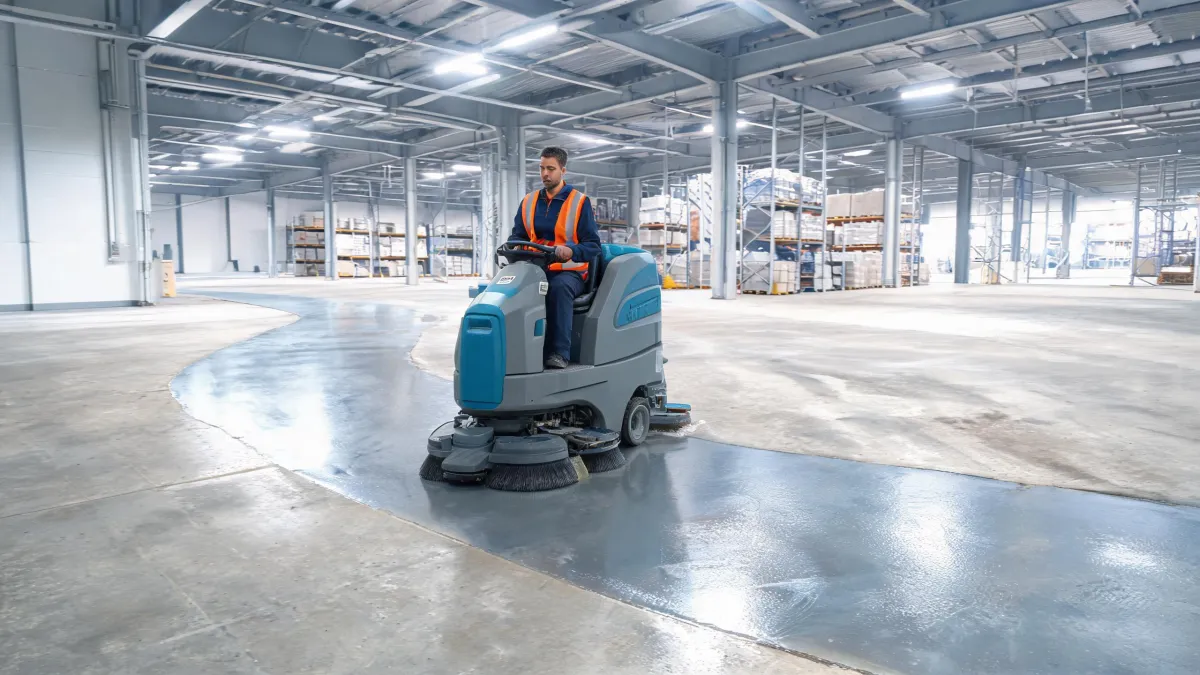
The most expensive question we face over and over: do we repair the scrubber we already own, or replace it with a new ride-on scrubber dryer?
Every facility manager eventually hits this wall. The machine ages. Repairs get more frequent. Someone on the team searches “floor scrubber repair mobile al” to find a local tech, while another person starts browsing the Nilfisk store online. Both paths cost money. But they cost very differently.
This comparison covers four dimensions: total cost of ownership, downtime, productivity, and long-term reliability. I made expensive mistakes in every single one, so you get to benefit from them.
Dimension 1: Total Cost of Ownership—The $5,800 Mistake
In September 2022, I recommended a complete battery replacement on an 8-year-old rider scrubber. Runtime had dropped from 4 hours to about 2.5 hours, the operator was frustrated, and the new machine quote ($26,000) seemed absurd next to the battery replacement cost ($5,800 installed).
On paper, the repair was elegant. What the paper didn't mention: the batteries were a generation old, they didn't improve charging speed, and six months later the drive motor failed. Replacement quote: $4,200. Total spent on the “repairable” machine: $10,000 over 18 months. Then we bought the new unit anyway.
What I mean is that the 'cheapest' option isn't just about the sticker price—it's about the total cost including your time spent managing repairs, the risk of repeat failures, and the potential need for redos. The formula I now use: repair cost + probability of another repair within 12 months × the likely cost of that repair. If that number exceeds 40% of a new machine's price, the argument for repairing collapses.
For reference, a new ride-on scrubber dryer in this class ranges from $18,000 to $35,000 (based on quotes I received from three authorized distributors between October and December 2024; verify current pricing). It should also meet UL 583 for electric industrial trucks (Source: UL Solutions, ul.com)—the dealer should provide the certificate in writing. Typical repairs fall into two buckets (based on our internal service records from 2022–2024):
- Routine service (brush decks, squeegees, hoses): $400–$900 per call.
- Major service (motors, batteries, drive systems): $2,500–$6,000 per incident.
Three things decide whether repair makes sense: how often you're writing these checks, the age of the machine, and whether your facility depends on that specific unit daily. In that order.
Dimension 2: Downtime—The Cost Hidden From the Invoice
In my first year (2017), I told the repair shop we needed the ride-on fixed “as soon as possible.” They heard “whenever convenient.” Result: eleven days without our only ride-on unit in a 48,000 sq ft facility, crew running overtime with a walk-behind.
Those eleven days cost $3,740 in extra labor (about $340/day—I've kept the spreadsheet). Add the $2,100 repair bill, and the “cheap repair” became a $5,840 event. The repair invoice was only 36% of the total cost. That's the dimension that never appears on a service report.
The contrast with buying new: a ride-on scrubber dryer from a dealer delivers in 2–4 weeks (as of January 2025), but you schedule that wait around your operations. A repair, by comparison, sits in a queue. If you don't have a mobile service arrangement, you're at the mercy of whoever answers the phone. Finding reliable floor scrubber repair mobile AL was genuinely difficult for us—surprisingly few options for a city that size.
Dimension 3: Productivity—Where New Machines Run Away From Old Ones
Here's a bias confession: I was never a “new machine” guy. I thought new equipment was old equipment with a shinier body and a bigger tag. I was wrong.
Never expected this: after we switched to a Nilfisk SC6500 floor scrubber, daily cleaning time in our warehouse dropped from 3.5 hours to 2.5 hours. The lithium battery option charges in about 2 hours, versus 8+ hours for the old lead-acid pack, which allowed the machine to cover two shifts. The operator doesn't get off the seat to change brushes, and the squeegee lifts itself in reverse. Small things. They add up.
The surprise wasn't just the productivity gain. It was the shape of the decline. I assumed a 5-year-old machine cleans about 75% as well as a new one. That's not how it works. Between degraded batteries, worn scrubber decks, and outdated brush tech, that “5-year-old” machine was running at maybe 50% of its original cleaning ability. It wasn't a straight line down—it was a cliff we didn't notice until a client audit flagged floor conditions.
Nilfisk's published specs for the SC6500 rate it well above our previous machine's effective output (Source: Nilfisk SC6500 product literature, accessed January 2025). Our real-world numbers won't match the theoretical maximum (surprise, surprise), but the gap between old and new was far bigger than I budgeted for.
Dimension 4: Long-Term Reliability—Sometimes Repair Is the Smarter Play
Here's the conclusion that surprised me: sometimes the older machine genuinely is the better investment. Not because the math is romantic, but because of factors that don't show up in the cost calculations.
Facility layout is one. If your racking and doorways are shaped around the old machine's turning radius, a new model might not fit. Reconfiguring a facility to accommodate a new ride-on scrubber is an invisible, recurring cost.
Environment is another. Older machines with simpler electronics and fewer sensors can be more durable in dusty or wet conditions. This isn't a knock on modern models—which, honestly, are generally more robust than their 2010-era counterparts. It's a reminder that “new” doesn't always mean “right for this building.”
We also didn't have a formal repair-versus-replace assessment process. That was the real failure. The third time we over-repaired a machine in 14 months, I finally built a checklist. It's basic: age, hours logged, major repairs in the past 24 months, total cost of those repairs against the machine's current resale value. Should have built it after the first mistake.
According to ISSA (issa.com), the Cleaning Industry Management Standard requires documented equipment lifecycle planning in accredited facilities. Fancy way of saying: have a written repair-or-replace policy before the moment arrives, not after. I learned that the hard way.
What I'd Do Today: A Scenario Guide
Here's how I'd answer the repair-versus-replace question in three common situations. If you're in one of them, you can skip some expensive trial and error.
Scenario 1: Over 4 hours daily operation, machine older than 6 years, repair quote above $4,000
Replace it. The downtime math alone makes repairs unattractive. Look at a current ride-on scrubber dryer—we seriously evaluated a Tennant unit (commonly searched as “tennet floor scrubber”) but chose the SC6500 for its compact dimensions. Either way, budget it now. Don't wait for the next failure, because it's coming.
Scenario 2: Under 2 hours daily operation, machine under 5 years old, repair quote under $2,500
Repair it. The machine isn't stressed, the investment is limited, and the resale value won't justify a new purchase. Schedule the repair with a qualified local tech—if you're near Mobile, AL, searching “floor scrubber repair mobile al” is your first move. Set a written timeline so it doesn't slip into “whenever convenient.”
Scenario 3: The machine runs fine, but you're already thinking about replacement
Plan the replacement, but don't rush it. Apply the 40% rule to any repair that crosses your desk in the meantime. And if a used or demo unit becomes available at the Nilfisk store or through an authorized dealer, that's a legitimate third path—just run the same checks on it that you would on a new machine.
One final thought: the industry has changed. What was best practice in 2020—running an aging scrubber into the ground—may not make sense in 2025. The fundamentals haven't changed (you still need a machine that cleans reliably), but the execution has transformed: battery tech, operator ergonomics, and real productivity gains now justify earlier replacement cycles.
And if you're searching “nilfisk ride on scrubber dryer” and comparing spec sheets, don't trust the marketing numbers alone. Ask for a site demo. Run the machine on your floors, with your operator behind the wheel. And ask other facility managers about their real-world experience—not just the dealer's references. That's the advice I wish someone had given me in 2017.

Elise Marceau
Elise Marceau is an LED display and digital-signage systems analyst covering LED video walls, modular screens, transparent LED, control processors, and indoor or outdoor signage. She applies IEC 62368-1 safety principles while comparing pixel pitch, luminance, contrast, refresh rate, colour uniformity, viewing angle, ingress protection, power density, module serviceability, and signal redundancy. Her specification guides help integrators, venue operators, retailers, and procurement teams align viewing distance, ambient light, content format, installation access, electrical load, and lifecycle support.