I Bought the Cheapest Floor Scrubber and It Cost Me $1,900: A Small-Buyer’s Nilfisk SC250 Story
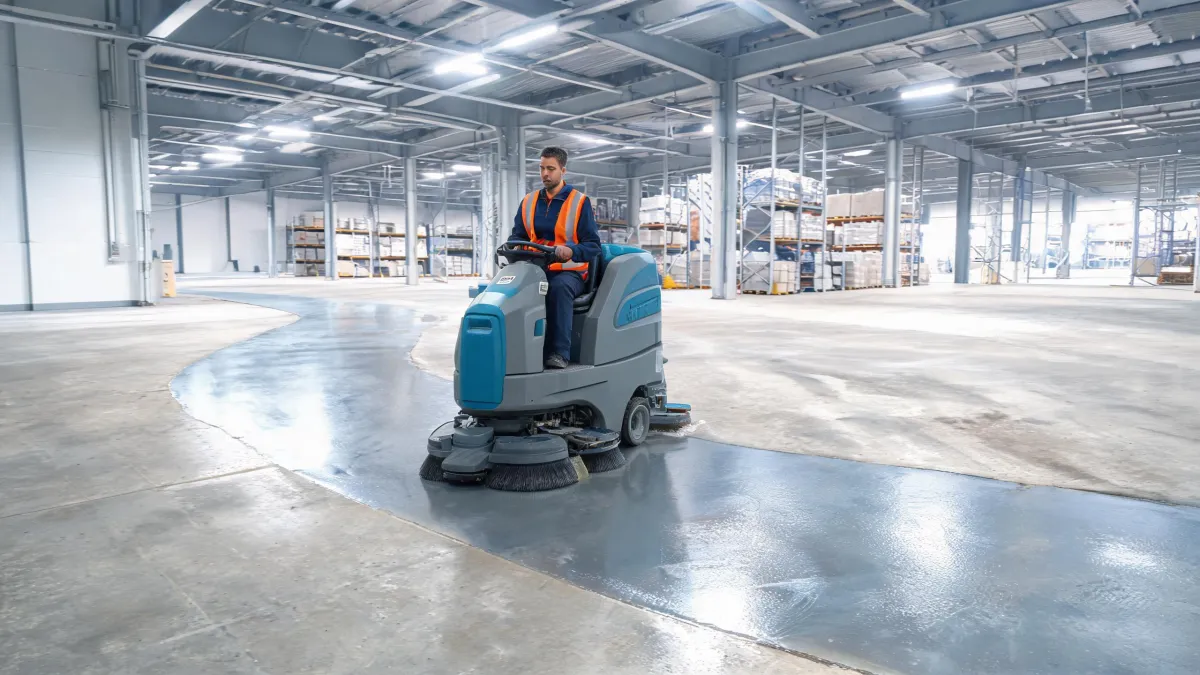
Last July, I found myself crouched in our maintenance closet, staring at a floor scrubber sitting in a puddle of soapy water. The red battery light was blinking. The start button did nothing. The machine was 14 months old. The repair quote was $1,900—more than half what we'd paid for it. And the dealer who sold it to us had stopped answering calls the week after the invoice cleared.
I'm an office administrator for a 400-person manufacturing company. I manage purchasing across three locations—everything from paper towels to forklifts. Roughly $150,000 annually, maybe $140,000 depending on freight. Since 2020, I've dealt with dozens of vendors. You'd think I'd know better by now.
When I first started managing equipment purchases, I assumed the lowest quote was always the best choice. That old scrubber came from a budget brand that looked fine on paper. The price was $3,200—no, $3,800, I'm mixing it up with the repair bill. It had decent reviews, a 30-day warranty, and the sales rep even threw in a free pad driver. I thought I'd won.
The machine did okay for about eight months. Then the brushes started dropping in the middle of a pass. At first, tapping the reset button fixed it. But soon that became a ritual. By month 11, the battery wouldn't hold a charge. By month 14, the controller board failed. The dealer said they'd order the part—then the phone went silent. I had to explain to the VP why the “bargain” scrubber was now a $1,900 paperweight.
I called the dealer three times. The first time, they said the part was backordered. The second time, they said “we'll have the technician call you.” That call never came. The third time, the line rang and rang. I eventually found out the dealer had shut down. No one bought their parts inventory, and our warranty was as useful as the paper it printed on.
That was my wake-up call. I started researching everything from scrubbing pressure to OEM parts availability. I talked to a regional Nilfisk distributor and was upfront about our volume: “We probably won't buy more than one scrubber a year. Is that too small for you?”
The sales rep was responsive. What I mean is, she returned my call within two hours, not two days. She asked about our square footage, our shifts, and what kinds of floors we had. She then suggested two options: the Nilfisk walk-behind scrubber lineup, specifically the SC250 battery scrubber dryer, and the Unipro floor scrubber (that's Nilfisk's budget-oriented line).
I was torn. The Unipro floor scrubber was cheaper, no question. But the SC250 had a longer run time and a sturdier deck. I'm not a maintenance guy, so the fact that the battery and controller were actually accessible made a difference. On the old machine, the control board was buried under the tank. The replacement labor cost more than the part itself.
I also looked at reviews from facility managers. Several mentioned that the SC250's battery was easier to service, and that the brush deck lifted automatically when reversing. The Unipro didn't have that feature. It seemed like a small thing, but our janitors run the machine for a few hours at a time. Pausing to lift the deck manually gets old fast.
When I compared the old scrubber's total operating cost against the SC250's numbers side by side, I finally understood why the details matter. Most buyers focus on per-unit pricing and completely miss spare parts availability, battery longevity, and dealer support. The cheap machine saved $600 upfront but cost us $1,900 in repairs, plus three weeks of stalled floor maintenance. Put another way: the “savings” turned into a loss.
To be fair, there are plenty of good budget machines out there. But “budget” shouldn't mean disposable. For a piece of equipment you'll run every single day, it's worth asking the seller how they'll support it in year two and three. If they can't answer that, any price is too high.
The bigger surprise was the service. Nilfisk's distributor didn't treat my small order like a favor. They brought the SC250 to us for a demo, trained our janitorial team on the charging cycle, and even showed how to change pads. No pressure. They actually said, “If your building were half the size, I'd recommend the Unipro instead.” That level of honesty was unusual.
The demo took about an hour. The rep let our head of janitorial drive it around the warehouse, going over the controls and the different mode settings. She also showed how to drain and rinse the tanks. That's the kind of onboarding you don't get from a “sign here and good luck” checkout.
I'm not 100% sure of the exact specs (take this with a grain of salt), but the runtime was roughly 45 minutes longer than the old machine. The SC250 also uses less water and detergent. The spec sheets included data to back that up. I'd looked at the FTC Green Guides (ftc.gov) before because I've had vendors claim “eco-friendly” with zero evidence. These guys actually had numbers.
We bought the SC250 in September 2023. Two years later, our only costs have been pads and regular maintenance. No surprise failures. The distributor stocks parts and schedules maintenance reminders. Compared to the old scrubber, it's a different universe.
I can't say every day has been perfect. There was a charging cable issue in the first month—the connector seemed loose. But the distributor sent a replacement cable via overnight shipping without an argument. That's the difference between a vendor and a partner.
A few months after that, we also ordered an auto dust collector for the workshop and a 4000 psi diesel pressure washer for the loading dock. I could have bid those out to multiple suppliers, but I'd already learned the lesson. The fact that the same team treated our small order like they treat the big industrial accounts sealed it for me.
For the auto dust collector, I remember asking the rep about filter cleaning. I had no idea there were different filter types. She explained the difference between cartridge and bag designs, and which one made sense for our wood shop. For the diesel pressure washer, the question was whether we needed 4000 psi or whether 3500 would do. She recommended the 4000 psi model because our loading dock has pretty tough grease stains. That honest guidance again.
To be fair, the old machine was cheaper upfront. But that saving vanished in the first repair. And I remember thinking: if this is how small customers are treated after the sale, I never want to be in that position again.
Now, I'm not saying every business needs a Nilfisk. If you have a small area and a mop works, a ride-on machine is overkill. But if you're renting a scrubber too often, or you're tired of fixing broken ones, do the math on parts, downtime, and dealer support. Then call a distributor with a small order. If they treat you like you're invisible, walk away. If they offer a demo and ask questions about your operation, that's the vendor to trust.
Small doesn't mean unimportant—it means potential. The vendor who treated my $4,100 order seriously is the one I still use today.

Elise Marceau
Elise Marceau is an LED display and digital-signage systems analyst covering LED video walls, modular screens, transparent LED, control processors, and indoor or outdoor signage. She applies IEC 62368-1 safety principles while comparing pixel pitch, luminance, contrast, refresh rate, colour uniformity, viewing angle, ingress protection, power density, module serviceability, and signal redundancy. Her specification guides help integrators, venue operators, retailers, and procurement teams align viewing distance, ambient light, content format, installation access, electrical load, and lifecycle support.