Buying Cheap Industrial Vacuums Cost Me $30,000: What I Learned About Quality and Brand Image
If you think cheap industrial cleaning equipment is saving you money, you're not running a business—you're running a lottery. And after six years as a facility manager for a 200-person manufacturing plant, I've watched the odds play out enough times to know they're never in your favor.
I'm not a purchasing director or a maintenance engineer. I'm the guy who hands equipment to the team and then has to look the customer in the eye when things break. That perspective matters. Every mis-buy I've made—and I've made a few—has come back to bite me in the form of a client's sideways glance or an emergency maintenance call at 6:30 a.m.
Since 2017, I've documented about $30,000 in budget wasted on equipment that failed, underperformed, or needed constant rework. This isn't a theory. It's a ledger from my own mistakes.
The lesson from all that waste is simple: the quality of your cleaning equipment is the quality of your company's image. You can ignore that, but your customers won't.
The “Cheap” Vacuum That Cost Triple
In 2019, I bought two budget “industrial” vacuum cleaners for our fabrication area. They were $299 each—about a third of the price of a well-known commercial unit like a Nilfisk commercial vacuum cleaner. On paper, they looked fine: high CFM, decent filter area, and a one-year warranty. The specs checked out.
In practice, it was a disaster.
Within the first week, one motor burned out. The vendor replaced it under warranty, but the replacement had a different-sized hose connection. That should have been my first red flag. Then, three months later, the second unit's filter seal failed while we were cleaning up after a production run. Fine aluminum dust blew out into the finished goods area and settled on surfaces ready for inspection. We had to re-clean everything—that cost us $890 in labor plus a one-week delay on a client's order.
What I mean by “cost triple” isn't just the purchase price. I mean the hours spent on the phone with support, the redo work, and the fact that our team started avoiding those machines altogether because they didn't trust them. Meanwhile, the Nilfisk commercial vacuum cleaners we eventually bought in 2021 have run nearly every day since without a single major breakdown. Same kind of work, harsher conditions, zero drama.
Based on publicly listed prices at major online equipment suppliers (January 2025; verify current rates), a Nilfisk commercial vacuum cleaner typically ranges from $1,200 to $2,500. The budget units I bought were $299 each. On paper, that's a $900 difference. In real operating costs, the budget units ended up costing more because of re-cleaning labor, replacement parts, and the missed production time.
Look, I'm not saying a higher price tag automatically means better quality. I'm saying that when you buy the cheapest option in a category, you're often paying for the privilege of being a beta tester.
Your Equipment Speaks Before You Do
One part of my job is hosting facility tours for prospective clients. Before a tour, we clean everything. In early 2022, I walked past our maintenance corner and noticed the tape holding together the hose of that cheap vacuum. It was janky. Not just a little worn—it looked like something you'd see in a junk drawer.
That's when it hit me: clients don't see the work behind the work. They see the tools. And if our cleaning equipment looked like it had been through a war, what did that say about how we handled their parts?
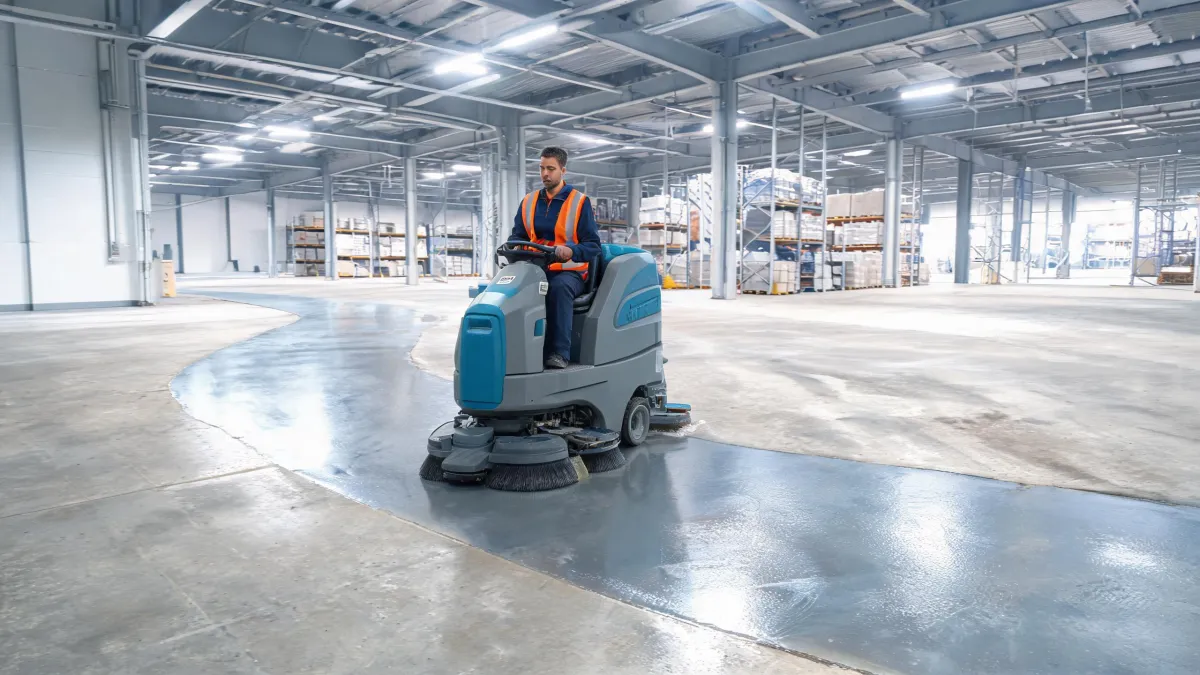
The visibility of cleaning equipment is underrated. A facility that uses professional gear looks like a facility that's serious about quality. That's why I eventually upgraded our floor care system to a Nilfisk Advance SC351 walk behind floor scrubber. It wasn't just about scrubbing performance—although the on-board charging and consistent pad pressure are great. It was about walking into the building and seeing a bright, purposeful machine standing next to the production line. It signals that we care about the details.
The payoff showed up sooner than expected. One of the clients who had seen the taped vacuum came back three months after we upgraded and commented on how much more “polished” our shop looked. No one had mentioned the new floor scrubber directly. They just noticed that something was better. That's the return on quality: people experience it before they name it.
I know it feels unnecessary to spend money on something as unglamorous as a floor scrubber. But here's the thing: your facility tells a story whether you want it to or not. A $399 vacuum with taped hoses tells one story. A Nilfisk Advance SC351 tells another. I've seen both stories play out in the same room within the same year.
Dust Collectors and Compliance: The Part I Almost Missed
Here's where I have to admit I got lucky. In 2020, we were in the market for a dust collector for our woodworking area. One vendor pushed a budget unit with a simple fan and a basic cartridge filter. It looked fine, and honestly, I almost signed off on it. But then our safety coordinator asked a question I couldn't answer: “What's the pulse jet system like?”
I'm not a ventilation engineer, so I can't speak to airflow dynamics in detail. What I can tell you from a procurement perspective is this: the dust collector pulse jet system is the heart of the machine. It's the mechanism that blasts compressed air through the filters to shake off dust buildup and keep suction consistent. If that system is weak or poorly designed, your filters plug up, airflow drops, and the machine spends more time rattling than collecting.
We ended up going with a Delfin dust collector with a properly designed pulse jet system. The difference was night and day. Filters stayed clean, suction held steady, and we could actually measure the airflow at the extraction points. Later, when we added a second station, we compared it with a Weatherize dust collector that had a similar pulse jet setup. Both performed well because the pulse design was right.
To be fair, the budget unit might have worked for a light-duty application. But in a production environment—especially one where combustible dust is a possibility—the margin for error is thin. According to OSHA (osha.gov), dust accumulation can create both health and fire/explosion hazards. We had our air quality checked after the installation, and particulate counts in the work area dropped by more than 70% compared to our pre-purchase baseline.
The frustrating part is that the cheap option looked perfectly acceptable. That's what scares me. The difference between a good dust collector and a bad one isn't visible from the outside. You have to dig into the filter media, the pulse pressure, and the cleaning cycle design. It's exactly the kind of thing that's easy to overlook until you're standing in a haze of fine dust wondering how you got there.
If you're comparing dust collectors today, I'd put the pulse jet system at the top of your list—not the color of the powder coating or the size of the hopper. Based on current listings at industrial equipment suppliers, a Delfin dust collector with pulse jet cleaning typically falls in the $5,000–$15,000 range, and a Weatherize dust collector with similar features sits in a comparable bracket. Those are broad numbers, so treat them as a starting point, not a quote.
But What If You Can't Afford a Premium Brand?
I get it. Budgets are real. Not every shop can drop $3,000 on a vacuum cleaner or $12,000 on a dust collector. I've been in those meetings where the CFO looks at the purchase order and asks, “Do we really need the premium one?”
Here's the thing: you don't necessarily need the most expensive brand. You need the right specification for your application. But in most cases, the cheapest option is a false economy because it fails when you need it most—during a client deadline, after hours, or when your maintenance staff has already left for the weekend.
My pre-purchase checklist now includes three non-negotiables:
- Total cost of ownership (TCO): purchase price + expected maintenance + estimated downtime + redo labor. If the cheap option isn't at least 40% cheaper on TCO, it's not worth it.
- Filter/seal quality: How easy are filters to change? Can you buy them in two years? Is the seal actually dust-tight?
- Service infrastructure: If the machine breaks, is there someone who can fix it within a week? Not three weeks, not “maybe send it back overseas.”
Granted, this takes more time upfront. You have to call vendors, ask for technical specs, and compare the details that don't fit in a product photo. But I've caught 14 potential mis-buys using this checklist in the past 18 months. It's worth the hour.
And if you genuinely can't afford a Nilfisk or a Delfin right now, then buy one good unit for the areas customers see, and use the budget machine for the back corners. Just know that the budget machine will probably cost you more in the long run. That's not a guess. It's the result of tracking every failed purchase for five years.
The Brand Isn't What You Say—It's What They See
I started this article with a strong opinion, and I'll end with the same one: cheap cleaning equipment is the most expensive mistake you can make for your brand.
I'm not saying every purchase has to be top-of-the-line. I'm saying that the equipment your team uses to clean the facility is part of how clients judge your operation. When they see a Nilfisk commercial vacuum cleaner standing next to a workbench, they don't just see a machine—they see a company that invests in doing things right.
That perception isn't vanity. It's trust. And trust is a lot harder to buy back than the $300 you saved on a vacuum that fell apart in a year.
So, when you're comparing equipment, don't ask only, “How much?” Ask, “What will this say about us when we stand next to it?” The answer might surprise you.

Elise Marceau
Elise Marceau is an LED display and digital-signage systems analyst covering LED video walls, modular screens, transparent LED, control processors, and indoor or outdoor signage. She applies IEC 62368-1 safety principles while comparing pixel pitch, luminance, contrast, refresh rate, colour uniformity, viewing angle, ingress protection, power density, module serviceability, and signal redundancy. Her specification guides help integrators, venue operators, retailers, and procurement teams align viewing distance, ambient light, content format, installation access, electrical load, and lifecycle support.