I Compared the Nilfisk Liberty SC50 to a Traditional Scrubber. Here's What TCO Actually Looks Like.
The Comparison I Almost Skipped
I review equipment specifications for a living. Every deliverable that reaches our production floor passes through my desk first—roughly 200 items per year, from safety gloves to industrial scrubbers. I'm the person who asks uncomfortable questions about tolerances, maintenance intervals, and whether the marketing spec holds up in practice.
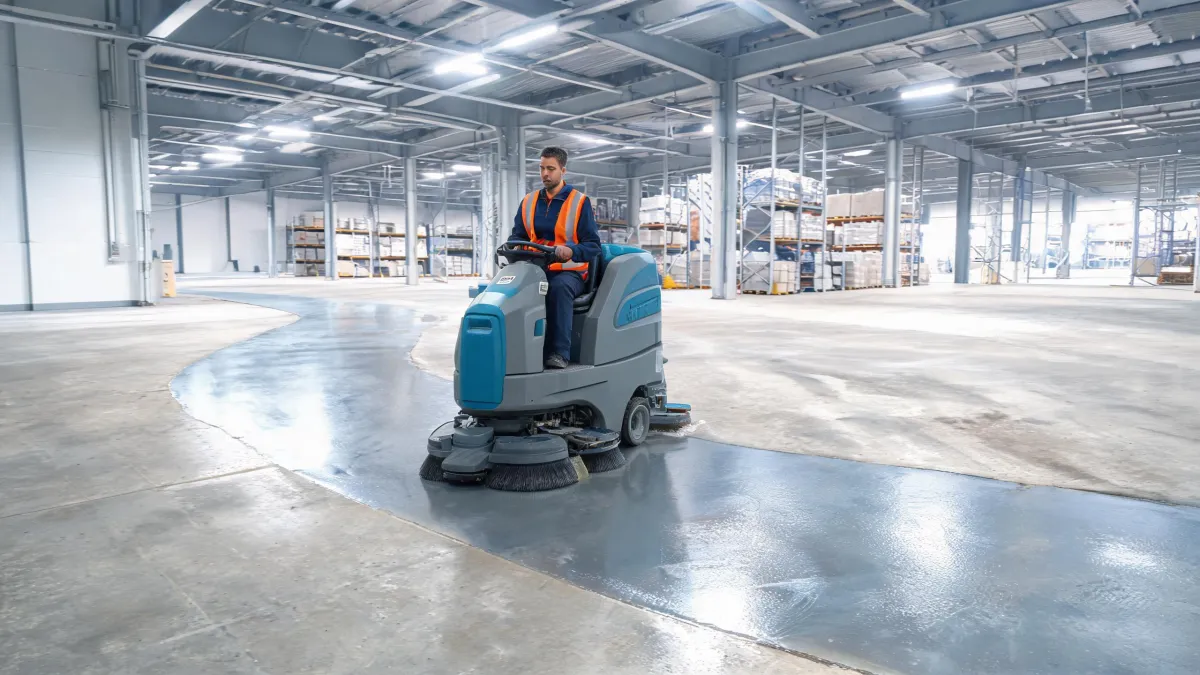
When the Nilfisk Liberty SC50 autonomous scrubber first crossed my desk, I almost dismissed it based on the price tag alone. The published specs looked solid—lithium battery pack, programmable routes, compact footprint. But the upfront cost was roughly $10,000 more than the walk-behind scrubber we were using at the time. My immediate reaction was simple: why would I pay that premium for the same cleaning result?
That was two years ago. Today, we run two SC50s across our facility, and the walk-behind is sitting in storage. Not because I'm a fan of automation for its own sake. Because the total cost numbers—the ones I initially refused to calculate—made the decision obvious.
Dimension 1: Labor Economics on the Ground Floor
Here's the reality nobody puts on a spec sheet: the most expensive component of any cleaning operation isn't the machine. It's the operator standing behind it.
With our old walk-behind scrubber, we assigned one operator for roughly 2.5 hours per day to cover our 30,000-square-foot production floor. At an effective labor rate of $18–20 per hour including overtime, that's about $1,400 per month—just for floor scrubbing labor. And that doesn't count turnover, training, sick days, or the simple reality that an operator on hour three of a shift is less thorough than on hour one.
The SC50 changed that equation. Instead of steering, our operator programs a cleaning route and lets the machine run. Supervision takes about 15 minutes per day. The labor cost dropped to roughly $100 per month for the same coverage area.
Do the math: that's about $15,600 in annual savings at our facility. The payback period against the SC50's price premium was under ten months.
Let me stop here and say something uncomfortable about myself. I only believed this math after ignoring it and watching our cleaning costs stay stubbornly flat for a year. I'd been so focused on proving the autonomous scrubber was a luxury purchase that I didn't calculate what the manual process was actually costing us.
Dimension 2: Cleaning Consistency As a Compliance Issue
Here's where the quality manager in me takes over. Consistency isn't just a nice-to-have. In our industry, floor cleanliness directly affects product quality and audit outcomes.
Human operators vary. Same person, same machine, same floor—the results still differ based on fatigue, mood, and day of the week. We measured this during the SC50 trial (which, honestly, I expected to fail—I was already drafting our 'stick with manual' memo). We ran the walk-behind scrubber on Monday and the SC50 on Tuesday, then compared clean-floor test strip readings. The manual results were all over the place; the SC50's readings clustered tightly. Why? Because it follows the same path at the same speed with the same brush pressure every single time.
That repeatability matters more than I expected. During an unannounced audit in Q3 2024, our documentation of consistent cleaning passes was a factor in passing with no corrective actions. With the manual process, I could never have made that claim confidently.
Now, the honest caveat: the SC50 doesn't handle corners, edges, or cluttered areas. Someone still needs to address those zones manually. But those areas represent maybe 20% of our floor. The other 80% is open space—and the autonomous unit handles that consistently.
Dimension 3: The TCO Breakdown That Changed My Mind
Let me walk through the total cost of ownership calculation, because this is where the whole debate actually lives.
For our three-year comparison, based on actual operating data from our facility plus publicly available pricing as of January 2025:
- Purchase price: The SC50 commands a meaningful premium over a comparable walk-behind unit—roughly $8,000 to $12,000 more depending on configuration and dealer terms.
- Labor, 3 years: The SC50 wins decisively. Our savings of roughly $15,600 per year compounds to about $46,000 over three years.
- Maintenance and repairs: Surprisingly comparable. The walk-behind scrubber has more wear parts (brushes, squeegees, and drive components stressed by human operation); the SC50 has more sensors and electronics. In our first eighteen months, neither has been a budget breaker.
- Battery replacement: The SC50's lithium pack is rated for roughly 2,000 charge cycles (manufacturer documentation, 2024). The walk-behind's lead-acid batteries cost $600–$900 per replacement and needed swapping around the two-year mark. The SC50's battery, when it eventually needs replacing, will cost more—budget for that at years five to six.
- Downtime risk: This is the SC50's weakest spot. If the machine needs service, you can't push it like a manual unit. We keep a backup plan for critical cleaning windows.
When I first ran these numbers, my gut and the spreadsheet disagreed. Every calculation pointed to the SC50 being cheaper over three years, but I still felt uneasy. In retrospect, that discomfort was automation anxiety—fear of replacing a known process with an unfamiliar one. I decided to run a 90-day pilot before committing, just so I could get comfortable. It was the right call. The pilot confirmed the projections, and I wouldn't have believed it otherwise.
One limitation I should state plainly: my experience comes from mid-size manufacturing facilities between 20,000 and 50,000 square feet. If you're running a smaller site—under 10,000 square feet—or your labor rates are significantly lower, the TCO math shifts. Run your own numbers.
When to Choose Which Option
Alright, here's my practical takeaway.
The autonomous route makes sense when:
- You have large, relatively open floor areas where the machine can work uninterrupted.
- Labor is a genuine cost pressure, and you regularly struggle to staff cleaning shifts.
- Cleaning consistency matters for compliance, audits, or product quality.
- You can commit to a pilot phase before making decisions.
The traditional scrubber still makes sense when:
- Your open floor area is smaller than roughly 10,000 square feet.
- The layout is complicated—lots of racks, machinery, or obstacles that require manual handling.
- You have irregular cleaning schedules with peak demands around shutdowns.
And a quick note on supporting equipment, because floor scrubbing is rarely the entire cleaning ecosystem. We pair our SC50s with a Nilfisk premium pressure washer for dock areas and equipment exteriors. When selecting that unit, I didn't chase peak PSI—I prioritized flow rate and durability, because those factors drive actual cleaning speed. It's the same TCO lesson: the headline spec doesn't equal the total cost of getting the job done.
Dust collection is another recurring consideration. If you have any drilling or fabrication activity, a standing dust collector with the right intake diameter for your tools is a safety investment, not an optional accessory. For light-duty applications, I've seen people use 3D-printed drill dust collector STL designs, but those are for workshop-level use. In a production environment, static pressure and filter capacity matter more than the tool's novelty factor.
Final Verdict
Looking back, I should have run the SC50 pilot in my first month of evaluation instead of spending two quarters debating spreadsheets. At the time, the premium seemed unjustifiable. Given what I knew then, the hesitation was understandable—but the math was never as close as I thought it was.
The autonomous scrubber isn't the right choice for every facility. But if you haven't run a TCO comparison that includes labor, consistency, and downtime—not just the price tag—you're not comparing the options at all.

Elise Marceau
Elise Marceau is an LED display and digital-signage systems analyst covering LED video walls, modular screens, transparent LED, control processors, and indoor or outdoor signage. She applies IEC 62368-1 safety principles while comparing pixel pitch, luminance, contrast, refresh rate, colour uniformity, viewing angle, ingress protection, power density, module serviceability, and signal redundancy. Her specification guides help integrators, venue operators, retailers, and procurement teams align viewing distance, ambient light, content format, installation access, electrical load, and lifecycle support.