The Electric Floor Scrubber Nilfisk RT50AC Was Perfect. The Accessories Almost Cost Us a Client.
The delivery that looked too clean
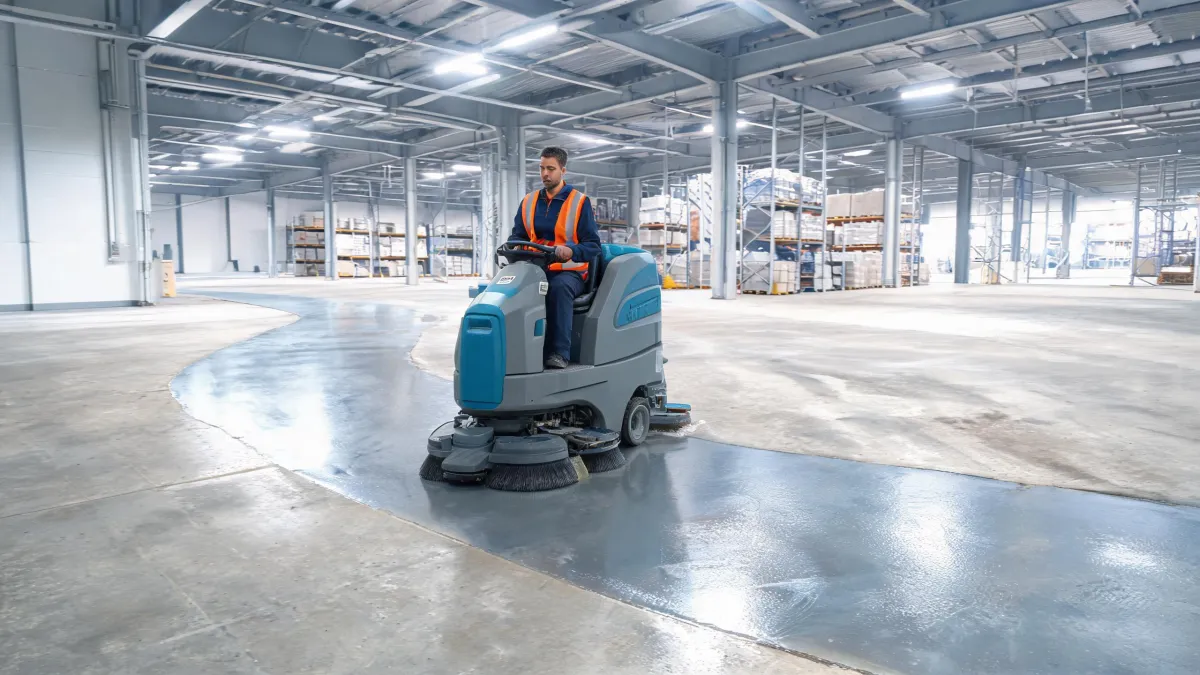
It was a Tuesday morning in late January 2025, and I remember thinking, 'this is why we buy from one manufacturer.' The pallets had arrived for a new warehouse contract we had won the month before. On that dock sat an electric floor scrubber Nilfisk RT50AC, a cyclone dust collector, a dust collector broom, and a Nilfisk 20 m HP drain & tube cleaning hose. Same logo on the boxes, same line on the purchase order. Fifteen minutes later, I had set two of those items aside as 'do not deploy.'
For context, I'm the quality and compliance manager at a regional facility services company. I review every piece of cleaning equipment before it reaches a client site—roughly 200 items a year. I've rejected about 9% of first deliveries in 2025 so far, mostly for small things like missing warning labels or a scratched housing. This one wasn't small.
How we ended up with four 'right' products
We'd won the contract in December, and I built the equipment spec in early January. I went to the Nilfisk website because I liked that they publish full spec sheets with model numbers and compatibility notes. The electric floor scrubber RT50AC was the main machine for the production floor. I added the 20 m HP drain and tube cleaning hose for the pressure washer our maintenance crew uses on floor drains. I added the cyclone dust collector for drywall dust after ceiling repairs. And I added the dust collector broom because it sounded like the kind of tool our crews would use every single day.
My mistake was treating 'same brand' as 'same system.' The old belief that a manufacturer makes one set of parts that all work together comes from an era when these machines were simpler. That's changed. Nilfisk's current range includes multiple scrubber platforms, vacuum classes, and high-pressure lines. The brand is not the spec.
The RT50AC was fine. The hose was not.
The scrubber itself checked out. I unboxed it, checked the brush pressure, looked at the squeegee blade, ran a quick battery cycle. Clean. That machine is still on that site today.
Then I opened the box marked 'Nilfisk 20 m HP drain & tube cleaning hose.' The hose itself was beautiful. Right length, right pressure rating on the label, heavy-duty cover. But the fitting at the pump end was one millimeter different from what our pressure washer required. One millimeter. The connection would not physically thread on without an adapter.
'It's all Nilfisk, it'll fit—you're overthinking it.'
That was the distributor's first response. I hate that sentence. 'It'll fit' has cost more overruns than any faulty part I've ever rejected. I told him I wanted a return authorization, not an adapter. He pushed back. So I spent 40 minutes on the Nilfisk website, pulling up the specs and compatibility lists. The RT50AC page confirmed the brush type we ordered was correct. The 20 m HP hose page had a compatibility dropdown that did not include our pressure washer. The cyclone dust collector diagram showed the inlet diameter it required, and it did not match the vacuum we intended to use it with.
Why I said no to the adapter
Here's the thing: on paper, adapters made sense. Cheaper than a reorder. Faster than the schedule allowed. But I had 36 hours to get the site operational. Normally I'd take a week to validate every SKU. There was no time. So I went with my gut.
If that sounds too vague, let me be specific. A high-pressure drain cleaning hose that relies on a random brass adapter is a failure point. In a food facility, a burst hose is not a plumbing problem; it's a contamination problem. The cyclone dust collector with a reducer sleeve would choke the airflow. It would turn a $400 dust separator into a loud restriction. And the dust collector broom—what I learned was that it wasn't a standalone broom. It was a broom head designed for a specific vacuum floor tool connector. It didn't match the standard vac hose we had in inventory.
We rejected the batch and ordered the correct versions. The replacement parts cost about 22% more than the stock items we'd picked first. Add premium freight and two days of overtime labor while the crew used push brooms and a shop vacuum, and the total avoidable cost was about $1,800. On a $45,000 equipment deployment, that is 4% of the budget—gone because I didn't check a dropdown.
What I do now
Here's what changed. Every purchase order for an accessory now has to include a spec match, not just a brand match. I open the original manual for the machine that will receive the part. Then I open the manufacturer's website and verify three things: connection type, connection size, and maximum working pressure or flow. In that order.
If the product page says 'compatible with the Nilfisk range' but doesn't list the exact model, I treat it as a red flag. If the manufacturer's website has a compatibility table, I screenshot it and save it to the P.O. file. I date it, too. That way, if there's a dispute later, I can show the spec as it existed when I ordered. It sounds paranoid. It pays for itself.
In our Q1 2024 quality audit, we found that 30% of accessory returns were caused by people buying 'fits the brand' instead of 'fits the model.' We updated the verification protocol then. I thought we had solved it. This delivery proved me wrong, so now the protocol has teeth: no spec sheet, no purchase order.
The takeaway
Look, I'm not telling this story because it makes me look good. I'm telling you because a great machine can be completely undermined by a wrong accessory. The electric floor scrubber Nilfisk RT50AC is a great machine. The Nilfisk 20 m HP drain & tube cleaning hose is a great hose. The cyclone dust collector is a great tool. The dust collector broom is a great idea. They were all great, and they were all wrong for the exact machines on that day. That's not a contradiction. It's the difference between buying a brand and specifying a system.
I'd rather work with a specialist who knows where their product stops than a generalist who will sell me an adapter and wish me luck. The rep who said 'it'll fit' was a generalist. The product specialist who later mapped out the correct hose end for our pressure washer was a specialist. That second person earned our next order.
If you've ever watched a perfectly good piece of equipment sit idle because a small connection was wrong, you know the feeling. Trust me on this one: check the model, not the logo. The website is free. The reorder is not.

Elise Marceau
Elise Marceau is an LED display and digital-signage systems analyst covering LED video walls, modular screens, transparent LED, control processors, and indoor or outdoor signage. She applies IEC 62368-1 safety principles while comparing pixel pitch, luminance, contrast, refresh rate, colour uniformity, viewing angle, ingress protection, power density, module serviceability, and signal redundancy. Her specification guides help integrators, venue operators, retailers, and procurement teams align viewing distance, ambient light, content format, installation access, electrical load, and lifecycle support.