I've Bought Nilfisk Equipment for 5 Years. Here's What I'd Buy — and What I'd Rent
When I took over cleaning-equipment purchasing for our company in 2020, the strategy I trusted was simple: choose a reputable brand and buy a premium model. Nilfisk was already on our approved vendor list, so I started there. Five years and roughly $300,000 in equipment, parts, and rental invoices later, I have clear opinions about what worked and what didn't.
Here's the honest short version: Buy the Nilfisk blue floor scrubber. Take the wireless dust collector seriously. Compare pressure washers by filter access and serviceability, not by PSI. And rent a walk-behind floor sweeper for at least three months before you agree to buy one.
That is not the list I would have written in 2020. Back then I didn't know what a pressure washer inlet filter did, and battery-powered dust collection sounded like a gimmick. Time and a few expensive mistakes changed my mind.
Who this advice comes from
I'm an office administrator for a regional logistics company with about 300 employees across three locations. I don't run the machines — I buy them, schedule maintenance, and explain to finance why the final invoice differed from the quote. My purchasing scope covers roughly eight vendor categories, and I process 40 to 60 orders per year. The cleaning equipment budget I manage sits at about $65,000 annually.
Before 2020, I had never evaluated an industrial pressure washer or a floor scrubber. What I know now came from actual purchases, warranty calls, and a very avoidable pump failure.
The Nilfisk pressure washer lesson: filters, not PSI
When our maintenance team asked me to replace two aging pressure washers, I compared models the way most purchasing people would: I opened the spec sheets and sorted by PSI and flow rate. The best pressure washer in Nilfisk's premium lineup looked like the obvious choice — strong numbers and a reasonable price difference from the models below it. I was ready to approve the order.
Then our maintenance lead asked a question I couldn't answer: “What does the inlet filter look like, and can we get to it without pulling the pump apart?”
I almost laughed it off. I'm not laughing now. That question has saved us more money than any discount I've negotiated since.
Here's what I learned the expensive way with a different brand a few years earlier: pressure washer pumps need consistent water flow. Sediment from outdoor spigots slowly blocks the inlet filter. If the filter is hard to reach, nobody cleans it. The pump starves, cavitates, and fails. That repair cost us close to $700 on an eleven-month-old machine.
Why does the filter matter more than pressure? Because a machine with a slightly lower PSI rating but a clean, serviceable filter will outperform a stronger machine that is slowly being choked by its own intake. Counterintuitive, I know — the spec sheets don't tell you that story.
Now I evaluate pressure washers on three criteria: whether the filter can be inspected in under a minute, whether replacement filters are stocked locally, and whether the pump is designed for the water quality we actually have. The Nilfisk pressure washer filter on the model we eventually ordered met all three. The model I nearly chose did not.
One more thing: when a dealer says a machine will “cut cleaning time in half,” ask for the documentation. Per FTC advertising guidance, performance claims should be substantiated with evidence — and the sales rep who cannot produce it is telling you something.
Why we standardized on the blue floor scrubber
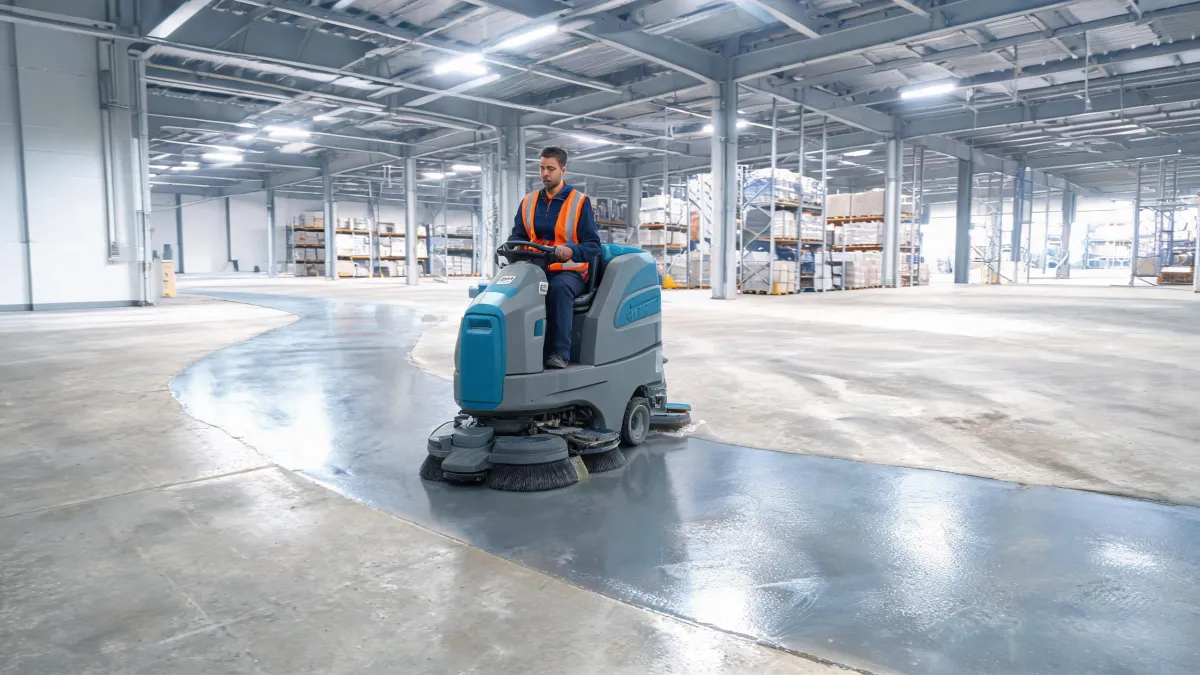
The easiest procurement decision we made was standardizing our scrubber fleet on Nilfisk. In our buildings, those walk-behind machines are simply the blue floor scrubbers.
The color turned out to be practical. Our warehouse is roughly 100,000 square feet. When equipment gets parked in the wrong bay, our staff can describe it from across the building: “the blue scrubber is by bay four.” It sounds small, but in a facility that runs three shifts, that clarity saves time every single day.
The bigger reason we standardized is user acceptance. When we brought floor care in-house in 2022, I expected a long training curve. The Nilfisk scrubber controls were intuitive enough that our third-shift crew picked them up quickly, and operator turnover stopped causing expensive mistakes.
Would I recommend a Nilfisk blue floor scrubber for every facility? Not for a small office. But if you're managing 50,000 square feet or more of hard flooring, it was our best-performing purchase of the last five years.
The wireless dust collector: what I got wrong
When our maintenance supervisor first requested a wireless dust collector, I assumed battery-powered industrial equipment was too weak for real work. I was wrong about that, but not in the way I expected.
The wireless unit we trialed through our Nilfisk dealer was not a toy. It maintained suction through a full shift because its automated filter cleaning kept the filter from clogging — which was exactly the problem we had with our older corded unit. And because there was no cord to plug into a designated outlet, it could be placed where the dust was actually created instead of where the electrical outlet happened to be.
Do I think every shop needs one? Absolutely not. The battery adds weight, and the equipment only works if your team charges it consistently. But I've learned to evaluate these machines on actual airflow data instead of dismissing them based on outdated assumptions about battery power.
Walk-behind floor sweeper: rent before you buy
This is the advice I most wish someone had given me in 2022, when our facility manager requested a walk-behind floor sweeper and our CFO asked why we weren't renting one.
I went back and forth for weeks. Renting felt like throwing money away. Buying felt risky if the machine just sat unused. When we priced a walk-behind floor sweeper rental, the daily rate looked reasonable — until the delivery and brush-wear fees landed on the invoice.
In the end, we rented for six months and tracked every hour of use. The rental cost was about half the purchase price over that period — but the runtime data made the eventual purchase an easy, defensible decision.
There's a rental catch worth naming: the advertised daily rate often excludes delivery, pickup, brush wear, and environmental fees. When our finance team challenged a rental invoice that came in 30% above the quoted rate, I started asking one question before every agreement:
“What is not included in this price?”
Ask that question on rentals, on repair quotes, and on equipment purchases. The vendor who lists all fees upfront — even when the total looks higher than the headline number — has consistently been the cheaper choice over time.
When I would not buy Nilfisk
To keep this honest, there are conditions where I'd recommend a different route:
- Small footprints. Under about 20,000 square feet of hard flooring, a full-size scrubber-dryer is overkill. You're better off with a smaller machine or an outside cleaning contractor.
- Seasonal sweeping. If your sweeping need is a few days per quarter, a walk-behind floor sweeper rental is the right answer. Ownership only makes sense when usage is regular.
- Unpredictable charging habits. Battery-powered equipment fails when nobody plugs it back in. If your team lacks charging discipline, stick with corded versions.
- Poor water quality without treatment. The pressure washer filter can only do so much. If your supply is heavily contaminated, invest in water treatment before you invest in a premium pump.
Nilfisk updates product lines frequently, and model availability varies by region. What I've described here reflects my procurement experience through early 2025 — it's worth verifying current specifications and dealer support before you commit to your own order.

Elise Marceau
Elise Marceau is an LED display and digital-signage systems analyst covering LED video walls, modular screens, transparent LED, control processors, and indoor or outdoor signage. She applies IEC 62368-1 safety principles while comparing pixel pitch, luminance, contrast, refresh rate, colour uniformity, viewing angle, ingress protection, power density, module serviceability, and signal redundancy. Her specification guides help integrators, venue operators, retailers, and procurement teams align viewing distance, ambient light, content format, installation access, electrical load, and lifecycle support.