Industrial Cleaning Equipment: Which Scenario Are You Actually In?
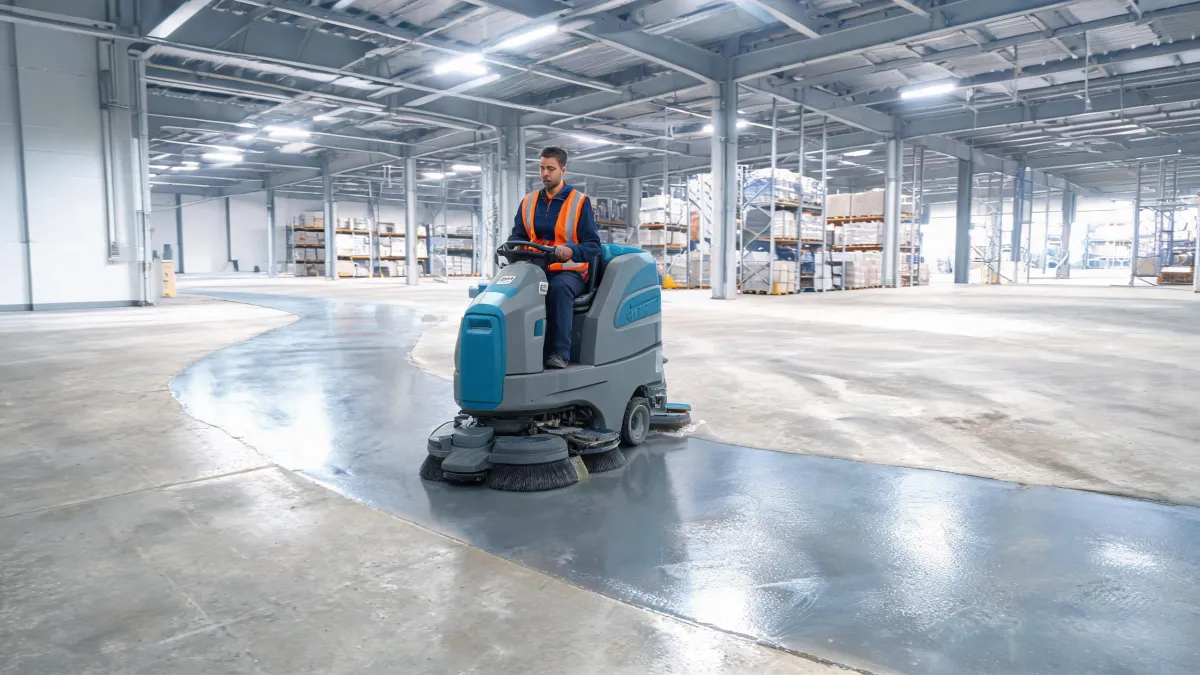
Six years, 11 machines, and a few decisions I'd take back
I manage procurement for a 140-person metal fabrication company. Our capital equipment budget runs about $600K annually, and I've been the one signing off on industrial cleaning purchases for the past seven years. That's 11 machines—pressure washers, floor scrubbers, industrial vacuums, and two dust collection systems.
Most buying guides tell you to "find the best value." That's useless advice. There is no universally best industrial cleaning equipment. There's only equipment that fits your specific usage pattern.
A Nilfisk Liberty SC60 that pays for itself in two years at one facility could sit idle 80% of the time at another. Same machine. Completely different outcome. I've watched this play out with my own purchase orders.
What follows is the framework I use now—after enough mistakes to know better.
The three variables that actually matter
Strip away the marketing and you're left with three numbers: how many hours per day your equipment runs, what your annual labor cost for cleaning is, and whether you can reliably staff those positions.
Everything else—brand reputation, color, horsepower specs—is secondary. I've seen a $3,200 machine outperform an $8,000 machine because the cheaper one matched the actual workload. I've also seen the opposite.
Scenario 1: Light use, specific problems
You are: Running single-shift operations. Ground cleaning is a side task, not a dedicated job. You mostly deal with specific issues—metal cutting dust, occasional part washing, maybe a floor rinse twice a month.
Typical facility: Metal shop under 10,000 sq ft, small auto repair, light manufacturing.
Here's where most first-time buyers overspend. They spec equipment for continuous use when their actual duty cycle is 90 minutes a day.
For a dust collector for metal cutting, a single-stage unit rated at 1,200–1,500 CFM handles one to two cutting stations comfortably. Moving up to a 5HP two-stage system adds $3,000–$4,000—and it won't capture more dust. It'll just draw more power and need filter changes on the same schedule.
Same logic applies to pressure washers. A Nilfisk C110-class compact machine covers part washing, equipment rinse-down, and occasional floor cleaning. The jump to a 3,000 PSI industrial unit only makes sense if you're cleaning heavy equipment all day. For most shops, it's overkill.
One place I don't recommend cutting: replacement filters. Cheap dust collectors often use filters rated at 800 hours or less. Over three years, that's $600–$900 in replacements. Mid-tier units typically run 1,500+ hours between changes.
I learned this one the hard way. We bought a budget dust collector in 2019. The filters cost us $780 over two years. The next machine, at $1,400 more upfront, has run three years on one filter set.
Scenario 2: Daily cleaning, limited staff
You are: Running multiple shifts. Floor cleaning happens every day. Your facility is 15,000–50,000 sq ft. You probably have one to three dedicated cleaning staff.
Typical facility: Mid-size manufacturing, warehouse, food processing.
This is where total cost of ownership gets interesting—and where I see the most purchasing mistakes.
A decent battery-powered walk-behind scrubber at this level runs $8,000–$15,000. Brands like Kodiak, Nilfisk, Tennant, and Hako all compete in this range. A machine at this price point should last six to eight years with proper maintenance.
The mistake isn't in the purchase price. It's in ignoring consumables.
In 2021, we bought a Kodiak floor scrubber at $11,400. Another vendor quoted us $8,900 for a comparable spec. I almost went with the cheaper option until I ran the five-year numbers:
- Kodiak: Brush life ~14 months. Battery replacement at year 3. Five-year consumable cost: ~$3,800.
- Budget option: Brush life ~8 months. Battery replacement at year 2. Five-year consumable cost: ~$6,100.
Over five years, the "expensive" machine cost $1,900 less to own. The purchase price was $2,500 higher. The math flipped because of brush wear rate and battery quality.
That said—this only holds if you're running the machine 6+ hours daily. At 20 hours a week, the cheaper brushes last nearly as long. Usage intensity determines whether premium consumables pay off.
For pressure washers in this scenario, the Nilfisk Lincoln series or equivalent ($2,500–$4,000 range) is worth evaluating. The hot water option matters if you're degreasing parts—it cuts cleaning time by roughly 30%. At $18/hour labor, that's about $1,400 saved annually.
I'm not 100% sure the 30% figure holds for every application. It's what we measured on our own line. Your results will vary with the type of grime and part geometry.
Scenario 3: Multi-site, high labor cost
You are: Operating multiple facilities where cleaning labor is a significant line item. Staff turnover is high, or hiring is difficult. Annual cleaning labor exceeds $65,000.
This is where automation starts making financial sense—and where the Nilfisk Liberty SC60 price point becomes relevant.
The SC60 runs approximately $40,000–$50,000 depending on configuration. That's the starting point, not the full cost. Factor in:
- Infrastructure setup (charging station, network): $3,000–$8,000
- Initial training and supervised operation: 40–80 hours across the first month
- Software/support fees in years 2+: $1,500–$3,000 annually, unless bundled
Realistic first-year investment: $55,000–$70,000.
The break-even calculation is straightforward: if you're currently spending $65,000+ annually on manual floor cleaning labor at a facility, the SC60 typically pays back in under three years. Below $30,000 annual labor cost, it won't.
But here's what the spreadsheet misses: our operations VP argued it wasn't about cost savings at all. "I can't hire these people anymore." When our best cleaner took a three-month leave in 2023, we paid a temp agency 40% above our internal rate—and got worse results. The automation case was about eliminating a headache, not just reducing a line item.
We deployed ours in phases. One facility first, ran it for six months, then added two more sites. I won't call it "transformative." It just quietly does the job. Which, honestly, is the point.
How to figure out which scenario you're in
Forget matching your facility type to a description. Run these three numbers instead:
Daily cleaning hours: Under 1 hour → Scenario 1. Between 1–5 hours → Scenario 2. Over 5 hours, or spread across multiple sites → Scenario 3.
Annual cleaning labor cost: Under $20K → automation almost never pencils out. $20K–$50K → depends on site count and hiring difficulty. Over $65K → automation likely pays back within 3 years.
Hiring reality: If you can easily fill cleaning positions, Scenario 2 math applies. If hiring is consistently difficult, you're functionally in Scenario 3 even if the cost numbers don't fully support it yet.
My rule of thumb: if a machine doesn't pay back within four years through labor savings or consumable reduction, I don't buy it. The "four-year payback" threshold is easy to explain to our finance team. No 10-year ROI assumptions. No arguing over discount rates.
What I'd tell my 2018 self
I've overpaid and underpaid. In 2022, I bought a cheap scrubber that needed $3,000 in repairs within 14 months. In 2020, I bought an industrial dust collection system for a shop running single shifts—we never used more than 30% of its capacity. That one still stings.
The equipment isn't the hard part. The hard part is being honest about how you'll actually use it—not how you imagine you might.
If you're comparing models right now, start with the TCO spreadsheet. Put real numbers in it. Include filter costs, brush replacements, battery lifespan, and the hour rate for whoever operates the machine.
Then add one column that doesn't fit in a spreadsheet: the cost of dealing with breakdowns, delays, and the phone calls you'd rather not make.
Prices and specifications referenced are based on vendor quotes and purchase records from Q3–Q4 2024. Verify current pricing directly—equipment costs and availability shift with supply chain conditions.

Adrian Okafor
Adrian Okafor is a professional audio systems analyst specializing in loudspeakers, PA speakers, subwoofers, line arrays, stage monitors, power amplifiers, and audio mixers. He uses IEC 60268-5 measurement methods for applicable passive loudspeakers while comparing frequency response, sensitivity, maximum SPL, nominal impedance, dispersion, crossover behavior, amplifier headroom, limiter settings, and rigging loads. His system guides help sound designers, rental companies, venues, and installers match acoustic coverage, audience capacity, deployment geometry, power distribution, monitoring needs, and safe operating margins.