Industrial Electric Floor Scrubber or Dust Collector? A Buyer's Guide to Choosing the Right Nilfisk Equipment
There's no universal answer to the question 'Which Nilfisk cleaning product should I buy?'—and anybody who tells you there is hasn't spent enough time watching how different facilities actually get dirty.
I've been an office administrator for a mid-sized manufacturing company since 2020. I manage roughly $400,000 a year in orders across eight vendors, and I report to both operations and finance. Part of my job is figuring out when a new industrial electric floor scrubber is worth the capital expense—and when the real problem is something else, like airborne dust or a polishing operation that's coating everything in a fine gray film.
So let's walk through the decision the way I'd explain it to a colleague: not as a spec-sheet comparison, but as three different problems.
Start With the Mess, Not the Machine
If you look at the Nilfisk official homepage, you'll see cleaning products organized by industry: warehouses, logistics, food and beverage, manufacturing, and so on. That's useful, but it doesn't tell you which type of machine fits your facility. The right choice depends on what kind of dirt you're dealing with, where it comes from, and how often you need to remove it.
Here's something vendors won't tell you: the machine is only half the system. The other half includes chemicals, water, filtration, and the people who operate it. Skip any one of those and you'll blame the machine, but the problem was in the process from the start.
Scenario A: Big, Open, Smooth Floors That Always Look Greasy
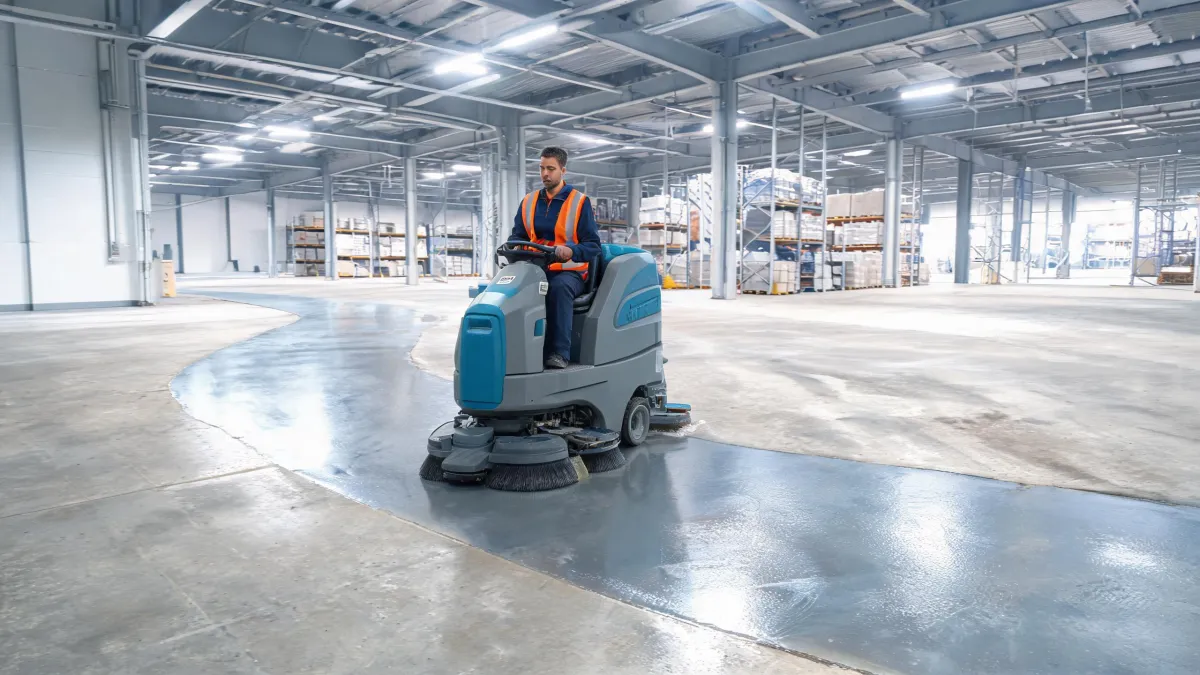
If you're responsible for a warehouse floor, a parking garage, or a production area with 40,000-plus square feet of sealed concrete, the right category is probably an industrial electric floor scrubber. It will do in an hour what a crew used to do in a day.
But here's where it gets tricky: the numbers said we should buy the smaller model, because our daily floor area is only about 25,000 square feet. My gut said no. Something about a battery spec and the distance between pickup points kept nagging at me.
Turns out my gut was catching a real issue: the charging room had old wiring, and the fast charger we would have needed would trip a breaker whenever it started with a hot battery. We solved it by speccing the next size up and scheduling overnight charging on a dedicated circuit. That kind of thing doesn't appear on a spec sheet.
In this scenario, look for:
- Rider models when the floor area exceeds about 30,000 square feet. Walk-behinds are fine for smaller spaces, but they're exhausting at warehouse scale.
- Effective cleaning width, not just total width. You'll lose 10 to 15 percent of theoretical coverage to turns, overlap, and obstacles, so calculate trip time with that reality.
- Brush access and downtime. The cheapest machine I ever ordered saved us $1,200 upfront, then cost us three days of downtime because changing brushes required a technician. Take it from someone who ate that mistake: verify serviceability before signing.
Scenario B: Polishing Dust, Fine Particles, and the Dust Collector Question
Now let's talk about the phrase that kept showing up in my search reports: 'dust collector polishing.' The surprise? It's not about polishing the collector itself. It's about the dust created when your crew polishes concrete, metal, or even wood. If that dust isn't captured at the source, it settles on every surface, including the very floors you just scrubbed. And over time, fine dust is harder to clean than any spill.
If this sounds like your facility, an industrial floor scrubber alone won't fix it. You need a dust collector with the right filter package, usually HEPA (H13) or at least M-class filtration, and a motor design that can handle fine abrasive particles. A $400 shop vac may seem like a workaround until it dies in two weeks.
Here's what vendors won't tell you: filter-cleaning mechanism matters more than the advertised horsepower. A pulse-clean system that shakes the filter automatically can extend filter life significantly. A manual filter cleaning system is cheap to buy but expensive in labor hours. The dust collector market has responded to this with more self-cleaning options, but you have to know to ask.
There's also a compliance angle. If your facility handles combustible dust—metal dust, certain wood dusts, many fine powders—NFPA 652 says you need a Dust Hazard Analysis, and your dust collection system has to be part of that assessment. You can spend days picking filters and still miss the bigger requirement: documentation. When I'm evaluating equipment, I now ask for the DHA paperwork before I talk price.
Scenario C: Mixed Spaces, Multiple Surfaces, a Little Bit of Everything
This is the category most people are actually in, and it's the one where it's easiest to overspend. You have offices, a small maintenance workshop, some tile, some carpet, and a receiving area that gets muddy when it rains. Do you really need a full-size machine?
No. You want a compact scrubber with a good squeegee and a vacuum for edges. A lot of people make two mistakes here: they buy a machine too big to fit through doors, or they buy one machine and expect it to do absolutely everything, including dust collection when someone grinds a weld.
Here's the 'one machine for everything' trap. I almost fell into it. The prediction said: buy a combination scrubber and dry vacuum, and you'll cover all bases. The numbers looked good on paper—one machine, one operator, one invoice. But in practice, switching between wet and dry tasks took twenty minutes per changeover, and the machine spent more time being cleaned than cleaning.
In a mixed environment, separate tools often beat a combo unit. A small electric scrubber for the hard floors, a backpack vacuum for the carpet and edges, and a dedicated dust collector for the workshop. It's less elegant, but it's honest about the fact that one mess is wet, another is dry, and another is very fine and dangerous.
How to Know Which Scenario You're In
So how do you decide without hiring a consultant? Here's the checklist I created after my third avoidable mistake. It now sits next to every quote I process.
- Measure the cleanable floor area. Not the building square footage—the actual surface you'll scrub, minus racks, shelves, and offices.
- List your dust sources. Polishing, grinding, sanding, concrete cutting? If any of these happen indoors, you need a dust-collection conversation before a floor-scrubber conversation.
- Note the floor material. Sealed concrete, tile, epoxy, worn concrete? Different brushes and pad expectations. Worn concrete usually needs a heavy-duty scrubber and a more forgiving floor tool.
- Ask who will operate it. If the answer is 'a different temp every week,' you don't want a machine with a nine-page startup sequence.
- Check your power and water access. This one bit us. Verify voltage, breaker capacity, and proximity to drains before you approve anything.
The 12-point checklist I built after my third mistake has saved us an estimated $8,000 in potential rework. That's not a huge number for big procurement, but it matters to me because I'm the one who has to explain the mistake to my VP when it happens.
Five minutes of verification beats five days of correction. I'm not being cute; that's just the math.
One more thing: the surprise when I bought our first dust collector wasn't the price of the unit. It was how much hidden cost came with the cheap option—poor filter sealing, no pulse-clean, and a motor that couldn't handle the fine dust. The better unit seemed expensive until we compared labor hours and filter replacements over a year.
Bottom Line
If you're deciding between the Nilfisk cleaning products lineup that includes both floor scrubbers and dust collectors, start with the mess. For large, open, hard surfaces, get an industrial electric floor scrubber. For polishing and fine dust, get a proper dust collector with HEPA or M-class filtration and a filter-cleaning system designed for abrasives. For mixed spaces, keep the machine's job narrow.
And before you finalize anything, spend the extra time checking the actual conditions at your facility. That upfront discomfort is the cheapest form of maintenance you'll ever buy.

Elise Marceau
Elise Marceau is an LED display and digital-signage systems analyst covering LED video walls, modular screens, transparent LED, control processors, and indoor or outdoor signage. She applies IEC 62368-1 safety principles while comparing pixel pitch, luminance, contrast, refresh rate, colour uniformity, viewing angle, ingress protection, power density, module serviceability, and signal redundancy. Her specification guides help integrators, venue operators, retailers, and procurement teams align viewing distance, ambient light, content format, installation access, electrical load, and lifecycle support.