Nilfisk Dryft Micro or SC351? A Cost Controller's Guide to Choosing Cleaning Equipment
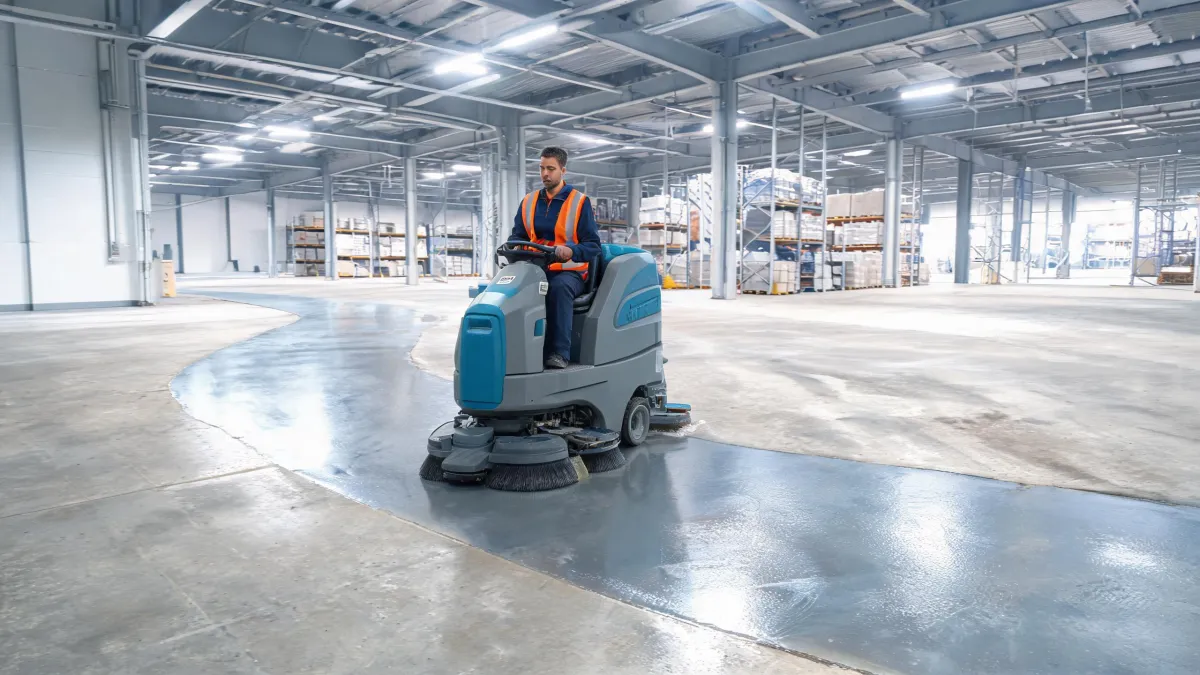
There's no universal answer for "what's the best floor cleaning equipment?" If someone tells you there is, they haven't tracked the invoices.
I've spent the past six years managing procurement budgets across retail, warehouse, and light manufacturing facilities. In that time, I've compared quotes from over a dozen vendors, tracked $180,000+ in cumulative cleaning equipment spend, and made mistakes that taught me more than any spec sheet ever did. This isn't a review blog. It's a decision framework.
If you're weighing the Nilfisk Dryft Micro against the SC351 scrubber dryer, trying to vet a China dust collector wholesaler, or shopping for the best robot floor scrubber for wood floors — this guide is for you.
Four Scenarios. Four Answers.
In my experience, you're in one of four situations. Each one calls for different equipment:
- Small to mid-sized commercial space — retail store, small office, cafe. Cleaning time matters, storage is tight.
- Large warehouse or industrial facility — 20,000+ sq ft, hard floors, heavy forklift or foot traffic.
- Dust-generating environment — woodworking shop, manufacturing line, bulk materials handling.
- Wood floors — showroom, gym, boutique space where water damage is a real, expensive risk.
Let's take them one by one.
Scenario 1: Small to Mid-Sized Commercial Space
If your space is under 5,000 sq ft and you're still using a mop and bucket, the Nilfisk Dryft Micro scrubber is worth a serious look. Not because it's the cheapest upfront option — it isn't — but because of the labor math.
We put a Dryft Micro in a 3,000 sq ft retail location in 2023. It runs about 35 minutes per charge, which covered the entire main floor plus the bathroom with time left over. The cleaning crew cut floor cleaning time from 45 minutes (mop + bucket) to 15 minutes. That's roughly 180 labor hours saved per year. At $18/hour, that's about $3,240 annually. The machine basically pays for itself in year one.
The surprise wasn't the cleaning quality — it was how much the staff actually used it. Because the Dryft Micro is small enough to store in a janitorial closet and simple enough that anyone can operate it, it became the default for daily cleanups. The mop bucket literally collected dust.
One thing I wish I'd tracked earlier: the battery is built in. When it degrades around year 3 or 4, replacement runs $300–500. That's a real total cost of ownership (TCO) consideration, though it doesn't change my recommendation for this scenario.
Bottom line: if your space is under 5,000 sq ft with hard floors and no major dust issues, the Dryft Micro is a no-brainer. If you're bigger than that, keep reading.
Scenario 2: Large Warehouse and Industrial Facilities
For anything above 20,000 sq ft, my pick is the Nilfisk SC351 scrubber dryer. Here's the math that convinced me.
When I compared quotes for a 40,000 sq ft warehouse in 2024, a competitor bid $8,400, while the SC351 came in at $7,600 — but that was without the $400 brush pressure kit, so basically a wash upfront. The real difference showed up in operating costs.
- The SC351's tank capacity is roughly 50% larger than the compact scrubbers we'd been using, and the cleaning path is about 20% wider. Fewer refill cycles, fewer passes.
- Per-hour operating cost worked out about 35% lower.
- Annual maintenance (brushes, squeegees, parts) ran around $650 — roughly 30% less than the competitor's quote.
What surprised me was that the "cheap" option ended up being more expensive overall. That vendor charged for software integration we didn't need and used proprietary parts that cost double the standard ones. Over a 5-year TCO, the SC351 came out about $3,200 cheaper — even though its initial quote was only $800 lower.
I don't have hard data on industry-wide failure rates for scrubber dryers in this class, but based on five years of tracking purchase orders, quality issues show up in maybe 8–12% of first deliveries across all brands. The SC351 wasn't dramatically better or worse than competitors on that front. What mattered far more was the local dealer's responsiveness. Vet that before you sign, not after.
Scenario 3: Dust Collection and the China Wholesaler Question
If you're running a woodworking operation, manufacturing line, or any environment with airborne dust, you need a dust collection system. And if you're comparing China dust collector options — which is common, especially when purchasing through a collector dust wholesaler — here's how to avoid the traps I fell into.
The old assumption that Chinese-made dust collectors are inherently low quality comes from an era when the market was full of generic, unbranded units with poor filtration. That's changed. Chinese manufacturers have closed most of that gap, and the pricing advantage is real, especially at wholesale volume.
But the trap isn't the upfront price. It's the filter replacement cost.
I compared a Chinese wholesaler's 2 HP dust collector at $480 delivered against a domestic unit at $820. Seemed like an easy call. Then I checked the filters. The Chinese unit required a proprietary cartridge at $120 per replacement, every 6 months. The domestic unit used a standard 0.5-micron filter bag at $35. Over three years, that's a $240 difference in consumables alone — plus the headache of sourcing proprietary parts from a wholesaler who might not prioritize restocking them.
Honestly, I'm not sure whether that filter pricing is a deliberate razor/razorblade strategy or just a supply chain artifact. My best guess is it's a bit of both. But the takeaway is clear: always calculate filter replacement costs when comparing dust collectors, not just the sticker price.
Another red flag: some wholesalers advertise CFM measured at the impeller rather than at the inlet. That inflates the number by 20–30%. Take any spec sheet with a grain of salt until you've verified it. If they won't share a third-party test report, treat that as a warning sign.
And per FTC Green Guides (ftc.gov), environmental claims like "eco-friendly" or "high-efficiency" need to be substantiated. When a supplier makes vague green claims with no data behind them, I file that under "not worth the risk."
Scenario 4: Wood Floors and Robot Scrubbers
Now, the question I get asked more than any other: best robot floor scrubber for wood floors?
Honest answer: most robot floor scrubbers aren't safe for wood floors. Water is the enemy of hardwood, and typical scrubber heads put down enough moisture to cause warping over time. Anyone who tells you any robot will work on wood is selling you something.
If you're shopping for a robot scrubber for wood, here's what you actually need:
- Soft brush material — nylon or microfiber, never stiff bristles.
- Precision water flow control — adjustable down to near-dry operation.
- Automatic squeegee pickup — the floor should be dry immediately after the robot passes.
- Moisture sensors — the unit should be able to detect and re-clean wet spots.
We tested several autonomous scrubbers in a 2,000 sq ft showroom with finished wood floors. One unit left visible water trails that had us nervous from day one. Another scratched the finish. The Nilfisk autonomous scrubber — with soft brushes and precision water dosing — has been running for eight months now with zero wood damage.
The surprise wasn't the machine's cleaning performance. It was how quickly the team started trusting it. The first week, someone stayed late to "supervise" the robot. By week three, nobody even looked up when it ran. The real ROI isn't headcount reduction — it's the mental bandwidth you get back.
How to Know Which Scenario You're In
If you're still uncertain, here's the framework I use:
- Under 5,000 sq ft, hard floors, no dust problems → Nilfisk Dryft Micro.
- Over 20,000 sq ft, hard floors → Nilfisk SC351 (or equivalent ride-on scrubber dryer).
- Between 5,000 and 20,000 sq ft → the gray zone. If your team spends 2+ hours per day on floor cleaning, size up. Otherwise, stay compact.
- Wood floors anywhere → prioritize water safety over everything else.
- Dust problems → solve dust collection first, then worry about floor cleaning.
The Bottom Line
There's no single "best" machine. The Dryft Micro is a legitimate fit for small spaces. The SC351 wins in large facilities. A China dust collector can be a smart purchase if you've verified filter costs and true inlet CFM. And a robot floor scrubber for wood floors is only worth considering if it has soft brushes, precision water control, and a decent squeegee.
I've made procurement mistakes — once I chose a machine on sticker price alone, and it cost us $1,200 in redo fees when the pads scratched a sealed concrete floor. The lesson stuck: calculate total cost of ownership, verify specs, and know which scenario you're in before you buy.
If you've got a specific facility size or floor type in mind, I'm happy to share my take. Just keep in mind that my experience comes from what I've actually tracked and documented — not marketing brochures.

Elise Marceau
Elise Marceau is an LED display and digital-signage systems analyst covering LED video walls, modular screens, transparent LED, control processors, and indoor or outdoor signage. She applies IEC 62368-1 safety principles while comparing pixel pitch, luminance, contrast, refresh rate, colour uniformity, viewing angle, ingress protection, power density, module serviceability, and signal redundancy. Her specification guides help integrators, venue operators, retailers, and procurement teams align viewing distance, ambient light, content format, installation access, electrical load, and lifecycle support.