Nilfisk Manuals Are Not Paperwork—They’re Your Best Quality Control Tool
If You’re Buying Nilfisk Equipment Without the Manual, You’re Guessing
My job is to catch problems before they reach our customers. I’m a quality and brand compliance manager at a facilities maintenance company. I review every equipment spec sheet and first delivery—roughly 220 items a year across pressure washers, floor scrubbers, industrial vacuums, and dust collectors. In 2024, I rejected about 19% of first deliveries because documentation or configuration didn’t match the quote.
So here’s my opinion: the Nilfisk manual is not a boring PDF you file after installation. It’s the cheapest quality control tool you have. If you’re specifying a Nilfisk pressure washer gun, a big floor scrubber, or a dust collector system, the manual should be open before you approve the purchase order—not after the crate shows up with the wrong fitting.
I know that sounds harsh. But I’ve seen too many “minor” mismatches turn into downtime. A missing dust collector stick. A pressure washer gun that doesn’t match the hose thread. A big floor scrubber delivered with the wrong squeegee for the floor finish. None of these are mysterious failures. They’re documentation failures.
The most frustrating part of equipment procurement: the same documentation gaps show up even when the spec is clear. You’d think a model number would prevent a wrong fitting, but supersessions and regional variants make it messy. That’s why I stopped treating the manual as an afterthought.
Why Nilfisk Manuals Belong in the Procurement File
First, Nilfisk manuals are the OEM baseline. They tell you what “correct” looks like: part numbers, torque specs, clearances, filter media, battery watering intervals, nozzle sizes, and accessory compatibility. When a dealer quotes you a Nilfisk pressure washer gun, the manual usually lists the exact model, thread type, and rated pressure. If that detail isn’t in the quote, that’s a red flag.
Second, manuals prevent the “it fits” trap. A generic pressure washer gun might thread onto a Nilfisk hose. It might work for a week. But if the manual specifies a particular flow rate or trigger design, a generic replacement can change performance or safety. I’ve had to reject a batch of guns because the fittings were close—but not right. The vendor claimed “within industry standard.” The manual said otherwise. Guess who paid for the redo.
Third, manuals make dust collector system inspections repeatable. A dust collector system inspection isn’t just “looks clean.” It needs baseline readings: differential pressure, filter condition, duct velocity, spark detection function, and discharge valve operation. Without the OEM manual, you’re guessing whether the readings are normal or drifting. With the manual, you have a reference point. That’s way more useful than a generic checklist.
I use a simple rule: if a vendor can’t point to the manual page for a claim, I treat it as unverified. That doesn’t mean the vendor is lying. It means I can’t audit it. For B2B equipment, unverified specs are how you end up with a big floor scrubber that cleans well but can’t make it through a full shift on one battery charge.
The Parts People Forget: Dust Collector Stick and Big Floor Scrubber Details
Two categories where I see the most avoidable problems: attachments and floor equipment.
Take the dust collector stick. It sounds like a small accessory. But if your crew is reaching into tight spaces or cleaning overhead ducts, the wrong stick length or diameter can make the job slower or unsafe. The Nilfisk manual or parts diagram usually shows the compatible stick, hose, and cuff. A missing stick can hold up an entire maintenance window. I’ve watched a team improvise with a shop vacuum attachment because the correct dust collector stick wasn’t ordered. It worked—until it didn’t. The attachment popped off and dumped dust back into the area they’d just cleaned.
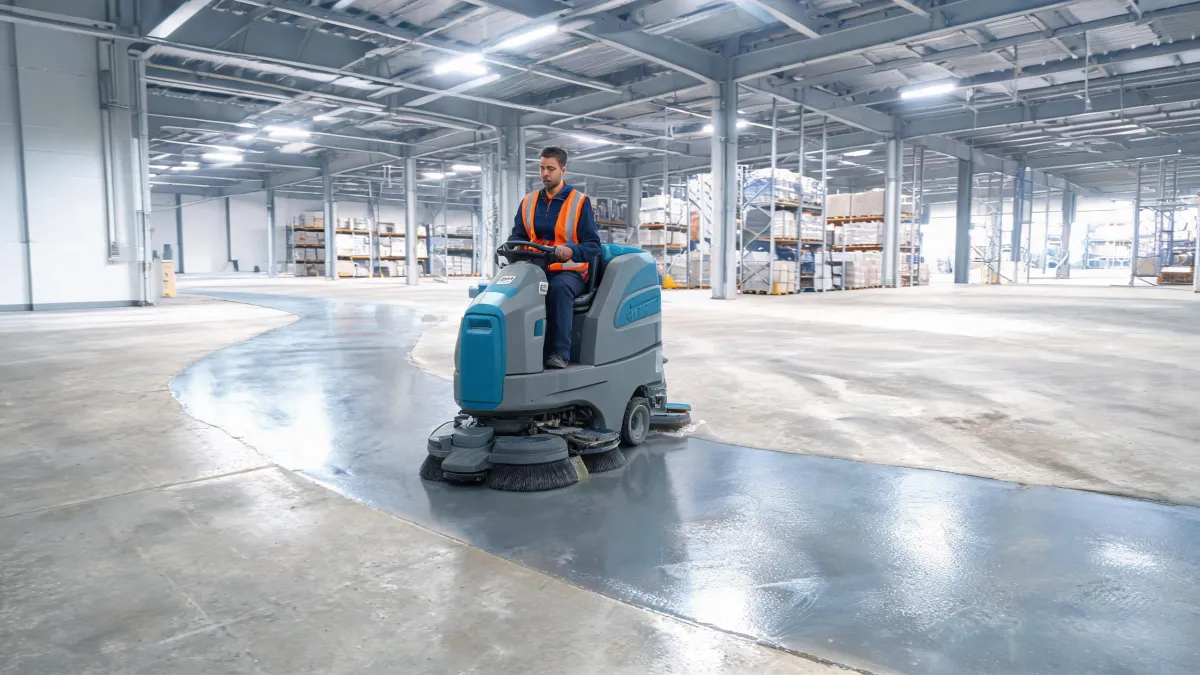
Big floor scrubbers are similar. Buyers focus on scrub width and price. The manual focuses on water tank capacity, brush pressure, squeegee type, battery type, charger profile, and turning radius. Those details determine whether a big floor scrubber actually fits your aisles and shift pattern. I once reviewed a quote where the scrubber was the right width but the battery charger wasn’t compatible with our electrical setup. The manual would have caught it in five minutes. Instead, it cost us a week of back-and-forth and a temporary rental.
What an Informed Customer Asks
I’d rather spend 10 minutes explaining options than deal with mismatched expectations later. An informed customer asks better questions and makes faster decisions. So here’s what I tell our procurement team to ask before any Nilfisk order is approved:
- Does the quote reference the exact Nilfisk manual section or parts diagram for the main unit and accessories?
- For a Nilfisk pressure washer gun, does the quote list the model number, thread type, and rated pressure?
- For a dust collector system inspection, does the vendor provide baseline differential pressure and filter specs from the OEM manual?
- For a big floor scrubber, are the squeegee, brush, battery, and charger specified by OEM part number?
- Is the dust collector stick included, and if not, what is the correct part number?
That last one might sound trivial. It isn’t. Trivial missing parts are the ones that stop a job at 6 a.m.
“But We Don’t Have Time to Read Manuals”
I get it. No one wants to read 200 pages before buying a scrubber. You don’t have to. You need the spec pages, the parts diagram, and the maintenance schedule. Bookmark them. Put them in the procurement folder. Make the vendor point to them. I do not mean you should read every page cover to cover—I mean you should know where the answer lives.
Another pushback: “The dealer should handle that.” Maybe. But the dealer isn’t on your floor at 2 a.m. when a Nilfisk pressure washer gun starts leaking during a critical washdown. The dealer won’t be the one explaining to an auditor why a dust collector system inspection log has no baseline. You are. The manual is your backup.
Dust collector system inspections also protect people. If your facility handles combustible dust, the inspection isn’t just maintenance—it’s risk control. The manual gives you the OEM’s baseline for filter change-out, pressure drop, and grounding. Without that, you’re writing your own rules. That’s not a position I want to defend in an audit.
My experience is based on about 220 orders a year in mid-size commercial facilities. If you’re running a heavy manufacturing plant with continuous dust loads or a hospital with strict infection control, your inspection cadence and documentation needs might differ. I can’t speak to every niche. But the principle holds: OEM documentation is the anchor.
The Bottom Line
There’s something satisfying about a clean dust collector system inspection. After weeks of clogged filters and pressure alarms, finally seeing the differential pressure back within the manual’s range—that’s the payoff. It doesn’t happen by accident. It happens when someone opened the Nilfisk manual before the problem started.
So if your Nilfisk quote doesn’t include manual references, part numbers, and an inspection baseline, it’s not a complete quote. It’s a ballpark. And ballparks are fine for budgets—not for equipment that has to run every shift.
Trust me on this one: the manual isn’t the boring part of the purchase. It’s the part that keeps the purchase from becoming a problem.

Elise Marceau
Elise Marceau is an LED display and digital-signage systems analyst covering LED video walls, modular screens, transparent LED, control processors, and indoor or outdoor signage. She applies IEC 62368-1 safety principles while comparing pixel pitch, luminance, contrast, refresh rate, colour uniformity, viewing angle, ingress protection, power density, module serviceability, and signal redundancy. Her specification guides help integrators, venue operators, retailers, and procurement teams align viewing distance, ambient light, content format, installation access, electrical load, and lifecycle support.