Your 2020 Cleaning Equipment Playbook Is Quietly Costing You Money in 2025
Most Facilities Are Still Buying Cleaning Equipment Like It's 2020
I'll say the uncomfortable part first: if your cleaning equipment procurement strategy hasn't changed since 2020, you're probably overpaying in ways you can't see on an invoice.
I'm not talking about inflation. I'm talking about the equipment itself—what it's capable of, who actually operates it, and how we measure whether it's doing its job. I coordinate emergency orders (rush equipment, replacement units, last-minute deployments) for facility operations teams. Last quarter alone, we processed 47 rush orders with a 95% on-time rate, ranging from a single Nilfisk VHS010N1 HC mini industrial vacuum to full floor scrubber fleets. That volume gives you a decent cross-section of what's breaking down and why.
The pattern is consistent: teams are still specifying equipment based on assumptions that made sense five years ago. And the gap between those assumptions and how the equipment actually performs today is where the money disappears.
The Three Assumptions That Need To Die
Assumption 1: Smaller equipment means less capable equipment
This one drives me up the wall. The most frustrating part of equipment specification reviews: watching teams reject compact units because "it can't handle our square footage." You'd think industrial cleaning scales linearly with size, but that's not how modern equipment works.
Take something like the Nilfisk VHS010N1 HC mini industrial vacuum. The name says "mini" so people assume it's a light-duty unit. It's not. It's a compact industrial vacuum designed for confined spaces—elevator shafts, between-machine gaps, overhead ductwork. The kind of places where a full-size unit physically cannot go.
Here's the thing we keep learning the hard way: most facility teams are running large equipment in spaces it wasn't built for, and tiny equipment in spaces it was never intended to handle. Square footage is the wrong metric. Accessibility and material type matter more.
"The question isn't 'how big is your floor,' it's 'where does the dust actually live?'"
I knew a team that ordered a compact unit for a small garage, then found out half their dust was concrete fines that needed HEPA filtration. Wrong vacuum, wrong filter, wrong job. They ended up ordering a second unit (rush shipping, +60% premium) because the first one clogged in a week. That's a $1,800 mistake driven entirely by assuming "small space = small unit."
Assumption 2: Manual cleaning is always cheaper than automated
I'm going to be somewhat blunt here: this math only works if you value labor at zero.
According to a 2024 ISSA (International Sanitary Supply Association) analysis, autonomous floor scrubbers typically reduce labor hours on large-format floors by 40-60% within the first year. The unit costs more upfront. The math changes when you factor in turnover, training, and the fact that you can run an autonomous unit at 2am without paying a shift differential.
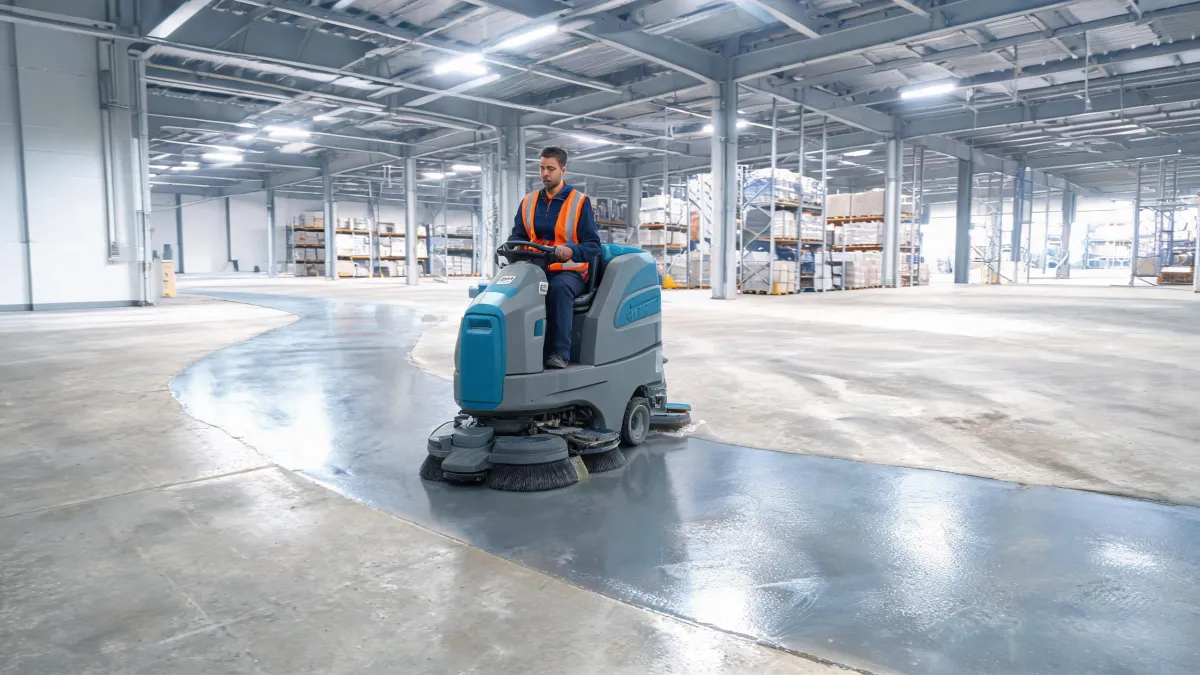
Last year we had a client running a 180,000 sq ft distribution center. They were budgeting roughly $9,200/month on manual floor cleaning labor (across multiple shifts). They replaced two of the four manual routes with autonomous units. Labor dropped to about $5,100/month. Payback period on the units: 11 months.
But here's what nobody tells you—the transition isn't clean. The first three months, the autonomous units underperformed because nobody mapped the routes properly. Obstacles weren't tagged. Charging stations were in the wrong spots. They paid $800 extra in emergency support fees (on top of the base setup cost) to get a vendor specialist on-site. Still cheaper than the labor gap, but it wasn't the smooth "set it and forget it" pitch.
Assumption 3: Dust collection is a maintenance issue, not a design issue
This is where I see the most expensive mistakes. Weatherization of dust collectors—proper sealing, filter management, humidity control—gets treated as an afterthought. Then winter comes, condensation builds inside the collector, dust cakes onto filters, and suddenly you're replacing filter cartridges monthly instead of quarterly.
I'm not an HVAC engineer, so I can't speak to the thermodynamics of specific setups. What I can tell you from a procurement perspective: teams that invest in proper dust collector weatherization upfront report significantly fewer emergency filter orders in Q1. One client told me their January filter spend dropped from $4,200 to $1,100 after weatherizing two collectors in fall 2024.
That's not a maintenance win. That's a design decision they should have made years earlier.
What I'm Not Saying
Let me be clear about the limits here. I've worked with mid-to-large facilities—distribution centers, manufacturing plants, commercial offices. My experience is based on roughly 200 rush equipment orders across those segments. If you're running a small office or a single retail location, the economics look different. Autonomous scrubbers rarely make sense below 50,000 sq ft. A Nilfisk hoover for sale listing that works for a warehouse might be overkill for a boutique.
I'm also not saying old equipment is bad. A well-maintained CT71 floor scrubber or a Teko Turbo Power floor sweeper can still do the job. I've seen Teko units from 2018 running fine with regular maintenance. The equipment isn't the problem. The assumptions are.
And some people reading this will think: "this is just vendor talk trying to sell more equipment." Fair. But the rush orders I handle aren't new sales—they're replacements for units that underperformed because they were spec'd wrong. The expensive route is buying the wrong thing twice, not buying the right thing once.
The Bottom Line
The fundamentals of industrial cleaning haven't changed. You still need to remove soil, protect surfaces, and keep air quality safe. But the execution has transformed. Compact industrial vacuums now outperform units twice their size in confined spaces. Autonomous scrubbers now have a payback period under 18 months for the right facilities. Dust collector weatherization now has measurable ROI within a single season.
What was best practice in 2020 doesn't automatically apply in 2025. If your equipment specification process hasn't been reviewed since before the pandemic, that's not stability. That's staring at a cost leak and calling it a fixture.
Run the numbers. Map your actual dust. Track your actual labor hours. The equipment industry already did its homework. Most facilities haven't done theirs yet.

Elise Marceau
Elise Marceau is an LED display and digital-signage systems analyst covering LED video walls, modular screens, transparent LED, control processors, and indoor or outdoor signage. She applies IEC 62368-1 safety principles while comparing pixel pitch, luminance, contrast, refresh rate, colour uniformity, viewing angle, ingress protection, power density, module serviceability, and signal redundancy. Her specification guides help integrators, venue operators, retailers, and procurement teams align viewing distance, ambient light, content format, installation access, electrical load, and lifecycle support.