Nilfisk SC250 vs A Ride-On: A $3,200 Mistake That Cost Us a Week’s Production
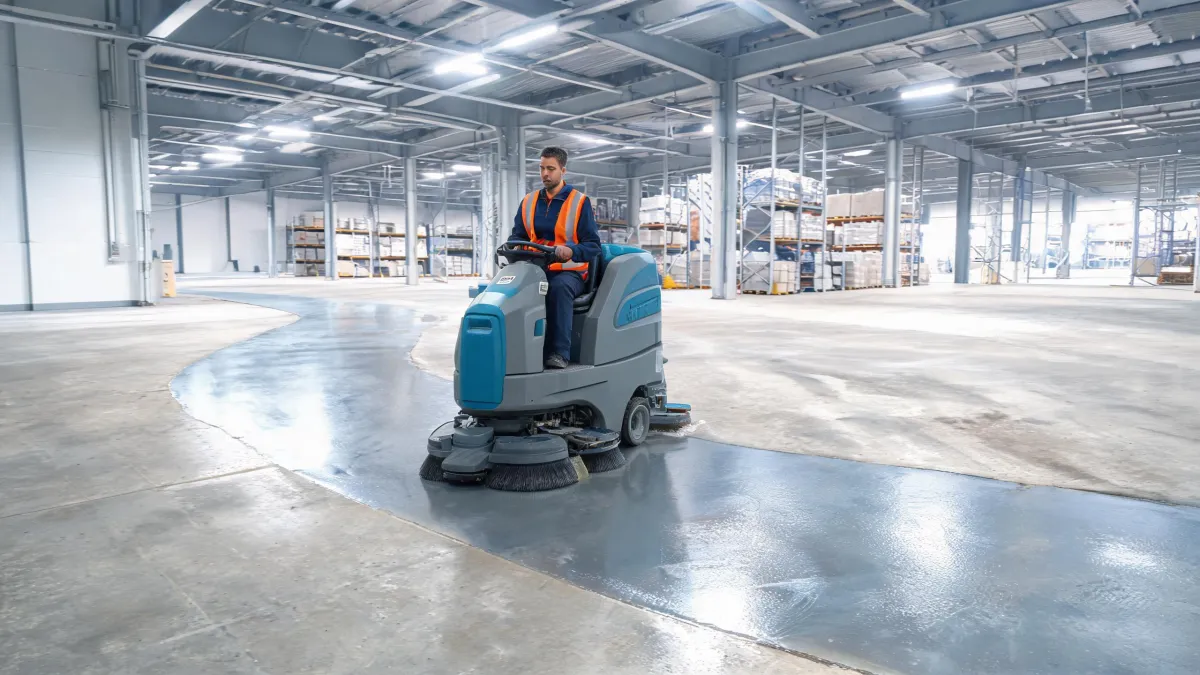
I've been handling equipment orders for a mid-sized manufacturing facility for about six years now. In my first year—2018, I think—I made a classic error: I bought the wrong floor scrubber for our main production hall. The specs looked fine on paper. The price was right. It was a Nilfisk SC250 battery scrubber dryer, a solid machine. The problem? I needed a ride-on. That mistake cost us about $3,200 in lost productivity, re-cleaning, and a week of production delays.
So, let me save you that headache. If you're trying to decide between the SC250 (or similar walk-behind scrubber dryers) and a ride-on model, here's the breakdown I wish someone had given me.
The Core Question: Coverage vs. Maneuverability
The real debate isn't about which machine is 'better.' It's about what you're cleaning. The SC250 is a nimble, battery-powered walk-behind. It's fantastic for tight spaces, around racking, and in areas with lots of obstacles. A ride-on, like a Nilfisk SC800 or a similar unit, is a different beast entirely. It's built for large, open floor plans where speed and coverage are the priority.
I'm not going to pretend one is universally superior. That's lazy. But I am going to show you exactly where the SC250 wins, where it loses, and why my failure to see those boundaries cost us real money.
Dimension 1: Cleaning Speed and Coverage
This is where the gap is biggest, and it's almost always the deciding factor. The SC250 has a 26-inch scrub path. A typical ride-on, like the Nilfisk SC800, has a 34-inch path. That 8 inches doesn't sound like much, but it changes everything.
- SC250: Covers about 26,000 sq ft per hour on a standard run.
- Ride-On (e.g., SC800): Covers about 50,000 sq ft per hour.
For a 40,000 sq ft production hall, the SC250 takes nearly 1.5 hours. The ride-on does it in under an hour. That's a 40% time difference. In our case, we had two 2-hour cleaning windows per shift. The SC250 couldn't finish, so we either rushed the job (bad cleaning) or let it spill over into production time. That spillover is what cost us—workers waiting for dry floors, forklifts being routed around wet zones.
Dimension 2: Operator Fatigue and Consistency
Honestly, I underestimated this. A walk-behind like the SC250 is physical work. Standing, walking, maneuvering. After two hours, even a fit operator gets tired. After four hours, quality drops. An operator on a ride-on is sitting. They're fresh for a full shift. The result? A ride-on delivers more consistent cleaning quality over a full day, not just a single hour.
So, if you have a 4-hour cleaning shift, the SC250 operator might be efficient for the first 90 minutes, but the last 90 minutes will be sloppy. The ride-on operator? Consistent. This was a big reason we switched. Your mileage may vary if you have short, irregular cleaning sessions, but for steady, long shifts, the fatigue factor is real.
Why the SC250 Still Makes Sense (And When to Choose It)
I'm not bagging on the SC250. It's a great machine, and we still use it in our warehouse aisles and packaging area. Here's where it's the right choice:
- Mixed environments: If your facility has a lot of obstacles, tight corners, or narrow aisles, a walk-behind is often easier.
- Smaller facilities: Under 15,000-20,000 sq ft of open floor, a ride-on's speed advantage is wasted.
- Multi-floor operations: Can't get a ride-on up the elevator? The SC250 is a no-brainer.
- Budget constraints: The SC250 is significantly cheaper upfront. But remember, I said 'upfront.' Factor in the labor cost.
The $3,200 Mistake: A Quick Recap
Here's what happened. I spec'd the SC250 for our main production hall because the price was about $4,000 less than a comparable ride-on. I didn't account for the fact that the cleaning window was too tight. The result? We had to pay a cleaning crew overtime to finish the job on weekends. Over six months, that overtime totaled about $3,200. Plus, we had one week where a wet floor forced a production line to pause for 45 minutes. That was the final straw.
The SC250 wasn't a bad machine. It was the wrong machine for the job. We eventually moved it to the warehouse and bought a used ride-on. The math worked out.
The Verdict: It's About the 'Time Certainty' Premium
This is where my core view comes in. The SC250 can clean your large floor. It just might not finish on time. In a production environment, might not is a risk.
Is the higher cost of a ride-on worth it? Not always. But if you have a strict cleaning schedule and a deadline you cannot miss (like a production start time), the time certainty you get from a faster machine is worth the premium. The uncertainty of a 'maybe' finish time is what cost us.
If you're dealing with a large, open area and a fixed cleaning window, do the math before you buy. Calculate the hourly labor cost, multiply it by the time difference, and see how long it takes for that difference to wipe out the initial price saving. I didn't. I learned the hard way.

Elise Marceau
Elise Marceau is an LED display and digital-signage systems analyst covering LED video walls, modular screens, transparent LED, control processors, and indoor or outdoor signage. She applies IEC 62368-1 safety principles while comparing pixel pitch, luminance, contrast, refresh rate, colour uniformity, viewing angle, ingress protection, power density, module serviceability, and signal redundancy. Her specification guides help integrators, venue operators, retailers, and procurement teams align viewing distance, ambient light, content format, installation access, electrical load, and lifecycle support.