Why I Stopped Buying Cheaper Cleaning Equipment (And What I Do Instead)
Stop Picking the Cheapest Option—It's Costing You More
I manage purchasing for a medium-sized facility—roughly $80,000 annually across maintenance, cleaning, and office supplies. For years, I chose the lowest-priced equipment on the market. Pressure washers, floor scrubbers, industrial vacuums—you name it. In every single case, the cheapest option ended up costing at least 35% more within 18 months due to repairs, downtime, and replacement parts.
That's not an exaggeration—I've tracked the numbers. Let me show you why.
My Experience with Low-Price Equipment
When I took over purchasing in 2022, my supervisor told me, 'Keep costs down.' I interpreted that as 'pick the lowest price.' I bought a $400 pressure washer from an online retailer. Within three months, the pump failed. The replacement part cost $180 and took two weeks to arrive (note to self: check parts availability before buying). Total cost: $580, plus the labor hours spent dealing with the breakdown.
The conventional wisdom is that you pay a premium for brand names like Nilfisk. In practice, from a TCO perspective, the premium is often lower than the cost of cheap equipment failures. I bought a mid-range Nilfisk pressure washer for $850 a year later. It's still running without a single service call.
What Cheap Equipment Actually Costs You (TCO Breakdown)
Here's the hard part: calculating total cost of ownership (TCO) isn't just about adding up repair bills. It includes hidden costs most buyers miss.
Maintenance and Parts Availability
Cheap pressure washers often use proprietary parts that are hard to find. Nilfisk pressure washer parts diagrams are publicly available (a quick search shows exploded views for every model). That means any technician can order the right part quickly. Generic brands? You're hunting on forums for a replacement seal that may not exist. I've learned this the hard way (ugh).
Downtime and Productivity Loss
When a floor scrubber breaks down mid-shift, you're not just losing the cost of repair. You're losing cleaning productivity. For a facility with 60-80 orders annually for cleaning supplies, a broken machine means subcontracted cleaning crews at $65/hour. That's a cost I didn't factor in until my first cheap scrubber failed.
Warranty and Support
A low-price cyclone dust collector might seem like a deal at $300. But if it catches fire (a real risk with hobby dust collectors in commercial settings), your insurance deductible could be $5,000. Reputable brands like Nilfisk carry UL certifications and offer real customer support. That's non-negotiable for commercial use.
How I Changed My Approach to Equipment Buying
After the pressure washer debacle, I implemented a simple three-question TCO checklist for every piece of equipment I buy:
- What's the total cost over 2 years? Include purchase price, estimated repair costs, parts shipping, and labor for downtime.
- How easy is it to get parts? If the manufacturer doesn't publish parts diagrams, I assume repair will be a nightmare.
- What happens if it fails during a critical job? If the answer is 'we have to subcontract,' that risk is too high.
Since switching to this framework, I've reduced equipment-related emergency spending by roughly 60%.
A Specific Case: Floor Scrubbers
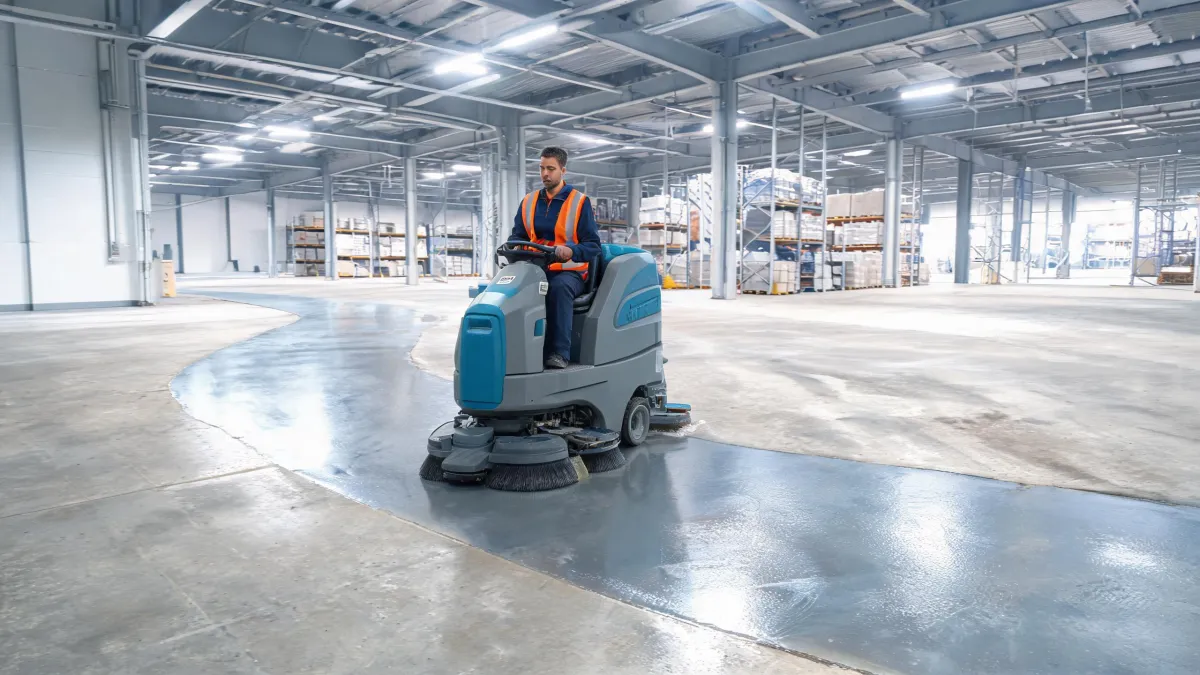
I needed two floor scrubbers for our 40,000 sq ft facility. The budget option was $2,800 each. The Nilfisk model was $4,200. All things being equal, the TCO worked out like this:
- Budget scrubber: $2,800 purchase + $950 estimated repair/year + $650 downtime cost = $4,400/year
- Nilfisk scrubber: $4,200 purchase + $250 estimated repair/year + $200 downtime cost = $4,650/year
The difference was only $250 per year. And the Nilfisk unit included a 2-year warranty versus 90 days on the budget option. To be fair, if you only need a scrubber for occasional light duty, the cheap one might work. For daily commercial use, the professional-grade equipment wins on TCO.
When the Cheapest Option Actually Works
I don't want to pretend cheap equipment is always bad. For infrequent or light-duty tasks, a budget pressure washer might be fine. Our office uses a $150 hobby dust collector for occasional woodworking cleanup—it works well enough. But if you're running commercial cleaning operations with 400 employees and multiple shifts, the risk of cheap equipment failures grows exponentially.
Granted, this requires more upfront work to calculate TCO. But I've found it saves significant budget and headaches over time. In my experience, the most expensive decision in purchasing is choosing without knowing the full cost.
(Updated January 2025. Prices reflect my purchasing experience and may vary by vendor and location.)

Elise Marceau
Elise Marceau is an LED display and digital-signage systems analyst covering LED video walls, modular screens, transparent LED, control processors, and indoor or outdoor signage. She applies IEC 62368-1 safety principles while comparing pixel pitch, luminance, contrast, refresh rate, colour uniformity, viewing angle, ingress protection, power density, module serviceability, and signal redundancy. Her specification guides help integrators, venue operators, retailers, and procurement teams align viewing distance, ambient light, content format, installation access, electrical load, and lifecycle support.