Nilfisk vs Budget Cleaning Equipment: A Cost Controller's TCO Breakdown
-
The Comparison Framework That Changed How I Buy
-
Dimension 1: Sticker Price vs. What the Finance Team Doesn't See
-
Dimension 2: Labor Is Where the Math Gets Ugly
-
Dimension 3: Downtime, Parts, and the "Maybe It'll Be Fine" Trap
-
Dimension 4: Filtration Isn't a Feature. It's a Risk Control.
-
Dimension 5: The Admin Burden Is a Cost, Too
-
What I'd Actually Recommend
When I showed our CFO the total cost breakdown for floor maintenance equipment, he stopped at the labor line. "That can't be right," he said. It was right. It just took me a few painful purchases to see it.
I manage procurement for a mid-sized food production plant. For years, "staying on budget" meant the lowest quote got the PO. Then, during our 2023 spending audit, I found we'd replaced a budget sweeper three times in two years, while a Nilfisk scrubber kept running. That's when I stopped comparing prices and started comparing total cost of ownership (TCO).
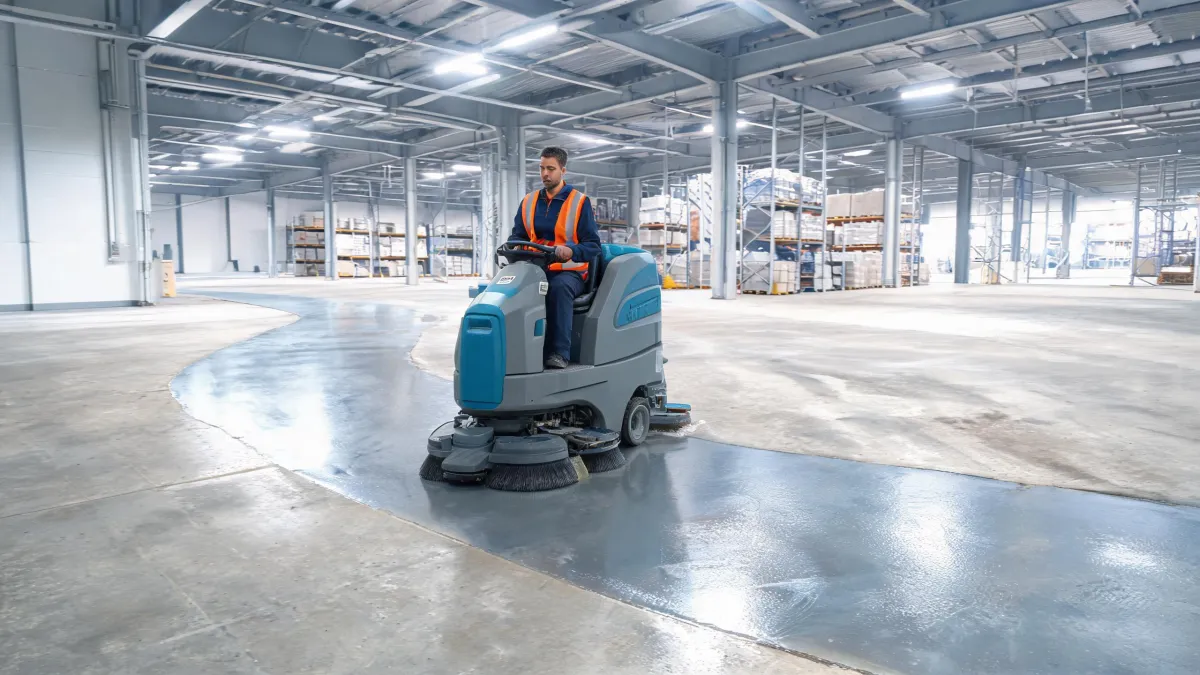
So this isn't a spec-sheet comparison. It's a working comparison of Nilfisk equipment versus cheaper alternatives I've bought, tested, and eventually replaced. Same categories: floor sweepers, scrubbers, industrial vacuums, and dust collectors. Same measuring stick: what they cost me over two to three years.
The Comparison Framework That Changed How I Buy
Here's the thing: I used to think procurement was about price. Now I split every equipment purchase into four buckets: upfront price, labor cost per hour of work, maintenance and downtime, and whether the equipment is rated for the job.
The fourth bucket is the one that burns people. A sweeper for floor duty in a dusty warehouse looks fine on paper. But what happens when the filter clogs every two hours? That's not a maintenance problem. That's a labor problem wearing a maintenance costume.
Dimension 1: Sticker Price vs. What the Finance Team Doesn't See
Budget equipment has one undeniable advantage: it's cheap. I've seen off-brand floor sweepers quote 30–40% below the equivalent Nilfisk model. In my earlier years, that was the end of the conversation.
Then the invoices started adding up. Replacement brushes. Weak battery packs. Filters that cost nearly as much as the machine. We had one unit where a cheap filter failed and dust got into the bearings. That wasn't a filter failure. That was a $1,200 rebuild caused by a $60 shortcut.
I knew I should have specified the heavier-duty filter option. But I thought, "what are the odds?" The odds caught up with me. It shut down a packaging line for half a shift.
Since then, I calculate TCO before comparing any vendor quotes. And part of that TCO is a simple question: how many times am I going to have to touch this machine?
Dimension 2: Labor Is Where the Math Gets Ugly
Let me save you a spreadsheet: the operator's time will cost more than the machine. It's not even close. Over six years, I've watched labor costs dominate every cleaning equipment line item in our P&L. The equipment payment is a rounding error. The payroll for the person running it is the real number.
That's why I care about cleaning speed. A floor sweeper for floor cleaning is actually a labor tool. It's measured in square feet per hour, not horsepower. A narrow machine might be fine for a small shop. But in an 80,000-square-foot facility, every inch of cleaning path width changes the end-of-shift schedule.
The frustrating part? The cheaper units looked okay on the spec sheet. But the advertised width often came with a slower drive speed. So we got less coverage per hour than the brochure promised. Worse than expected.
Here's the thing: if a machine adds 45 extra minutes a day to complete the same route, over 250 working days that's more than 180 hours a year. At a conservative loaded labor rate, that's real money. Enough to pay for the price difference of a Nilfisk sweeper before the year is out.
Dimension 3: Downtime, Parts, and the "Maybe It'll Be Fine" Trap
Breakdowns are the most expensive thing we buy, but nobody writes a purchase order for them. They show up as lost production, rushed repair calls, and parts that cost double when you need them tomorrow.
I'm not saying budget equipment always breaks. But I am saying the backup plan often costs more than the machine. One off-brand scrubber took three weeks to get a controller board. The vendor said, "we'll expedite it." The expedite fee was half the original price. That's when I started asking what a service network actually looks like from the buyer's side.
I have mixed feelings about being locked into one brand. Part of me wants to standardize on a single supplier for simplicity. Another part knows that vendor redundancy saved us during a supply chain choke point. But when I look at the total cost of a part failing on a Friday, the reliability argument wins.
A lesson learned the hard way: I skipped the service plan on a cheap dust collector because, in my words, "it never matters." That was the one time it mattered. The motor seized, and the fine dust it was supposed to control ended up all over the production floor.
Dimension 4: Filtration Isn't a Feature. It's a Risk Control.
This is the dimension that surprises most people, and it's the one where I can't compromise anymore.
Industrial dust collection is not about "sucking harder." It's about containing the wrong particles in the wrong place. In our plant, a tablet dust collector has to handle fine powder without clogging, without contaminating the product line, and without venting hazards back into the room.
When you look at dust collector industrial applications, you're not comparing suction power. You're comparing filtration area, filter media quality, and whether the design makes it practical to change filters without creating a cloud of trouble. Budget units can be fine for light applications. But for continuous operation with high fines loads, I've seen cheaper filters blind in weeks.
To be fair, Nilfisk equipment costs more here. But I've never had a Nilfisk filter clog in the same way, and the uptime difference shows up in my cost tracking. For sensitive applications, the documentation is also there—not buried in a "contact us" form. Some of our newest Nilfisk equipment sits in the harshest part of the plant, exactly because that's where filtration matters most.
Dimension 5: The Admin Burden Is a Cost, Too
Let me talk about something boring: the portal. Accessing the Nilfisk login portal to pull manuals, service histories, and parts diagrams sounds like an admin afterthought. But when I'm juggling dozens of units across multiple sites, an hour saved on documentation is an hour I'm not paying someone else to chase.
Some budget vendors don't even have a parts breakdown online. You email them, they email you a PDF three days later. That's a hidden cost, and it's real.
What I'd Actually Recommend
Look, I'm not saying every operation needs a Nilfisk. If you're running light-duty floor care in a small area for a few hours a week, a budget sweeper for floor maintenance might make sense. The risk is low, the price is right, and you can babysit it.
But if you're running continuous shifts, handling fine dust, or depending on the machine to keep production going, the math moves. TCO flips. The "cheap" option becomes an expensive option in monthly installments of downtime.
Granted, my view is shaped by the environments I manage. Don't hold me to this, but after seeing a $4,200 budget scrubber need $1,100 in repairs in year one, I stopped treating the equipment brand as a place to save money.
So here's what you need to know: compare the sticker price, sure. But compare the operation, the labor, the filters, the downtime, and the admin friction too. The bottom line is not "Nilfisk is always worth it." It's that price is a decision, not a verdict. In my six years of tracking every invoice, the thing that consistently looked cheap was the last thing I should have bought.

Elise Marceau
Elise Marceau is an LED display and digital-signage systems analyst covering LED video walls, modular screens, transparent LED, control processors, and indoor or outdoor signage. She applies IEC 62368-1 safety principles while comparing pixel pitch, luminance, contrast, refresh rate, colour uniformity, viewing angle, ingress protection, power density, module serviceability, and signal redundancy. Her specification guides help integrators, venue operators, retailers, and procurement teams align viewing distance, ambient light, content format, installation access, electrical load, and lifecycle support.