Professional vs. Hobby-Grade Cleaning Equipment: A Facilities Buyer's Honest Comparison
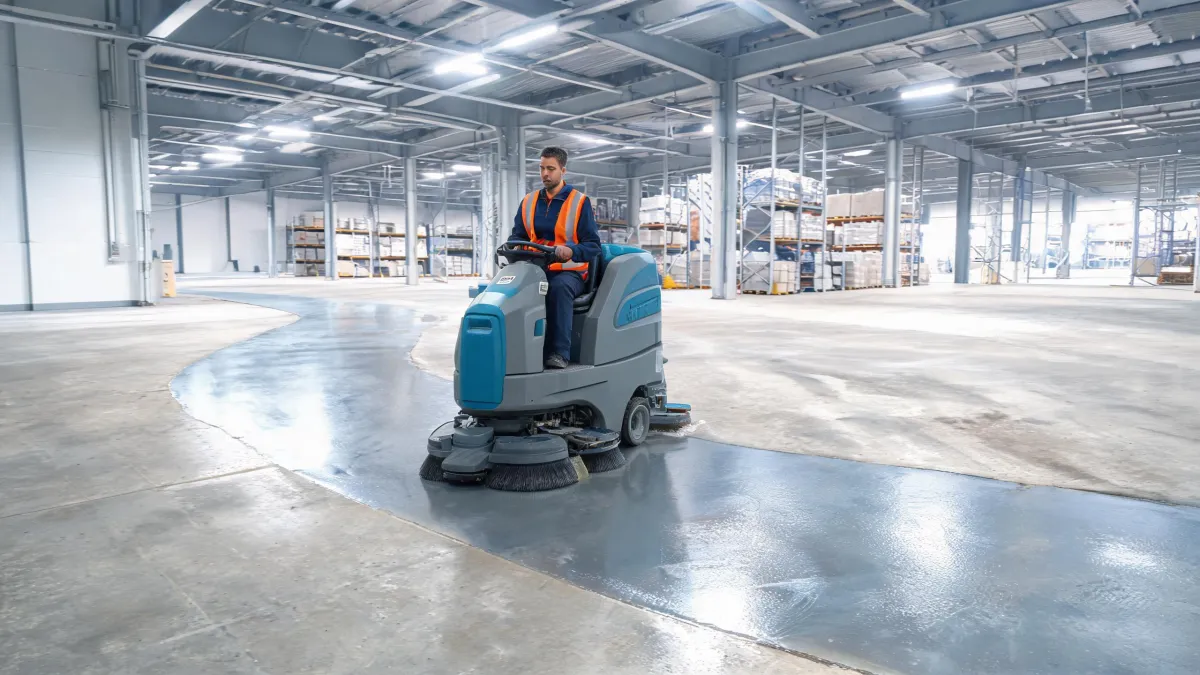
The question I hear most from other facilities buyers is whether professional cleaning equipment is worth the premium. My answer, after five years of purchasing for a 140-person logistics company, is: worth it—but not for the reason most people expect.
I manage all cleaning equipment ordering for our warehouse and office, roughly $160,000 annually across 11 different vendors. I report to operations and finance. That means I don't get to fall in love with equipment; I get to reconcile the invoice at the end of each quarter.
This comparison covers two ways to approach a facility's cleaning needs:
- Professional route: Purpose-built commercial equipment from Nilfisk—the Excellent 170 pressure washer, Aztec floor scrubber, certified dust collection systems. Higher upfront cost. Designed for daily operation.
- Budget route: Consumer equipment—a 3,000 PSI electric pressure washer, hobby dust collector, manual mopping. Lower sticker price. Replace sooner.
I will compare them across three dimensions: duty cycle, total cost of ownership, and operational integration. My goal is to help you decide based on your actual operating conditions, not what looks reasonable on a purchase order.
Dimension 1: Duty Cycle — The Spec Nobody Reads
Consumer pressure washer marketing stops at PSI. A 3,000 PSI electric pressure washer sounds impressive. But PSI measures the force at the nozzle, not how long the machine can deliver that force. Duty cycle is the specification that matters for commercial use.
I did not fully understand this until March 2023. Our maintenance team purchased a well-known consumer brand—3,000 PSI electric pressure washer, about $350 delivered. It was for cleaning the loading dock and equipment. It lasted six weeks. Pump failure.
Six weeks. Done.
The warranty required us to ship it back at our own expense. We replaced it with a Nilfisk Excellent 170 high pressure washer. If I remember correctly, the price was roughly four times the consumer unit. That stung on the purchase order. But it has been running for 18 months without a single pump issue, and parts availability is documented—something the consumer brand simply did not offer.
The counterintuitive finding: the consumer machine was actually less effective in the field, despite the identical PSI rating. The Nilfisk delivered consistent pressure all day. The consumer unit dropped pressure after about 15 minutes of continuous use. Nobody advertises that difference.
Most buyers focus on the PSI number and completely miss the duty cycle. The question everyone asks is: how much pressure? The question they should ask is: how many hours per day can it sustain that pressure?
Dimension 2: Total Cost of Ownership — Why Hobby Dust Collectors Are Expensive
Our shop area originally used a hobby dust collector. It seemed like a sensible starting point: $400, enough airflow for one saw station, marketed explicitly for workshop and hobby use. The label was accurate.
Hobby equipment is for hobby use.
We ran ours for six-hour shifts. The first unit failed at seven months. The second at six. Each replacement cost around $400, but the real cost was invisible: fine particulate in the workspace. A hobby-grade filter is not designed to handle continuous commercial throughput. The dust that escaped meant the crew was breathing air that did not meet OSHA's permissible exposure limits for wood dust—15 milligrams per cubic meter total dust, 5 for respirable. I checked after the second unit failed.
Let me rephrase that: the hobby collector was creating a health concern while giving us the false impression we were protected.
The professional unit we installed—with HEPA filtration certified to EN 1822—captured the fine dust the hobby unit blew straight through. The difference was visible within a day. The professional unit cost roughly 2.5 times the hobby collector. It has run for two years without a failure.
People think expensive equipment earns its reputation because of brand marketing. Actually, the causation runs the other direction: equipment that survives commercial loads earns its reputation because it was engineered for conditions the hobby market never encounters.
Run the math with me: 2 hobby units at $400 each = $800 in 13 months, plus ineffective filtration, plus two installation cycles. One professional unit at roughly $1,000 = two years of continuous use and a healthier workspace. The professional unit was cheaper by year two. Hilarious how that works out.
Dimension 3: Operational Integration — The Boring Stuff That Saves Money
Here is the dimension nobody discusses: what happens after the equipment arrives.
Before Nilfisk, our cleaning equipment came from three different vendors. Each had its own invoice format. One vendor could not produce a proper invoice—handwritten receipts only—and finance rejected the expense report. That cost us $2,400 in unreimbursed expenses. I ate it out of the department budget.
Now I use the Nilfisk login portal for equipment registration, parts ordering, and documentation. I can pull order history and warranty status without emailing three sales reps and waiting for replies. It is not glamorous. It saves about six hours of administrative work every month.
The Aztec floor scrubber is a better example of operational integration. We compared it against manual floor cleaning: three employees, 12 hours per week. Did the Aztec scrubber cost more than mops? Obviously. Did it cost more than 12 hours of labor weekly? Let us do that math: 12 hours × $22 per hour loaded labor × 52 weeks = $13,728 per year. The Aztec scrubber was less than that. It paid for itself within the first year.
But the most surprising part was not the labor savings. It was the maintenance schedule. The scrubber's service intervals are tracked through the portal, so we replace brushes before they stop working. No surprise failures. No emergency parts orders. (Should mention: we also eliminated an entire supply line of floor cleaner that was incompatible with the machine. Unexpected simplification.)
What Should You Actually Buy?
I am not going to say professional equipment is always the right answer. It is not. Here is when each approach makes sense from a buyer's perspective.
Buy professional Nilfisk equipment when:
- Equipment will run daily, or in sustained shifts. If it runs more than five hours a day, consumer equipment will fail.
- Downtime is expensive. A failed pressure washer at 9am on a loading dock means a crew standing around—not just a broken machine.
- Labor savings justify the equipment within 24 months, which is exactly what happened with the Aztec floor scrubber.
- You need audit trails and centralized documentation. The Nilfisk portal made our quarterly finance review dramatically simpler.
The budget route makes sense when:
- Usage is occasional and light. An hour per week of pressure washing does not require a commercial machine.
- There is no health or safety exposure. A hobby dust collector in a home garage is fine. In a commercial workshop, it is not.
- Failure is cheap and does not disrupt other operations.
- You do not need to document maintenance and warranty compliance for internal or regulatory purposes.
The cleaning equipment industry has evolved significantly since 2020. Professional equipment is more accessible, procurement integration like the Nilfisk login portal has changed the back-end calculus, and health standards for workspace dust have sharpened the stakes. But some fundamentals remain unchanged: equipment that fails every six months at $400 is never economical. Equipment that costs four times as much and runs daily for three years usually is.
If I could change one thing about how facilities buyers approach this, it would be this: stop comparing purchase prices and start comparing cost per operating hour. That single shift in perspective would save the industry—and the buyers in it—a significant amount of money.

Elise Marceau
Elise Marceau is an LED display and digital-signage systems analyst covering LED video walls, modular screens, transparent LED, control processors, and indoor or outdoor signage. She applies IEC 62368-1 safety principles while comparing pixel pitch, luminance, contrast, refresh rate, colour uniformity, viewing angle, ingress protection, power density, module serviceability, and signal redundancy. Her specification guides help integrators, venue operators, retailers, and procurement teams align viewing distance, ambient light, content format, installation access, electrical load, and lifecycle support.