Scrubber Dryer vs Mop Floor Scrubber: What 400+ Emergency Calls Taught Me
-
11 PM, 3 cm of Water, and a 7 AM Deadline
-
Why I'm the One Comparing These
-
Dimension 1: Speed — The Metric That Dwarfs Everything Else
-
Dimension 2: Dryness — Where Squeegees Are Actually Everything
-
Dimension 3: Cost — The Payback That Surprised Me
-
Dimension 4: Reliability Under Pressure
-
Dimension 5: Completeness — No Single Tool Handles Everything
- Which One Should You Buy?
11 PM, 3 cm of Water, and a 7 AM Deadline
In March 2024, a distributor called. A burst pipe had flooded their 8,000 sq ft warehouse floor, and the insurance adjuster needed it clean and dry before the morning shift at 7 AM. We had about five usable hours once we arrived on-site.
That job—and the 400+ emergency call-outs I've coordinated over three years—taught me more about the difference between a mop floor scrubber approach and a proper scrubber dryer floor cleaner than any equipment brochure ever did. If you're making that same choice, here's the comparison nobody gives you upfront.
Look, I'm not going to tell you mops are useless. They have a place, and I'll get to that. But for anyone running a facility or cleaning operation where time matters, the gap between these two approaches is enormous—and most people underestimate it until they measure it on a real job.
Why I'm the One Comparing These
I run a cleaning operation that handles time-critical work: post-construction cleanups, flood response, event prep, weekend store resets. Clients call at odd hours and expect results by sunrise. In that environment, you learn fast which tools hold up under pressure.
For the past three years, I've tracked the two common approaches in commercial cleaning:
- Approach A — Mop and bucket: what most crews rely on, especially in smaller facilities.
- Approach B — Scrubber dryer: a walk-behind or ride-on machine that scrubs, washes, and squeegee-dries in one pass.
The numbers come from real jobs, real invoices, and more than one equipment mistake. My experience is mostly in warehouses, production floors, and hotel back-of-house areas. If you're cleaning a 500 sq ft boutique or a medical clinic, some of this might not apply—and I'll flag that where it matters.
Dimension 1: Speed — The Metric That Dwarfs Everything Else
In an emergency, time is the entire game. Missing a 7 AM deadline doesn't earn a polite apology. The distributor's lease carried a $50,000 penalty clause for delaying operations. That makes equipment choice a risk decision, not just a cost decision.
Here are the numbers from our tracked jobs:
- Mop + bucket: a capable mopper covers roughly 150–250 sq ft per hour. Add wringing, bucket changes, and moving obstacles, and realistic output lands closer to 150. Eight thousand square feet with mops means a six-person crew working 6–8 hours. Then the floor still needs 30–60 minutes to dry.
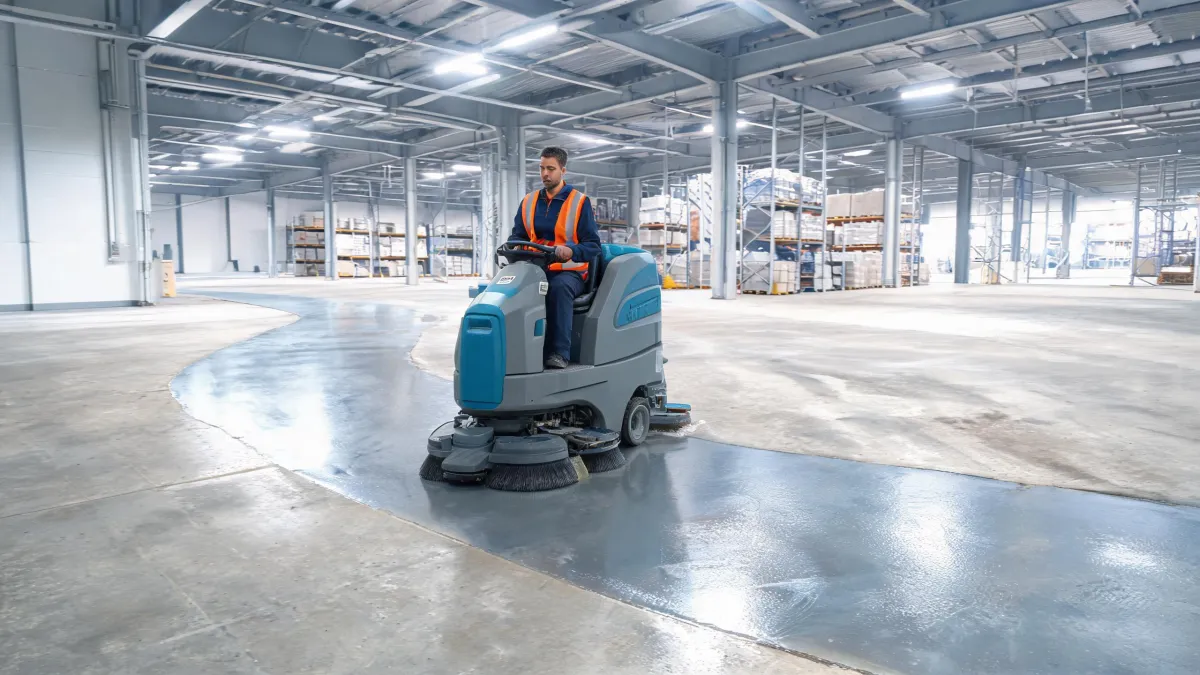
- Scrubber dryer: a walk-behind unit covers 2,000–4,500 sq ft per hour—one pass, one operator. On the March flood job, our Nilfisk walk-behind scrubber cleared the entire 8,000 sq ft in three hours, including setup. The floor was dry enough to walk on when the morning shift arrived.
The mop approach took five times longer and left a damp floor. Not ideal, but that was the baseline before we invested in the machine.
One thing I tracked separately: fatigue. A mopping crew loses output after the third hour. Elbows, backs, motivation. The machine doesn't. By hour six of a mop job, the gap widens even further.
Dimension 2: Dryness — Where Squeegees Are Actually Everything
Ask any facilities manager what they care about after a floor is cleaned, and the answer isn't "it looks clean." It's "is it safe to walk on?"
Mops deposit water, move it around, and absorb some of it. Even with solid wringing technique, a mopped floor stays damp for 30 to 60 minutes. In a warehouse or hotel kitchen, that's a slip-and-fall exposure that never shows up on the invoice—until it does.
A scrubber dryer extracts the wash water as it goes, using a floor scrubber squeegee system. The squeegee is the difference between "clean and dry in one pass" and "machine that leaves puddles behind." I check squeegee blades the same way a mechanic checks tires: worn blades cause streaking, reduce water recovery, and turn a $10,000 machine into a disappointing wet mop.
Honestly, I'm not sure why some operators still choose mops for large areas. My best guess is habit plus the perception that machines are complicated. But the dry-floor result is not close. The squeegee alone shifts the safety equation completely.
Dimension 3: Cost — The Payback That Surprised Me
Let's talk numbers, because "buy a machine" is easy to say and harder to fund.
- Mop setup: $50–100 per station—bucket, wringer, mops, wet-floor signs. Affordable. Nobody debates the purchase price of a mop.
- Scrubber dryer: roughly $3,500–12,000+ depending on model and manufacturer (as of January 2025, at least). Our Nilfisk walk-behind unit sat at the upper-middle of that range, and I got pushback from my business partner on the initial investment.
Here's what convinced him: we ran the machine almost daily. Each job replaced 2–3 labor hours with 30–45 minutes of machine time. At a blended labor rate of around $28/hr, the machine was saving $60–90 per job. With a typical week of 5–7 jobs, the payback period landed at about four months.
The numbers said any scrubber dryer would work. My gut said don't buy the cheapest one. When we tested the budget option, it had a "technically compatible" squeegee system that leaked on every pass—and it cost us two jobs before we replaced it. Turns out my gut had caught something the spec sheet didn't.
A caveat: if your facility is small or your cleaning frequency is low, the payback math doesn't work. My experience is based on daily-use operations. If you're mopping a 1,000 sq ft shop two evenings a week, this comparison doesn't apply the same way.
Dimension 4: Reliability Under Pressure
This is the dimension no one considers until the machine stops mid-job.
A mop never breaks down. That's its quiet advantage. A scrubber dryer, though, is a machine with a battery, a motor, and a pump. Things can fail.
The difference—and this is where brand matters—is how often that happens and what it costs when it does. In my first year, I bought cheap used equipment to save about $3,000. Mid-clean, with a hotel lobby that needed to be ready before check-in, the budget machine's pump gave out. We scrambled with mops for six hours. The hotel made the deadline, but barely. We replaced that unit with a new Nilfisk machine and never looked back. That's when we implemented our "buy right the first time" policy.
The Nilfisk units, in the shop at least, have needed only routine maintenance. I can't speak to every brand, but the reliability gap between the budget unit and the professional unit felt like two different industries.
Dimension 5: Completeness — No Single Tool Handles Everything
Here's the conclusion I didn't expect: neither the mop nor the scrubber dryer wins the "complete solution" category. Both miss stairs, ledges, and awkward corners. Neither removes fine dust from overhead surfaces.
That's where the rest of our backup arsenal comes in:
- Pressure washer: for dock areas and outdoor surfaces where scrubbing floods back in. The best Nilfisk pressure washer for commercial use is, in my experience, the premium triplex-pump models—they're the ones that survive daily abuse without the pump seals giving out at the worst possible time (which, honestly, was the only time they gave out). Budget units under our schedule didn't last six months.
- Industrial vacuum: after a flood or construction cleanup, fine dust settles after the floor is done. The Nilfisk VHS010N1 HC mini industrial vacuum is what we carry for those touch-point jobs. Compact enough for one person to haul up stairs, efficient on fine dust, and HEPA-certified—our insurance now requires that on post-construction work.
So the real choice isn't just mop versus machine. It's whether you're equipping yourself for the range of emergencies that will actually show up.
Which One Should You Buy?
Here's a practical framework I use with clients who ask this question.
Mop and bucket wins when:
- Your hard surface area is under 1,000 sq ft.
- Floors are tile with grout lines or heavily textured surfaces that scrubber dryers can't reach effectively.
- You have one cleaner and a part-time schedule.
- Emergency cleanings are rare enough that "fast" doesn't matter.
Scrubber dryer floor cleaner wins when:
- You're maintaining 5,000+ sq ft of smooth sealed flooring.
- Cleaning happens daily or high-traffic operations need consistent turnaround.
- Dry floors and safety compliance matter more than upfront cost.
- You've been called at 11 PM to fix what mops can't handle. Exactly what we needed.
If you land in the middle, consider the hybrid route: keep mops for edges and spill response, invest in the machine for the main floor. That's not indecision—it's matching tools to the job.
So when you compare mop floor scrubber costs against a scrubber dryer floor cleaner, don't just compare the purchase price. Compare what each approach costs when the deadline is real, the floor needs to be dry, and the client's operation—and your reputation—is on the line. That's the comparison that actually matters.

Elise Marceau
Elise Marceau is an LED display and digital-signage systems analyst covering LED video walls, modular screens, transparent LED, control processors, and indoor or outdoor signage. She applies IEC 62368-1 safety principles while comparing pixel pitch, luminance, contrast, refresh rate, colour uniformity, viewing angle, ingress protection, power density, module serviceability, and signal redundancy. Her specification guides help integrators, venue operators, retailers, and procurement teams align viewing distance, ambient light, content format, installation access, electrical load, and lifecycle support.