The 8-Point Checklist I Use Before Committing to Any Nilfisk Machine
-
When This Checklist Applies
-
Step 1: Name the Contaminant Before You Name the Machine
-
Step 2: Walk the Floor Before You Commit
-
Step 3: Read the Manual Before You Talk to Anyone
-
Step 4: Check the Dust Classification (Pharma and Lime)
-
Step 5: Verify the Battery and Charging Setup
-
Step 6: Lock Down Commissioning Before Delivery Week
-
Step 7: Confirm Service Response and Parts Availability
-
Step 8: Build the Contingency Plan in Writing
-
Common Mistakes and What to Do Instead
When This Checklist Applies
If you're specifying Nilfisk cleaning equipment—a scrubber dryer, an industrial vacuum, or a dust collector—and you don't have weeks to deliberate, this one's for you. In my role expediting equipment for manufacturers and warehouse operators, I've processed 200+ rush orders in the past six years. Most of them didn't need to be rush orders. The ones that failed failed for the same handful of reasons, over and over.
This is the checklist I use when time is short and the margin for error is thinner. It won't make you an equipment engineer. It'll make sure you catch the expensive mistakes before they catch you.
Step 1: Name the Contaminant Before You Name the Machine
Most teams do the opposite. They say "we need a Nilfisk machine" before they can describe what they're actually dealing with. That's backwards.
Nilfisk machines cover a broad range: scrubber dryers, sweepers, industrial vacuums, dust collectors. That breadth is an advantage, but it also means more ways to pick the wrong one. Start with the material. If you're collecting lime dust, you're dealing with something alkaline, abrasive, and prone to moisture absorption. If you're dealing with pharmaceutical powder residues, that's a compliance issue first and an engineering issue second—containment, filter class, cleanability, cGMP expectations.
A general-purpose vacuum isn't a pharma-rated system. Treating it like one is how integration projects end badly (I've watched it happen, unfortunately). Write down what you're collecting, how much per shift, and what the operator exposure limits are. If you're not sure, pull the safety data sheet and get a process engineer to confirm. That's not bureaucracy. It's the cheapest insurance you'll buy all year.
Step 2: Walk the Floor Before You Commit
Walk the actual floor before you pick the machine. Doorway widths, aisle turning radii, ceiling heights, drainage locations. All of it.
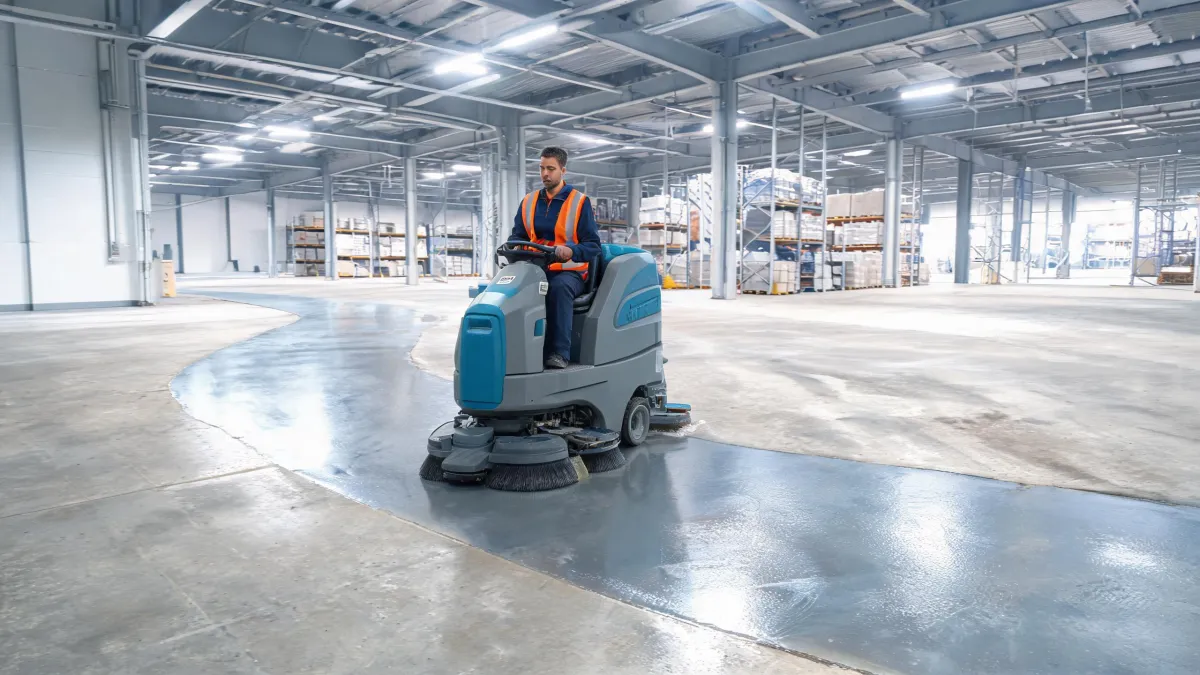
A battery industrial riding floor scrubber looks great on paper. But if the maintenance bay doorway is 82 inches and the machine is 86 inches with the brush deck down, you have a problem. I found that out with a client in 2023—on delivery day, in front of a plant manager whose expression I'll never forget. It took three wrong-sized deliveries before I made the site walk a non-negotiable step. Every one of those was avoidable.
The right platform for your space might be a walk-behind scrubber like the Nilfisk SC401. It might be a riding unit. It might be two machines for two different zones. You can't determine that from a website. You have to measure.
Step 3: Read the Manual Before You Talk to Anyone
This sounds ridiculous, but I've seen three significant procurement errors that would've been caught by a 30-minute read of the manufacturer's documentation.
Say you're evaluating a battery scrubber dryer like the Nilfisk SC401. Download the SC401 manual PDF from Nilfisk's website (it's been up there since at least mid-2024). Check the runtime, charge time, cleaning width, water tank capacity, and noise rating. Those numbers define what the machine can actually do in your environment. Most people skip this and rely on the sales rep. The sales rep is nice. The manual is accurate.
Pay special attention to what the manual says the machine can't do. That's the section that saves you.
Step 4: Check the Dust Classification (Pharma and Lime)
If your application involves dust collection, the material classification trumps every other consideration. This is the step that gets skipped the most, and it's the one with real safety and compliance implications.
For a pharma dust collector, ask: what filter class do you need? HEPA? ULPA? Is the system cleanable for product changeover? Does it meet the expectations of your health authority? In the US, that means being ready to defend your setup under cGMP. As of January 2025, the regulatory baseline hasn't shifted dramatically, but you should always have the vendor document compliance for the current period.
For a lime dust collector, the priorities are different. Lime isn't combustible the way metal dust is, but a concentrated cloud of fine lime dust can still deflagrate—same risk category that NFPA 654 covers for combustible particulate solids. And on a day-to-day level, lime is hygroscopic, which means it absorbs moisture and crusts over. If your filter media and air-to-cloth ratio aren't sized for that, the system fails in months, not years. I still kick myself for not catching that on a 2022 installation, where the client's filter bags turned into solid tubes after a humidity spike.
Send the vendor your dust data: particle size distribution, moisture content, bulk density. They can't select filters without it.
Step 5: Verify the Battery and Charging Setup
Battery-powered equipment needs a charging ecosystem, not just a battery. Before you commit to a battery industrial riding floor scrubber or the SC401, check what voltage exists near the maintenance bay, whether the charger is included, and how long a full charge takes.
A standard charger can take 8–10 hours. A fast charger changes the math significantly. If you run two shifts, that gap is business-critical. I've seen a $30,000 scrubber sit idle for three days because nobody verified there was a compatible outlet within 50 feet. It wasn't an expensive fix. It was an avoidable one.
The SC401 manual (that PDF from Step 3) specifies charger requirements clearly. Read that section twice.
Step 6: Lock Down Commissioning Before Delivery Week
Arrival is not the finish line. A machine that arrives in a crate is not a working machine. Installation, battery connection, testing, and operator training all take time—and if they're not scheduled, they don't happen.
In March 2024, a client's production line was going live in 36 hours. Their floor scrubber had arrived the day before. The dealer's scheduled installation was two weeks out. We paid $1,200 for a certified third-party tech to assemble and commission it overnight. Worth it—but avoidable if commissioning had been in the original purchase conversation.
Ask at the point of order: Who installs? Who trains my operators? Who commissions and tests? What happens if commissioning fails?
Step 7: Confirm Service Response and Parts Availability
Every machine eventually needs a filter, a brush, or a squeegee blade. What matters is how fast you can get one.
Call the local distributor before you commit and ask: What do you stock locally? What's the lead time on consumables for this model? What does service response look like in my area?
How you respond when the machine is down determines whether you're down for one day or five. I do not mean to suggest that every distributor is slow. I mean that you should verify, not assume.
Step 8: Build the Contingency Plan in Writing
Plan for the delivery to slip and the install to stretch. What's your backup? Is rental equipment available locally? What level of downtime is acceptable before customer deadlines break?
I started requiring contingency plans after a 2023 episode: a vendor quoted three days, the equipment landed ten days late, and the client's contract carried a $6,000-per-day penalty. Their plan was hoping the vendor's estimate was accurate. Hope is not a strategy.
Common Mistakes and What to Do Instead
Here's the short version of everything above, for the day you only have ten minutes:
- Spec'ing without a site walk. Measure the doorways and turning space first.
- Underestimating charge time. An 8-hour charge on a 4-hour runtime doesn't support two shifts.
- Assuming the standard filter works for your material. Send your dust data and make the vendor justify the selection.
- Forgetting that installation, testing, and training are separate workstreams. Confirm them in writing.
- Skipping the manual PDF. The SC401 manual and every other Nilfisk manual are available online—read them before the sales call.
There's something deeply satisfying about watching a properly specified machine—a Nilfisk scrubber humming through its first full shift, a dust collector running steady through a humidity spike—knowing it was set up right from day one. Five minutes of verification beats five days of correction. That's the whole philosophy.

Elise Marceau
Elise Marceau is an LED display and digital-signage systems analyst covering LED video walls, modular screens, transparent LED, control processors, and indoor or outdoor signage. She applies IEC 62368-1 safety principles while comparing pixel pitch, luminance, contrast, refresh rate, colour uniformity, viewing angle, ingress protection, power density, module serviceability, and signal redundancy. Her specification guides help integrators, venue operators, retailers, and procurement teams align viewing distance, ambient light, content format, installation access, electrical load, and lifecycle support.