Cleaning Equipment Is Production Equipment: What I Learned From 130 Emergency Calls
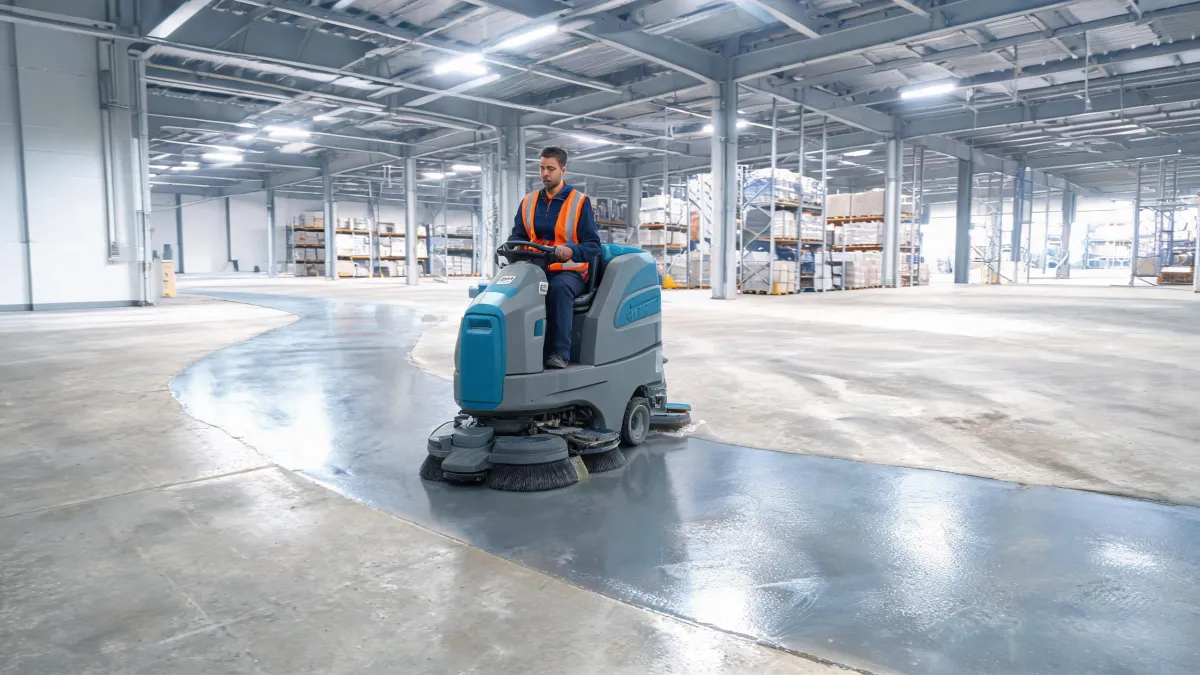
I'm the person you call when a floor scrubber goes down two days before a customer walkthrough. Since 2022, I have coordinated more than 130 rush equipment requests for facilities that suddenly needed dust collection, commercial vacuum, or floor-cleaning capacity on short notice. My conclusion is straightforward: cleaning equipment is production equipment. Treating it as a janitorial afterthought is how you end up paying emergency rates right before a deadline.
The organizations that handle this well aren't always the ones with the newest machines. They're the ones that have already decided that speed and reliability matter more than the sticker price. They understand the real cost of cleaning, and it's not the chemical or the machine payment.
Argument 1: Time Savings Are the Real Return
In March 2024, a packaging plant called me on a Wednesday afternoon. Its only floor scrubber had stopped working, and the unannounced customer audit was scheduled for Friday morning. The normal lead time for a replacement was two weeks. That plant had two options: cancel the audit or pay for an expedited delivery and installation. We sourced a machine and had it running in less than 36 hours.
That isn't because I'm a miracle worker. It's because a production facility with no floor scrubber becomes an efficiency disaster. Dust and debris on a floor don't stop production by themselves, but they slow every cart, every lift truck, every person walking across the floor. And once they're tracked into work cells, they create quality headaches too.
The same pattern shows up in routine cleaning. On a 30,000-square-foot warehouse floor, a dedicated HHQ floor scrubber can finish the job in about two hours with one operator. A walk-behind unit takes twice as long. A wet-mop operation can eat most of a shift. If your cleaning method costs four extra labor hours every week, that difference eventually pays for the better machine.
Argument 2: Dust Is a Risk Problem, Not Just a Housekeeping Problem
Not every rush request is about a floor. Dust collectors fail, too. In one woodworking shop, a dust collection problem grounded an entire line because fine dust settled on motors and electrical panels. That shop needed source capture at the point where dust is made, not another person walking around with a wand.
That is where a source-capture unit such as a Uni-Wash dust collector earns its place. Dust collectors are not all equal—or rather, not all of them handle fine process dust with the same reliability. According to NFPA 652, facilities handling combustible dust should complete a dust hazard analysis. In facilities that generate wood dust or metal dust, the collector is part of the fire and explosion prevention system, not an optional accessory.
Portable machines can support that plan. The DeWalt dust collector wet/dry vacuum DXVA00-1500 is a solid tool for cleaning around machinery and catching tool dust. But in a continuous production setting, it is not a replacement for a fixed dust collector sized to the operation. The difference is less about brand and more about duty cycle and airflow.
Argument 3: Support Infrastructure Is the Real Specification
Now comes the part where I state a preference. I usually specify Nilfisk cleaning equipment for continuous-use environments. I didn't always feel that way. Earlier in my career, I approved a cheaper line of commercial vacuums because the motor amperage looked close to the premium brand. I assumed that suction is suction. It was not. The filters clogged faster, the motors ran hot, and my maintenance supervisor was not shy about telling me. The replacement filters and overtime cost me close to $800—on a project that was supposed to save money.
The same reasoning pushed me toward Nilfisk commercial vacuum cleaners for facilities that need consistent pickup of fine dust, dry debris, or occasional liquid spills. In my experience, the price difference is small compared to the cost of a machine sitting offline waiting for a nonstandard filter. Replacement parts and service support become more valuable each time equipment is used close to a deadline.
This is not a claim that any brand never fails. That would be an unrealistic promise. The question is what happens after failure—and whether the support system prevents the failure from becoming an emergency.
The Pushback: 'We Don't Need Industrial Equipment'
Some people will read this and think I'm overcomplicating cleaning. To be fair, if your operation is small and your cleaning equipment failure doesn't affect production, buy less machine. There is no reason to pay for capacity you will not use.
But I keep hearing that same argument from facilities where cleaning failure does matter. A budget vacuum burns out before a rush job. A floor scrubber breaks during an inspection week. A dust collector creates more downtime than the dust would have caused. At least, that has been my experience in the facilities that call me after the problem has already happened. The efficient choice isn't always the expensive one, but it is almost always the one that includes a plan for the worst plausible week.
Cleaning equipment is not a trophy or a line item. It is a risk management tool and a scheduling tool. The best purchasing decision is one that lets a facility answer a simple question: 'What happens if the cleaning equipment fails before a deadline?' If the answer is 'we'll call an emergency supplier,' then you have already built inefficiency into the process.
I'll keep taking those calls. But I would rather you didn't need to make them.

Elise Marceau
Elise Marceau is an LED display and digital-signage systems analyst covering LED video walls, modular screens, transparent LED, control processors, and indoor or outdoor signage. She applies IEC 62368-1 safety principles while comparing pixel pitch, luminance, contrast, refresh rate, colour uniformity, viewing angle, ingress protection, power density, module serviceability, and signal redundancy. Her specification guides help integrators, venue operators, retailers, and procurement teams align viewing distance, ambient light, content format, installation access, electrical load, and lifecycle support.