Nilfisk Liberty SC50 vs. Conventional Floor Machine: What a Quality Inspector Compares First
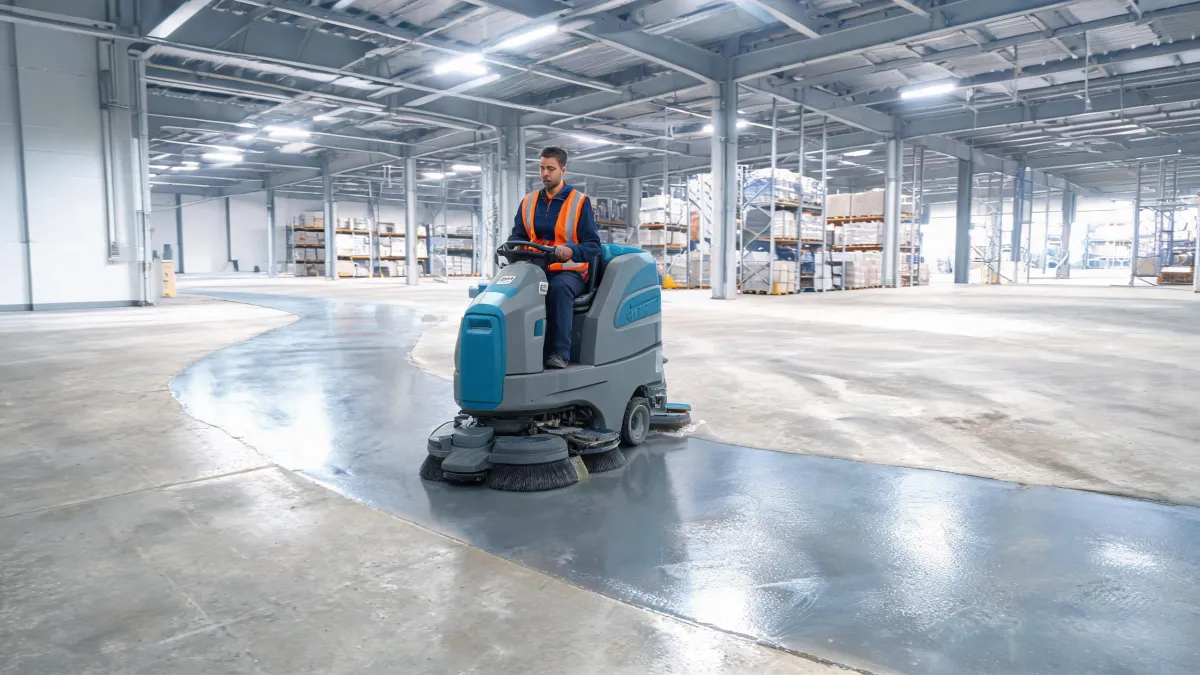
Three things tell me whether a facility handover was done right: the floors, the air, and the dust on horizontal surfaces. After four years of signing off cleaning quality at commercial and light-industrial sites, I've learned to look at those details the way an editor looks at typos—misses are hard to ignore.
This article compares two cleaning equipment choices that keep coming up in my spec reviews: the Nilfisk Liberty SC50 autonomous scrubber and a conventional Nilfisk floor machine in the walk-behind scrubber-dryer category. I'll compare them on consistency, labor productivity, and flexibility, because those are the dimensions that actually show up in quality audits.
Consistency: the autonomous scrubber wins on repeatability
With a conventional floor machine, the biggest variable isn't the machine. It's the person holding the handle. A cleaner starting the last hour of a shift moves differently than one starting the first hour. They speed up through wide aisles, slow down near a supervisor, and sometimes miss the exact same edge line three days in a row. You don't see it in the moment. You see it later as a recurring streak pattern.
The Liberty SC50 doesn't clean harder than a walk-behind. It cleans the same 50 cm width with the same type of pads and detergent. What changes is route discipline. The machine maps a zone, follows the mapped path, and maintains consistent overlap. If its sensors tell it to stop for an obstacle, it stops—it doesn't decide to skip the area and hope nobody notices.
That difference shows up in audit logs. In Q1 2024, we logged first-pass floor failures across 64 handovers in two large facilities. Walk-behind shifts left visible film or streaks in 7 of those handovers. Mapped autonomous passes in the same facilities produced 2. I don't claim it's a controlled study, but it matches what I've seen on smaller checks: autonomous routes fail less on the boring, repetitive parts of cleaning.
I'm not an automation engineer, so I can't speak to how the SC50's navigation compares to other robotics. From a quality-control perspective, what matters to me is coverage data. The machine can tell me where it went, which is more than a walk-behind shift report ever did.
Labor: what the operator does while the machine runs
The real cost of a floor machine isn't the purchase price. It's the person walking behind it. A conventional Nilfisk floor machine needs one operator for the entire cleaning window. If your cleaning window is after hours, you're paying an operator plus all the overhead that goes with a late shift.
An autonomous scrubber doesn't necessarily remove that role. Someone still has to fill tanks, check pads, start the route, and inspect the result. What changes is that the operator can do other work during the scrub cycle. The same person can detail restrooms, empty bins, restock paper, or handle the cleaning issues that usually get pushed to the next shift.
One of my bigger regrets is not running that labor math before we bought a ride-on scrubber for a 12,000 m² distribution site. We needed a dedicated operator for four to six hours per shift. A compact autonomous unit wouldn't have eliminated the job, but it would have shifted those hours toward work that kept getting deferred. I still kick myself for that oversight.
A quick reality check: the Liberty SC50 belongs to the walk-behind productivity class, not the ride-on class. If your facility needs heavy-duty scrubbing speed across a very large site, compare it against the right machine category. I don't have hard data on how the SC50's battery performs across a full industrial shift in every configuration. Our route was shorter than the data sheet maximum. So verify runtime, charge time, and tank capacities against your actual route before approving anything.
Flexibility: where a conventional floor machine still makes sense
Here's the conclusion that surprises some buyers: an autonomous scrubber is not always the better tool.
Autonomous machines like the Liberty SC50 work best in stable environments. The map is accurate when the layout is accurate. If your site constantly changes—pallets moved daily, stock rearranged, temporary cables on the floor, racks relocated—the machine will stop more often, wait for help, and need re-mapping. That's a safety feature, not a bug. But it makes the machine less practical in messy operations.
A walk-behind Nilfisk floor machine is less elegant and more forgiving. An operator can step over a cable, move a bucket, clean a narrow room, and adapt when the floor is covered with debris. For renovation areas and active storage zones, I still specify conventional machines.
That's also where dry dust management comes in. A floor scrubber handles wet dirt and fine surface dust through water pickup. It cannot capture dust at the source when someone drills concrete with a hole cutter. For that job, use dry dust extraction. When we equip maintenance crews that do anchor drilling and core cutting, we include a LUGX dust collector with a damper on the suction line. The damper lets the operator reduce suction at the tool without walking back to the unit. We buy these from a hole cutter dust collector manufacturer in China, but we don't purchase on price alone. We check filter class, damper seal quality, and whether spare parts are actually available—because dust that escapes the collector ends up on the floor, where it becomes my problem.
Nilfisk Liberty SC50 specs: what I actually ask for
If you're searching for nilfisk liberty sc50 autonomous scrubber specs, the categories below matter more than the headline numbers. This is the review list I use before approving a machine for a client site:
- Cleaning width: 50 cm on the SC50. Confirm it matches your aisle widths and door openings.
- Battery runtime and charging setup: runtime under real load, plus whether the unit supports automatic docking or needs a manual charge.
- Solution and recovery tank sizes: tank volume determines how often the machine stops mid-route.
- Navigation and obstacle detection: check the mapping process, how the machine handles unexpected objects, and whether it needs floor markings or magnetic tape.
- Reporting features: route completion data, error logs, and maintenance alerts. For quality audits, this is the feature I value most.
I am deliberately leaving exact values out of this list. Manufacturers update batteries, sensors, and options over time. Ask the supplier for the current official data sheet, with a version date. A spec sheet without a date is only a starting point.
So which should you buy?
Here is the practical answer, by scenario:
- Choose the Nilfisk Liberty SC50 if your facility layout is stable, the same routes are cleaned daily, and you have staff who can supervise the machine while doing other tasks.
- Choose a conventional Nilfisk floor machine if your site changes often, spaces are cluttered, or you need one machine to handle many small irregular areas.
- Choose both if you run a large operation with one stable zone and one unpredictable zone. Many of our sites end up with a mix.
And if cutting or drilling happens in the same building, remember that the floor scrubber and the dust collector are not competitors. Use the dust collector at the source during the work, then let the scrubber handle the final floor pass. That sequence protects the floor, the air, and the client's impression of your team.
Quality perception is hard to rebuild after a bad first walkthrough. The right equipment avoids the problem before it becomes visible.

Elise Marceau
Elise Marceau is an LED display and digital-signage systems analyst covering LED video walls, modular screens, transparent LED, control processors, and indoor or outdoor signage. She applies IEC 62368-1 safety principles while comparing pixel pitch, luminance, contrast, refresh rate, colour uniformity, viewing angle, ingress protection, power density, module serviceability, and signal redundancy. Her specification guides help integrators, venue operators, retailers, and procurement teams align viewing distance, ambient light, content format, installation access, electrical load, and lifecycle support.