I Kept Selling Commercial Floor Scrubbers the Old Way—Until Autonomous Machines Changed My Mind
-
The old checklist was about the machine. The new one is about the system.
-
The autonomous scrubber changed my "bigger is better" bias
-
Watch out for the over-spec trap (yes, pressure washers count too)
-
A short checklist I use now
-
But wait—what about tight aisles and tricky floors?
-
My maybe unpopular take
I'm going to say something that might annoy a few old-school facility managers: If you're shopping for a commercial floor scrubber the way you did in 2020, you're not buying a scrubber—you're buying an expensive mop.
That sounds harsh. I mean it. I've been managing equipment orders for commercial cleaning operations for eight years. In that time, I've personally made and documented 11 significant purchasing mistakes, totaling roughly $46,000 in wasted budget. That's not a brag. It's why I now maintain a pre-purchase checklist for every scrubber quote that comes through our shop.
And that checklist? It looked completely different in 2021. If yours hasn't changed either, let's talk.
The old checklist was about the machine. The new one is about the system.
What was best practice in 2020 may not apply in 2025. The fundamentals haven't changed—you still need to remove dirt and keep floors safe. But the execution has transformed. According to ISSA's 2024 industry benchmarks, labor makes up more than half of a typical facility's cleaning budget. So the machine that saves an hour of labor every shift is worth more than the machine that just has a bigger tank.
Here's an example. In 2022, a facility in Evansville, Indiana, asked us to spec a floor scrubber for a large warehouse floor. We quoted the biggest ride-on we thought they'd need. The machine did its job. But nobody had accounted for the time lost to moving it between zones, waiting for staff to finish another task, or maintaining the hoses and filters. The ROI model slowly fell apart.
I don't have hard data on exactly how many conventional scrubbers end up underused. But based on our orders, I'd say roughly 30% of the mid-size ride-ons we've sold in the last five years probably get less than 40 hours a month of actual use. What I can say anecdotally is this: the purchase price was rarely the problem. The labor around the machine was.
The autonomous scrubber changed my "bigger is better" bias
For a long time, I was skeptical of autonomous floor scrubbers. Honestly, I'm not sure why. It's probably because the first robotic cleaners I saw got lost in warehouse aisles or stopped halfway through a run. So I defaulted to safer, familiar manual equipment.
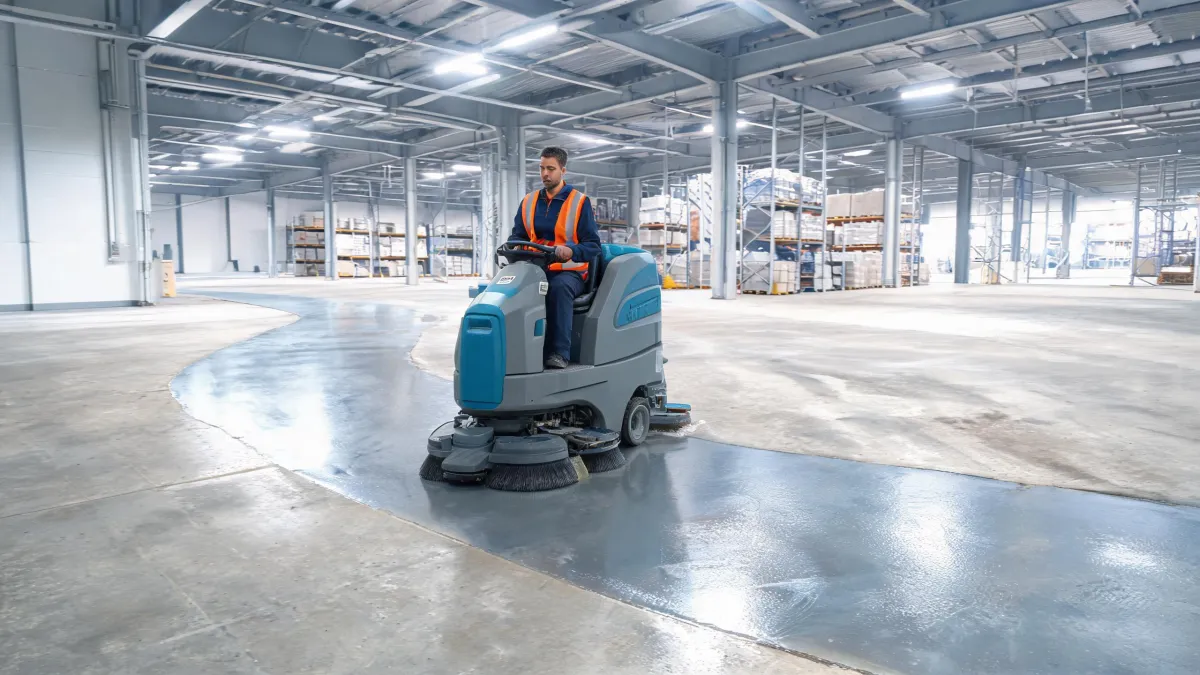
Then in 2024, I visited a distribution center outside Roanoke, Virginia, where they run a Nilfisk Liberty SC50 autonomous scrubber. The facility manager showed me their new schedule: scrub during the day, not just after hours, because no one has to drive the machine. That's when the lightbulb went off. The autonomous scrubber doesn't have to clean faster. Put another way, it cleans longer because it doesn't need a human on board. That changes the labor math completely.
In their case, the machine freed up about six hours of labor per week—or rather, closer to eight when you count the time they used to spend re-walking wet areas. They didn't fire anyone. They simply earned back one full day of crew time every month, which in this market is hard to argue with.
Watch out for the over-spec trap (yes, pressure washers count too)
I have a confession: I once recommended a Nilfisk Core 140 pressure washer to a customer who needed something much smaller. The spec sheet looked impressive—high pressure, solid build, familiar red paint. But they needed to clean a drain line, not blast concrete. The Core 140 wasn't a bad machine; it was overkill for that use case. The order cost a few hundred dollars more than it needed to, and it added a week of confusion while we swapped it out.
Why am I talking about a pressure washer in an article about floor scrubbers? Because the over-spec mistake happens just as often with scrubbers. Commercial floor scrubbers get sold on tank size, brush pressure, and scrub width—specs that sound great in a demo but don't tell you whether the machine fits your Tuesday afternoon reality.
So if you're searching for "floor scrubber Evansville" or "floor scrubber machine Virginia," please don't add "biggest" or "cheapest" to that search. Search for the one that your facility can actually staff, recharge, and maintain. That's the commercial floor scrubber that saves you money.
A short checklist I use now
I learned most of this from my own mistakes, so I'll save you the cost. These are the five questions I ask before quoting any commercial floor scrubber:
- What labor will this machine save, and how will we measure it? If you can't answer that, don't buy.
- When would an autonomous machine run, and when would a manual machine sit idle? Idle time is the real expense.
- Who can service it near you? A floor scrubber machine in Virginia needs a dealer with fast parts access; a floor scrubber in Evansville needs someone who understands local water and chemical conditions.
- What's the total daily cost, not the sticker price? Include charging, water treatment, brushes, pads, and operator time.
- Is the machine autonomous-capable or fully autonomous? There's a difference, and yes, the marketing guys will blur it.
A few years ago, a client gave me two days to spec a scrubber for a new production line. Normally I would have walked the floor and checked drains, lighting, and shift breaks. There was no time. We bought a standard, reliable model and it worked—but I still can't tell you if it was the optimal one. That's one of the reasons this checklist exists.
But wait—what about tight aisles and tricky floors?
I'll answer the objection I'm most likely to hear. "Autonomous scrubbers sound nice, but our facility has tight aisles, mixed surfaces, and wifi dead zones."
Fair point. In fact, I've never fully understood why some older autonomous machines struggled so much with tight spaces. My best guess is they depended too much on external infrastructure and not enough on onboard sensors. The newer generation, including the Nilfisk autonomous floor scrubber line, handles mapped routes much better than the machines I saw in 2019. But I'm not going to claim it works in every facility. Before you commit, demo it with your actual floor plan.
Here's the thing though. The alternative isn't "keep doing what you've been doing." The alternative is finding a way to clean more space with fewer people. That's the direction the whole industry is moving. You can lead it or chase it—but you can't ignore it.
My maybe unpopular take
So here's my conclusion: The best commercial floor scrubber in 2025 isn't the one with the biggest tank. It's the one that gives hours back to your team every week. Sometimes that's a simple unit. Sometimes it's a Nilfisk autonomous floor scrubber. Often, it's something in between.
I built my checklist because I made expensive mistakes. But the checklist didn't stop changing after mistake number eleven. It changed again in 2023 when I saw an autonomous machine clean an entire warehouse without anyone on board. That's not a threat to the old way. It's an evolution. And pretending it didn't happen is the most expensive mistake I could make now.
Prices and specs for equipment like the Nilfisk Core 140 pressure washer and the Liberty SC50 vary by dealer and configuration. As of January 2025, verify current pricing and availability with your local Nilfisk representative. This article isn't a quote sheet—it's a warning from someone who learned the hard way.

Elise Marceau
Elise Marceau is an LED display and digital-signage systems analyst covering LED video walls, modular screens, transparent LED, control processors, and indoor or outdoor signage. She applies IEC 62368-1 safety principles while comparing pixel pitch, luminance, contrast, refresh rate, colour uniformity, viewing angle, ingress protection, power density, module serviceability, and signal redundancy. Her specification guides help integrators, venue operators, retailers, and procurement teams align viewing distance, ambient light, content format, installation access, electrical load, and lifecycle support.