Stop Buying on Price Alone: A Quality Inspector's Take on Nilfisk Industrial Equipment
My position is simple: when you are evaluating industrial cleaning equipment, ask for the full price list before you ask for the lowest quote. A low number with missing parts, vague specs, and hidden installation requirements is not a bargain. It is a risk.
I say this as a quality compliance manager who reviews equipment specifications before anything reaches our operations floor. In Q1 2024, I audited 214 pieces of cleaning equipment—not estimates, actual units. I rejected more than 8 percent of first deliveries because the product did not match the documentation. What made those cases expensive was never the sticker price. It was the gap between what was quoted and what was needed.
Price Is Not the Problem. Missing Parts Are.
Take pressure washers. Someone will type 'pressure washer how to install' into Google after the delivery truck leaves, and that is usually a warning sign. If the quote does not include the installation essentials, the machine might look like a great value until you realize the inlet hose, the spray nozzles, or the pressure gauge is a separate line item. (Note to self: I keep seeing this in purchase orders.)
For a Nilfisk professional pressure washer, the first thing I do is go to the nilfisk official website and check the accessory list in the manual. If the seller cannot tell me what is included before I ask, I expect surprises later. That is not a one-time feeling; it is a pattern I have seen across multiple vendors. Last year, a quote for a seemingly complete unit omitted the unloader valve. The machine still ran, but it voided the safety certification until we added the correct part. The vendor did not flag it. We only caught it during the installation review.
What often gets missed on pressure washer projects:
- the right inlet hose size and thread type
- a proper backflow preventer for local codes
- nozzle sets for different surface types
- mounting brackets or hose reels you actually need
- training or setup time
None of these are expensive on their own, but they turn a $4,000 quote into a $5,200 invoice. The vendor who lists them upfront—even if the total looks higher—usually costs less in the end.
Rated Capacity Means Nothing Without a Test Method
A standing dust collector is another area where transparency matters. A spec sheet can say '1.5 kW' or '650 CFM,' but what does that mean for your material? If the test method is not documented, the number is just decoration. What most people do not realize is that some vendors rate equipment with an empty filter and an open inlet, which inflates performance dramatically. Under real loading, performance drops.
In one standing dust collector evaluation for our shop, the airflow looked acceptable on paper. In our layout, with ducting and a partially loaded bag, it lost 30 percent of its rated airflow. The vendor said it was 'within industry standard.' We rejected the batch because our standard was not a range—it was a minimum. (Should mention: we paid for a third-party test the second time.)
The Federal Trade Commission's advertising guidelines require that claims be truthful and substantiated. That does not only apply to consumer marketing. I use it as a useful reminder: if a spec is not testable, it is not a spec. For industrial air cleaning equipment, I want to know the exact standard behind the rating. If the answer is 'we use our own method' without details, I walk away.
Robotic Scrubbers Need Honest Boundaries
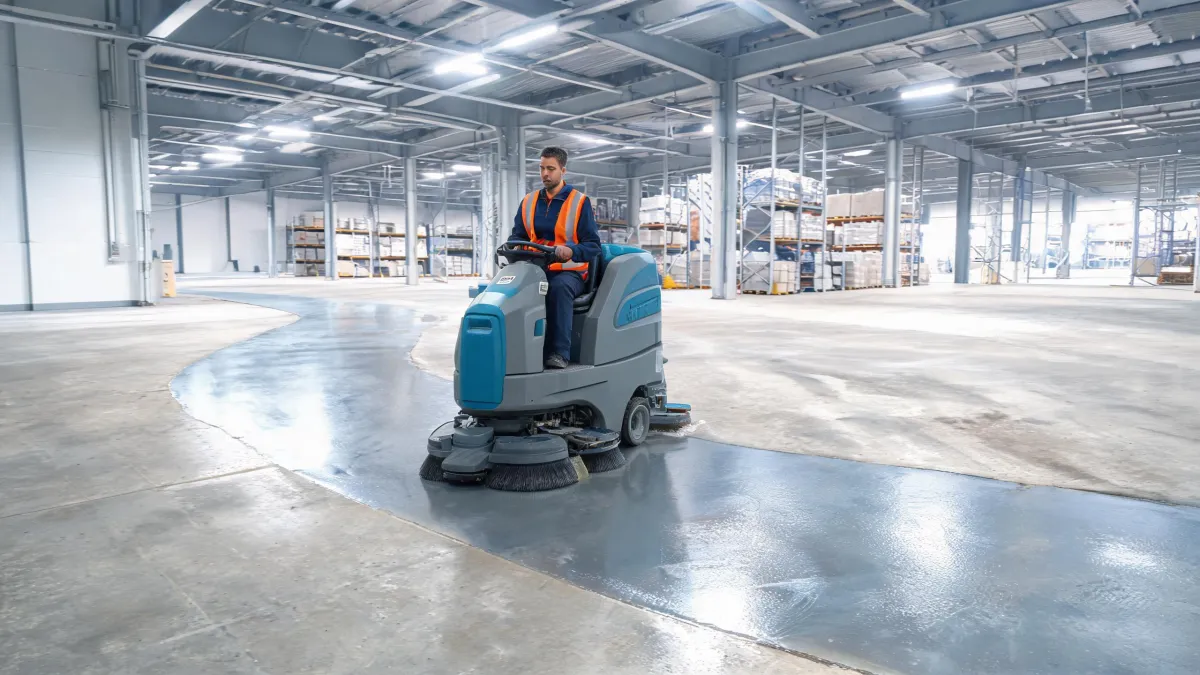
Automation is the future. We have evaluated a few autonomous floor scrubbers under our AIMS project, and the technology is genuinely good. But I have seen proposals with production rates that assume a perfectly clear floor, a full battery every second, and an operator who never has to refill the tank. That is not a cleaning plan; it is a fantasy.
Honestly, I am not sure why the industry gravitates to optimistic numbers like that. My best guess is that sales teams repeat the best-case figures and let the customer find the boundaries later. For the aims floor scrubber category, I care more about the documented limits than the headline number: maximum ramp angle, minimum aisle width, charging curve, battery replacement interval, and how much operator training is required.
That is why the official documentation matters. If a manufacturer like Nilfisk publishes a manual with wiring diagrams, installation steps, and maintenance intervals in one place, it tells me they expect the machine to be taken apart and verified. If the manual is 12 pages and unspecific, the machine is probably not ready for the kind of scrutiny I am going to apply.
The Pushback I Get
I hear the objection: 'Every vendor hides fees. That is just how the industry works.' I have been in enough negotiations to know that some vendors do pad their quotes. But the answer is not to accept vague pricing—it is to make transparency a requirement. My contracts now include a line that says any item required for operation, per the manufacturer's manual, must be listed in the quote. If the engineer missed it, that is their cost, not ours.
Put another way: you do not manage risk by trusting the low number. You manage it by specifying what you need and forcing the supplier to document what they are giving you. A supplier who resists that level of detail is telling you something valuable before you spend a cent.
The Goal Isn't the Lowest Cost. It's the Lowest Surprise.
After four years of reviewing equipment purchases, I still buy on value, but I define value as the difference between the delivered performance and the promised performance. That gap causes more budget damage than any single line item.
This worked for us because we are a mid-size operation with time to review documents and run audits. If you are a one-person contractor, maybe you cannot spend three days checking every spec. But the principle still applies: ask for the full list, ask for the test method, ask for the installation requirements. I still look at Nilfisk equipment first because their official website gives me a place to check the details instead of hoping a sales PDF is accurate. That is not a guarantee—it is a starting point.
Your best source is not the cheapest seller. It is the seller who can answer the question, 'What is not included?' Transparency, not the lowest number, is what builds trust.

Elise Marceau
Elise Marceau is an LED display and digital-signage systems analyst covering LED video walls, modular screens, transparent LED, control processors, and indoor or outdoor signage. She applies IEC 62368-1 safety principles while comparing pixel pitch, luminance, contrast, refresh rate, colour uniformity, viewing angle, ingress protection, power density, module serviceability, and signal redundancy. Her specification guides help integrators, venue operators, retailers, and procurement teams align viewing distance, ambient light, content format, installation access, electrical load, and lifecycle support.