Industrial Vacuum vs. Push Sweeper: Which Floor Machine Actually Saves Your Team Time?
Two Machines, One Job: Cleaning Hard Floors
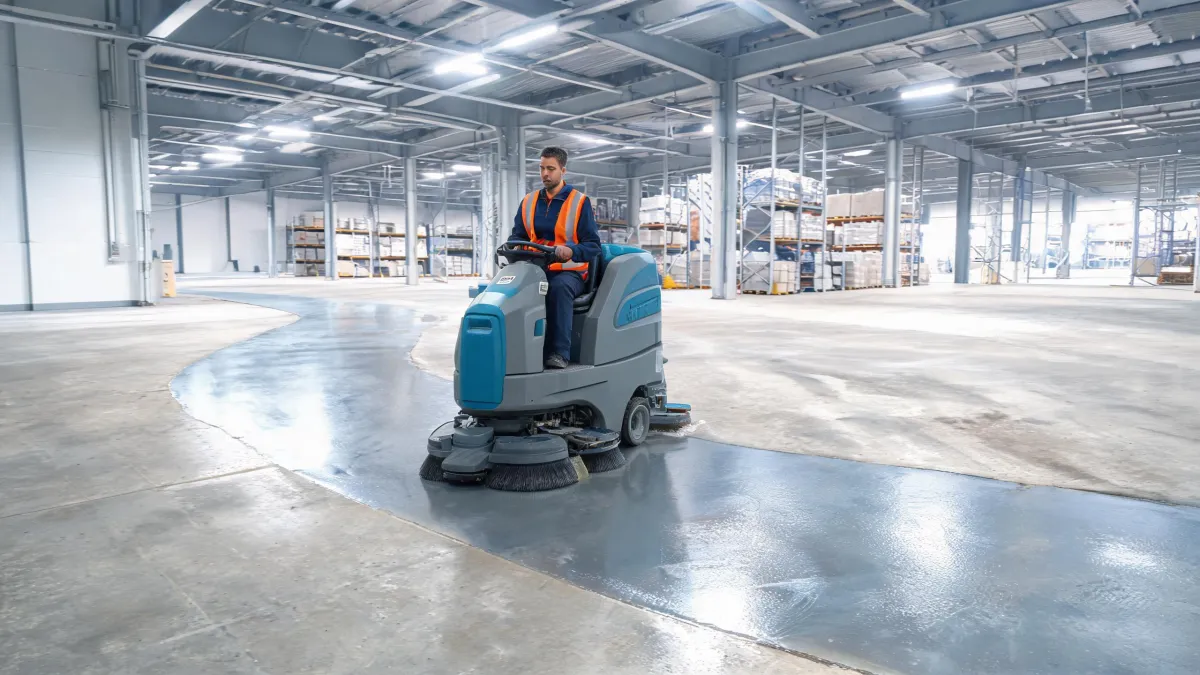
In 2022, I managed to waste a solid $3,200 on the wrong machine for our warehouse expansion. We bought a high-capacity floor scrubber machine mobile unit because it looked efficient. Three weeks in, we realized half our floor area had tight corners and debris that the scrubber couldn't touch. We ended up renting a push sweeper machine for those zones—double the equipment cost.
Since then, I've become meticulous about matching the machine to the space. In my experience, the two most common starting points for hard floor cleaning are an industrial vacuum cleaner (like a Nilfisk model) and a push sweeper machine. They seem to do the same job. They don't. Here's what I've learned comparing them across four critical dimensions.
Dimension 1: Floor Space & Navigation
The first question I always ask now is: how much open floor vs. how many obstacles?
The Push Sweeper: A standard push sweeper machine is compact. You can push it into a 3-foot aisle, around pallet racking, and under low shelves. In our facility, the push sweeper could navigate a 36-inch wide storage corridor with no problem. The trade-off? It covers roughly 12,000–15,000 sq ft per hour at a walking pace.
The Industrial Vacuum: A Nilfisk industrial vacuum cleaner with a wide floor tool (let's say a 30-inch head) can cover 25,000–35,000 sq ft per hour. That's faster—but the unit is larger. These machines are designed for open warehouses or production floors. Take them into a cluttered stockroom, and you're constantly maneuvering around rack legs and machinery. I've seen operators spend 40% of their time repositioning the unit instead of cleaning.
Verdict: If your floor is wide open, the vacuum wins on speed. If you have obstacles, tight aisles, or varied zones, the push sweeper covers more ground in practice because it's always moving.
(Should mention: This is based on our experience with a 50,000 sq ft facility split 60/40 between open floor and racked storage. Your mileage may vary.)
Dimension 2: Type of Debris & Surface
This is where I made my first big mistake in 2017. I assumed a vacuum handled everything a sweeper could. I was wrong.
Fine Dust & Powder: The Nilfisk industrial vacuum cleaner is unmatched here—specifically if it's a model with a HEPA filter. For fine dust from manufacturing processes (cement, flour, plastic pellets), vacuuming is the only safe and efficient method. A push sweeper will push fine dust into the air, creating a health hazard.
Large Debris & Wet Material: A push sweeper machine handles large debris better. Think: wood chips, cardboard scraps, metal shavings, or anything heavier than a coin. The brush-and-hopper mechanism sweeps it up in one pass. A vacuum's hose or floor tool can choke on larger items. I recall a coworker trying to vacuum a pile of small packing peanuts—the hose clogged three times in ten minutes.
Wet Floors: Standard dry vacuums (including most Nilfisk industrial units) cannot handle standing water. Push sweepers also struggle with wet surfaces—the debris sticks to the brush. If your floor is ever wet, you need a scrubber or a wet/dry vacuum, not either of these.
Verdict: Fine dust = Vacuum. Large debris = Sweeper. Wet floor = Neither.
Dimension 3: Precision & Edge Cleaning
One thing that surprised me during a trial in Q1 2024: edge cleaning performance varies wildly.
Push Sweeper: Most push sweepers have side brushes that direct debris into the main brush path. This makes them surprisingly good at cleaning right up to a wall or rack edge. The manual effort also allows the operator to briefly lift the front and capture debris from corners.
Industrial Vacuum: A standard floor tool leaves a 1–3 inch gap against walls. If you're using a wide floor tool (e.g., 30-inch), that's a significant missed strip. You end up going back with a crevice tool or a smaller hand vacuum. In our packing area, this added an extra 15 minutes per cleaning cycle.
Verdict: Push sweeper for edge-to-edge cleaning. Vacuum if your cleaning standard allows for a small gap, or if you use a specialized edge tool attachment.
Dimension 4: Total Cost & Maintenance
Okay, let's talk money—because the price tag doesn't tell the whole story.
Initial Purchase: A decent commercial push sweeper machine with a 3–4 cubic foot hopper costs between $2,500 and $5,000. A Nilfisk industrial vacuum cleaner with comparable durability and a HEPA filter can run from $4,000 to $8,000 or more.
Consumables: Push sweepers wear through brushes—they're the main cost. Expect to replace the main brush every 6–12 months ($100–$300). Vacuums need filters. A HEPA filter replacement might cost $50–$150, but you also have bags or dirt-disposal costs. Vacuum bags add up, especially if you're emptying them frequently.
Downtime: The vacuum's filter is its weakest point. If you vacuum fine dust, a filter can clog in weeks, requiring cleaning or replacement. A push sweeper's hopper just needs to be dumped. In my experience, the push sweeper had 50% less unplanned maintenance time over a 12-month period.
Verdict: The push sweeper is cheaper upfront and in maintenance, provided you don't need HEPA-level filtration. The vacuum costs more but is essential for high-dust environments.
“I’ve learned to ask ‘what’s NOT included’ before ‘what’s the price.’ The vendor who lists all fees upfront—even if the total looks higher—usually costs less in the end.” — Something I tell every new buyer on my team.
Final Choice: Which One to Buy?
I don't believe in a universal winner. Instead, here's how I now guide our purchasing decisions:
Buy the industrial vacuum (Nilfisk or similar) if:
- Your primary debris is fine dust under 100 microns (cement, toner, airborne particles).
- You have open floors with few obstacles.
- Health/HVAC regulations require HEPA filtration.
- You're cleaning near sensitive equipment that can't get dust airborne.
Buy the push sweeper machine if:
- Your debris is larger (trash, wood, metal, packaging).
- Your facility has many corners, racks, and tight aisles.
- Budget is tight and maintenance simplicity is key.
- You need one machine that works in multiple zones quickly.
And if you have both types of floor zones and both types of debris? The honest answer is: you need both. In our facility, we run the vacuum in the production area (fine dust) and the push sweeper in the warehouse and packing zones. The combined cost is lower than a single expensive ride-on scrubber—and the cleaning quality is better.
That's my two cents. At least, that's been my experience after five years of testing these machines. If you're still unsure, Nilfisk's store login has product specifications you can compare. Or rent a unit for a week. I wish I had done that before my $3,200 mistake.

Elise Marceau
Elise Marceau is an LED display and digital-signage systems analyst covering LED video walls, modular screens, transparent LED, control processors, and indoor or outdoor signage. She applies IEC 62368-1 safety principles while comparing pixel pitch, luminance, contrast, refresh rate, colour uniformity, viewing angle, ingress protection, power density, module serviceability, and signal redundancy. Her specification guides help integrators, venue operators, retailers, and procurement teams align viewing distance, ambient light, content format, installation access, electrical load, and lifecycle support.