Nilfisk SC25 vs Liberty SC50: The Price Difference Is Not the Real Difference
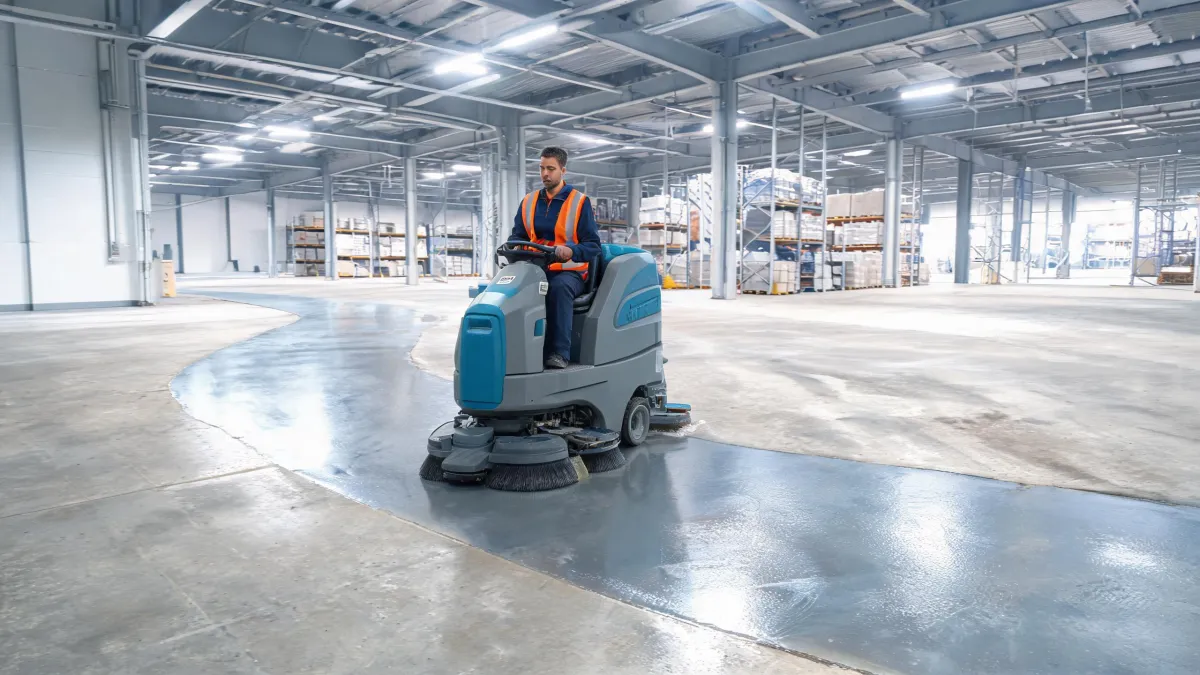
If you've ever tried to choose between two floor scrubbers by reading spec sheets, you know that dead feeling. I'm a quality inspector for a commercial equipment distributor, and I review every unit before it goes out the door—roughly 200 machines a year. I've rejected about 12% of first-production units in 2024, usually for issues that don't show up in a brochure. So when people ask me about the Nilfisk SC25 and the Nilfisk Liberty SC50, I don't start with marketing pages. I put them on the same floor and run them for a month.
Here's the short version before I get into the weeds: the cheaper-looking machine is not automatically the cheaper one. The more expensive one isn't always the better one. It depends on your floor plan, your team, and your willingness to take care of electronics. The comparison breaks down into four areas: cost, daily usability, maintenance, and knowing when neither machine is the right answer.
Price versus the number you should actually track
Search for 'nilfisk sc25 price' and you'll get a number. Search for 'nilfisk liberty sc50 price' and you'll get a bigger number. Most buyers stop there. That's a mistake.
To be fair, the SC25 is less expensive upfront. I'm not going to pretend otherwise. But in our side-by-side test, the Liberty covered a 7,000-square-foot warehouse section in about 40 minutes without an operator following it. The SC25 covered the same section in about 55 minutes, with the operator walking behind it the entire time. If that operator costs $22 an hour with burden, the SC25 adds roughly $20 more in labor per cleaning cycle. Run that twice a day, five days a week, and the Liberty's purchase premium disappears in less than a year. That's the ballpark you should be living in.
Bottom line: 'nilfisk sc25 price' and 'nilfisk liberty sc50 price' are the least useful specs. Cost per 1,000 square feet per month is the real one.
Daily use: autonomy is a feature and a limitation
The Liberty SC50 is as close to a hands-off scrubber as I've used. It maps the route, moves around obstacles, and at the end of the run it docks itself and reports charge and chemical usage. There's something satisfying about watching that happen. But it needs a predictable environment. If your facility changes layout weekly—pallets in different places, cables on the floor, storage lanes that appear and disappear—the Liberty will get confused. That's not a defect. It's a boundary.
The SC25 doesn't care. You push it around whatever mess is in front of you. For a chaotic space, the SC25 is the no-brainer. For a stable, repetitive layout, the Liberty is the no-brainer. Per FTC guidelines, a claim like 'autonomous' has to mean something in practice. In our test logs, the Liberty needed human help about once every ten runs. The SC25 needed human attention for the entire run. The right pick depends on which job you're actually hiring for.
Cleaning quality: the unexpected difference
The biggest surprise wasn't raw scrubbing power. When I compared the SC25 and the Liberty side by side—same facility, same cleaning solution, same month—I finally understood why consistency matters more than peak performance.
The Liberty produced the same result every pass. Not just 'pretty clean'—I do not mean that loosely. The standard deviation between runs was tiny. The SC25 produced a great result when the operator was fresh, and a noticeably worse one two hours later. That variability isn't a machine issue; it's a human issue. But if you're in food, pharma, or any environment with compliance checklists, consistency is the product. That's when the Liberty's higher price starts to look like insurance.
I ran a blind panel with five maintenance staff. They rated 12 floor sections, half from each machine, without knowing which was which. The Liberty sections were rated higher on consistency. The SC25 sections were usually fine, sometimes great, occasionally streaky. That's a real difference, and it has nothing to do with the brush pressure.
Maintenance: the part nobody budgets for
This is where the Liberty makes me hesitate. I have mixed feelings about recommending autonomous machines. On one hand, the labor savings are legit. On the other, they require a maintenance culture that many facilities just don't have yet.
The SC25 is more mechanical. When something breaks, a decent maintenance tech can fix it with basic tools and a multimeter. Parts are easier to source because the machine is simpler. The Liberty has sensors, mapping electronics, and a battery management system. If a sensor fails, you may be waiting on a certified tech and a proprietary part. I'm not 100% sure of the exact cost—don't hold me to this—but a replacement sensor for that class of machine was around $700 in our parts system. That's not an argument against automation. It's an argument for being honest about your team's capability.
And regardless of which one you choose, follow the dust collector PM schedule. The vacuum side of a scrubber is effectively a dust collector, and filters degrade faster than people think. I've seen a $900 motor failure because a $20 filter was replaced three months late. 'Dust collector PM' is boring, but it's the difference between a machine lasting five years and three.
When neither machine is the right answer
A floor scrubber is a floor scrubber. It doesn't remove heavy grease from a loading dock, and it's not a pressure washer. If your actual problem is exterior grime or grease, that's a different product category. I've tested the Avago pressure washer for light commercial work. Honest assessment: for intermittent use on a small area, it's okay. For daily industrial duty, the pump isn't designed for that load. That's not a dig at Avago; it's a boundary. A good supplier will tell you which category fits the job, even if it means pointing you to a different line. If they don't, that's a red flag.
And before I get the question again: the 'best nail dust collector amazon' result is not an industrial dust collector. A nail dust collector is designed for tiny acrylic and gel particles. Construction dust, drywall dust, and concrete dust are a completely different scale. Different particle sizes, different volumes, different filtration. It's a kayak paddle versus a marine propeller. Buy the right tool from the specialist who sells it, not the gadget that happens to be on sale.
The vendor who told me 'this isn't our strength—here's who does it better' earned my trust for everything else. I'd rather work with a specialist who knows their limits than a generalist who overpromises. That applies to machines, too.
So which one should you buy?
Here's the practical version of everything above:
- Choose the Nilfisk SC25 if your facility is chaotic, your staff turnover is high, and you need a simple machine that any operator can run after a 10-minute training. Accept that you're paying labor costs every time it's used.
- Choose the Nilfisk Liberty SC50 if your layout is stable, you're short on labor, and you're cleaning the same large areas multiple times a day. The purchase price hurts more up front, but the operating cost wins.
- Choose neither if your real need is pressure washing or industrial dust collection. Get the right category from the right specialist.
Trust me on this one: the best machine is the one that fits your actual operating pattern, not the one that wins a spec sheet comparison. In our month of testing, I didn't want to give the Liberty back. But I also wouldn't put it in front of a crew that can't manage its own charging schedule or sensor cleanliness. Machine selection is not about ego. It's about knowing what you're actually buying, and what you're signing up to maintain.

Elise Marceau
Elise Marceau is an LED display and digital-signage systems analyst covering LED video walls, modular screens, transparent LED, control processors, and indoor or outdoor signage. She applies IEC 62368-1 safety principles while comparing pixel pitch, luminance, contrast, refresh rate, colour uniformity, viewing angle, ingress protection, power density, module serviceability, and signal redundancy. Her specification guides help integrators, venue operators, retailers, and procurement teams align viewing distance, ambient light, content format, installation access, electrical load, and lifecycle support.