Nilfisk Machines vs. Industrial Floor Sweeper Hire: An Emergency Planner's Honest Take
-
Why This Comparison, and Why Now
-
The Comparison Framework
-
Dimension 1: Time to Operational
-
Dimension 2: Total Cost Over Time
-
Dimension 3: Reliability Under Pressure
-
Dimension 4: The Nilfisk Logo and Client Perception
-
Specialized Equipment Matters More Than You'd Expect
-
What Do You Actually Do?
-
Bottom Line
Why This Comparison, and Why Now
If you're reading this, you're probably in one of two camps: you need a clean floor before a client visit, or your equipment just died and the maintenance budget isn't there yet. I've been in both places. In my role coordinating emergency equipment for an industrial cleaning supplier, I've handled 200+ rush orders in eight years—including a same-day turnaround for a food plant that had an auditor scheduled for 7 a.m. the next morning.
This isn't a 'Nilfisk is the greatest brand ever' post. It's a practical comparison between buying Nilfisk machines and hiring an industrial floor sweeper when time is the main enemy. I'll go through speed, cost, reliability, and one thing most people overlook: what the equipment says about you.
The Comparison Framework
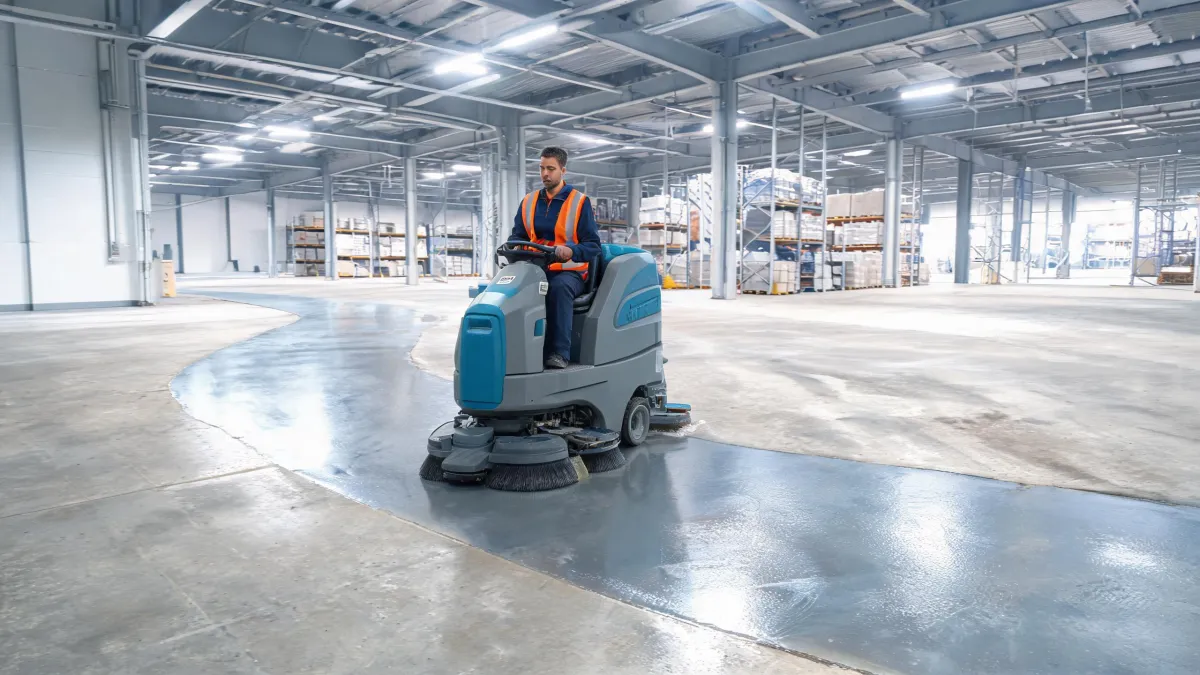
We're comparing two routes to the same goal: get the floor clean without screwing up the schedule. Buying means investing in Nilfisk machines—sweepers, scrubbers, vacuums, dust collection—that you own. Hiring means calling a local dealer and renting an industrial floor sweeper for a day or a week.
I'll judge them on four dimensions:
- Time to operational: how fast you can be cleaning.
- Total cost: not just today's quote.
- Reliability under pressure: what happens when a machine fails.
- Customer perception: what the equipment silently says about you.
One note before we dive in: this worked for us, but we're a mid-size B2B operation with predictable cleaning demand. If you're a one-off renovation contractor, your math might be completely different.
Dimension 1: Time to Operational
Renting an industrial floor sweeper can be insanely fast. In our area, same-day hire exists if you call before 10 a.m. and the local supplier has a unit available. If you literally need a machine this afternoon, renting is the obvious call.
But here's the catch—available is not the same as appropriate. The rental fleet has what it has. Last spring, we needed a sweeper with a dust control attachment for a client with a very dusty workshop. The rental company had a unit, but it was the basic model with no dust collector. We ended up saying yes because we were desperate. That's where the Nilfisk Dust Right collector earns its keep. It's a modular system, and when we bought a Nilfisk machine with the Dust Right collector, we didn't have to gamble on what we'd get.
So, for raw speed, rental wins. For the right configuration, owning—or buying through a Nilfisk dealer—can actually be safer. The dealer can quote a specific setup and reserve it before you pay.
Dimension 2: Total Cost Over Time
Let's talk numbers. In our region, industrial floor sweeper hire runs roughly $175–$400 per day depending on size and age of the fleet. Weekly rates are cheaper per day, but they still add up. We rented a sweeper for six days during a chaotic month in 2024. That invoice was $1,980. It wasn't the most expensive rental we've had—but it got me thinking.
At that rate, renting for two months can exceed the price of a mid-range Nilfisk sweeper. I don't mean the giant ride-on one. I mean a walk-behind or smaller rider that handles normal daily cleaning. The upfront cost is higher, but the moment you hit the break-even point, every day after that is cheaper.
I still kick myself for not running this calculation earlier. We rented for almost two years before accounting finally approved the purchase. If I'd done the math in 2022, we could have paid for the unit once and then had some left over.
But I do not want to pretend renting is always wrong. For a single event, a one-month shop cleanup, or a seasonal need, rental is the correct answer. The trick is to know which category you're in before the invoice arrives.
Dimension 3: Reliability Under Pressure
When you're in an emergency, the last thing you need is a machine that fails in front of the client. It's happened to me. A rented sweeper rolled in with a battery charge that wasn't what the rep promised. We lost 40 minutes waiting for a charging station, and I spent the rest of the day doing damage control.
With owned Nilfisk machines, you know the history. You know what's been replaced and what hasn't. You also know where the fuses are. This sounds small, but consider pressure washer fuses. I've seen pressure washer fuses blow on rental machines at the worst possible moment—7 a.m., six hours before an inspection. The rental company's first response was 'we can have a technician out this afternoon.' That kills a job. If you own the machine, you carry spare fuses, and you swap them in under a minute.
Dodged a bullet once when a rental order got double-booked and we had to drive an hour to a different depot. The backup sweeper was a newer model and worked fine. But we were already an hour behind before we started. So no, rental isn't automatically bad. It's just an extra variable.
Dimension 4: The Nilfisk Logo and Client Perception
This is the one that surprised me. When I started in this industry, I thought equipment was equipment. Then I began noticing how clients react. When we rolled onto a site with a clean, well-maintained Nilfisk machine—logo visible, hoses coiled, no rust—the facility managers treated our team differently. Not because the logo is magic. Because it's a signal of investment, maintenance, and professionalism.
I've also rented machines that looked like they had been through a war. The sweeper worked, but the company's impression didn't. The Nilfisk logo on a machine is a small thing. It doesn't make the floor cleaner all by itself. But in B2B, perception drives trust, and trust drives whether you get called back.
If you only care about getting a job done once, rent. If you care about building a business that looks like it can be trusted with a client's facility, the visible quality matters.
Specialized Equipment Matters More Than You'd Expect
Hiring an industrial floor sweeper covers the basics. But if your operation needs dust control at the source, retrieval systems, or a particular setup, rental fleets are often limited. According to Nilfisk's official product pages, the Dust Right collector is designed to work with specific Nilfisk dust extractors and vacuums. That specificity is exactly why owners tend to trust the setup more than a rental depot's 'this should work' approach.
What Do You Actually Do?
Here's the rule I've landed on:
- Rent an industrial floor sweeper if you need it for a handful of days a month, for a specific project, or if you need a machine this afternoon and can accept what the rental company has.
- Buy Nilfisk machines if you need cleaning equipment weekly or daily, if you want consistency, and if brand perception matters to your customers.
Don't forget the hidden costs of renting: pickup and delivery windows, paperwork, deposits, and the time you spend checking the rental unit when it arrives. That time is not free. In my experience, it's often one to two hours per rental—and that's before the machine actually cleans anything.
Bottom Line
In an emergency, speed matters, but so does certainty. Rental wins when you need something fast and temporary. Buying Nilfisk wins when you need the right machine, repeatably, without the 'will it work today?' conversation.
Our company's policy now is: if we need it more than three times in a quarter, we buy. That policy came from a painful 2023, when we rented for a recurring client and ended up with four different machines, three billing errors, and one very annoyed facility manager. I'm not saying you'll have that experience. But if you're on the fence, ask your rental supplier how many times you need to rent before buying starts to make sense. If they can't answer, that's your answer.

Elise Marceau
Elise Marceau is an LED display and digital-signage systems analyst covering LED video walls, modular screens, transparent LED, control processors, and indoor or outdoor signage. She applies IEC 62368-1 safety principles while comparing pixel pitch, luminance, contrast, refresh rate, colour uniformity, viewing angle, ingress protection, power density, module serviceability, and signal redundancy. Her specification guides help integrators, venue operators, retailers, and procurement teams align viewing distance, ambient light, content format, installation access, electrical load, and lifecycle support.