Nilfisk Products vs. Piecemeal Procurement: A Cost Controller's Honest Analysis
-
The Comparison Framework
-
Dimension 1: Nilfisk Viper Ride-On Floor Scrubber DS710R-245 vs. the Discount Walk-Behind
-
Dimension 2: Commercial Dust Collector and Pressure Washer for Car Wash Duty
-
Dimension 3: Service, Support, and the Northern Illinois Factor
-
Where I Second-Guessed Myself
-
What I'd Do Differently (and What I'd Recommend)
Six years ago, I took over procurement for a 150-person industrial facility in northern Illinois. One of the first things I learned: cleaning equipment was eating almost 12% of our annual non-payroll operating budget—and nobody could tell me if we were spending it well. So I did what I always do: built a comparison spreadsheet.
The question I was trying to answer was straightforward. When we needed a new industrial floor scrubber, a commercial dust collector for our fabrication area, and a pressure washer for our vehicle bay, would we be better off buying a full Nilfisk lineup or sourcing each piece from a different low-cost supplier? (The way I see it, this is a question every facility manager faces at some point.)
Here's what the comparison actually looked like, and the conclusions I reached after the invoices settled.
The Comparison Framework
Before comparing anything, I set three rules. First, evaluate total cost of ownership, not sticker price—the hidden fees and maintenance costs matter more than the upfront number. Second, model labor costs explicitly, because a machine that saves 15 minutes a shift is worth more than a machine that costs $500 less. Third, include the risk of downtime, which is the one metric nobody puts into their spreadsheet.
With those rules in place, I started with the biggest line item: the ride-on floor scrubber.
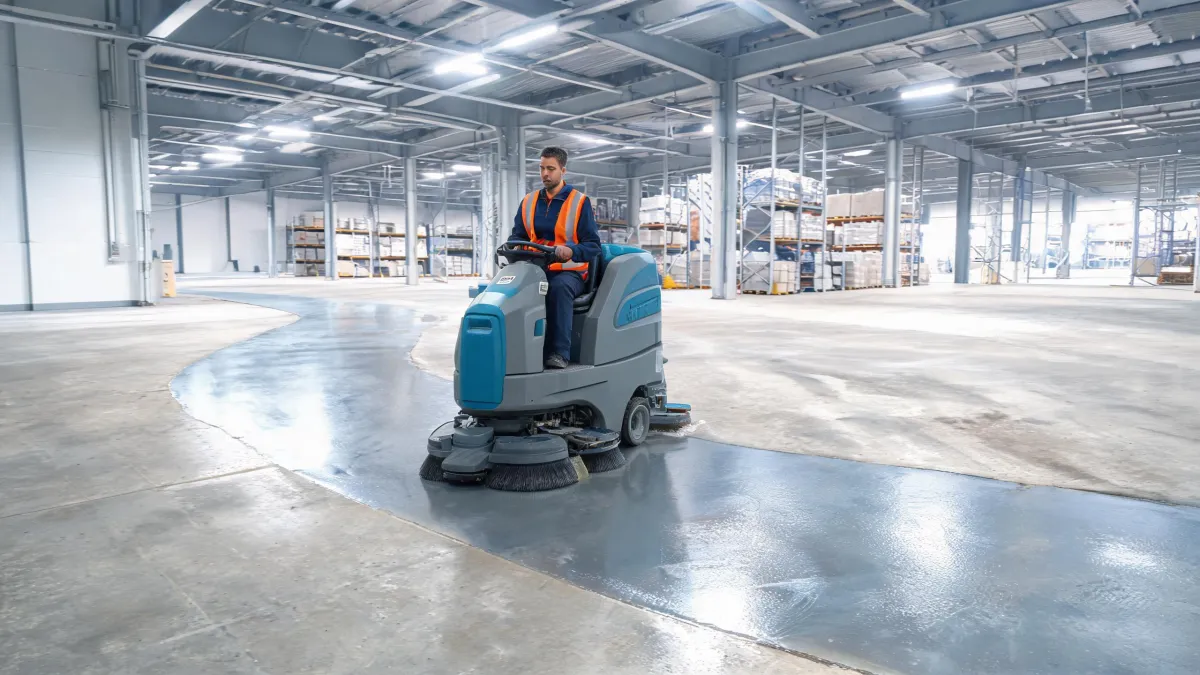
Dimension 1: Nilfisk Viper Ride-On Floor Scrubber DS710R-245 vs. the Discount Walk-Behind
We had quotes for two very different approaches to floor cleaning. One was the Nilfisk Viper ride-on floor scrubber DS710R-245. The other was a walk-behind scrubber from an online discount supplier that had a tempting price tag—about 58% lower than the Nilfisk. (Surprise, surprise, that's where the good news ended.)
- Upfront cost: The discount unit was clearly cheaper. But it came with a smaller battery, and the quoted price didn't include the charger—that was $620 extra, which I only caught because I read the fine print.
- Battery life: The Nilfisk's battery is rated for roughly 1,800 cycles. The discount unit's battery was rated for 800. In our facility, running three shifts, we'd be replacing the discount battery about every 18 months. A replacement battery cost $2,100. That's $6,300 over five years.
- Productivity: A ride-on scrubber covers about 70,000 sq ft per hour. A walk-behind covers maybe 28,000 sq ft per hour. Our facility has 200,000 sq ft of hard flooring. Every day, we were paying someone to spend almost double the time on the same task.
- Service intervals: The Nilfisk spec'd a 2,000-hour service interval on the brush deck. The discount unit recommended inspection every 500 hours. (In other words, more downtime, more labor.)
When I added it all up, the discount unit had a lower first-year cost by about $4,800. But over five years, the total cost of ownership favored the Nilfisk Viper by roughly $11,000. The word "roughly" is doing a lot of heavy lifting there—real TCO numbers vary with usage patterns and electricity costs—but the direction was consistent in every sensitivity scenario I ran.
The upside was $4,800 in first-year savings. The risk was higher operating costs and more downtime. I kept asking myself: is $4,800 worth potentially disrupting our operations twice a year?
Dimension 2: Commercial Dust Collector and Pressure Washer for Car Wash Duty
Now, comparing a Nilfisk pressure washer for car wash use to a big-box store pressure washer isn't apples to apples—not because one is "better" in a moral sense, but because they serve different use cases. The same logic applied to the commercial dust collector.
For the vehicle bay, we needed a pressure washer that could handle 3-4 trucks per day, in northern Illinois winters, with water that isn't exactly soft. The big-box unit was rated at 2,300 PSI and cost $399. The Nilfisk pressure washer we looked at was rated at 3,000 PSI and cost more than double that. But the big-box unit had plastic pump components; the Nilfisk had a brass head and a triplex plunger pump. (Which, honestly, is the difference between a tool you rebuild and a tool you throw away.)
Here's where the comparison gets interesting. If you're washing personal vehicles once a month, the big-box unit is the right call. I'd argue it's a waste of money to buy a commercial pressure washer for that use case. But when we replaced the big-box unit three times in two years—each time at $399 plus $89 shipping—the total was $1,464. The Nilfisk was still running.
The commercial dust collector followed a similar pattern. We needed to capture fine dust from our fabrication area, and the sales rep from a budget equipment company suggested a "heavy duty" shop vacuum at a third of the price of a Nilfisk commercial dust collector. That vacuum lasted four months before the motor bearings failed. The filter replacement on the Nilfisk costs about $120 and takes 10 minutes. The shop vacuum maxed out on efficiency rating and literally blew dust back into the workspace. (Not that we didn't try to make it work—we did, because nobody likes approving a $6,000 unexpected capital expense.)
After the third time I had to process a warranty return on a budget product, I built a cost calculator for our procurement team. The formula was simple: total cost = purchase price + (replacement frequency x purchase price) + (downtime hours x cost per hour). Most of the "cheap" options lost once you included the downtime component.
Dimension 3: Service, Support, and the Northern Illinois Factor
Here's one thing that gets left out of most online comparisons: local support. When we bought the new industrial floor scrubber northern Illinois dealers were pitching, the Nilfisk dealer included installation, operator training, and a 24-hour response guarantee for service calls. I didn't fully appreciate that until the budget vacuum failed and the manufacturer's hotline put us on hold for 42 minutes before closing.
I'm not saying every Nilfisk dealer is perfect. I'm saying the service infrastructure is part of the product. The discount supplier's "warranty" required us to ship the unit back at our expense, packed in the original packaging, with a 6-8 week turnaround for repairs. For a floor scrubber in a working facility, six weeks is a lifetime.
That 24-hour response guarantee? We actually used it once when the scrubber's squeegee blade wore down unexpectedly. The tech arrived the next morning and had it fixed in 20 minutes. The total cost of that service call was included in our service contract. If the same issue happened with a discount machine, we'd be looking at a replacement blade shipped ground freight in 5-7 business days, plus a maintenance employee spending hours on a fix they weren't trained for.
Where I Second-Guessed Myself
I'll be honest: even after choosing the Nilfisk package, I kept second-guessing. What if the cheaper options were actually fine and I was just budget-shaming? The first two months after we deployed the new equipment were stressful, every time I saw the invoice for the last machine.
What finally settled it was a very unglamorous metric: cost per square foot cleaned, per month. After the first full quarter, the cost per square foot for floor cleaning had dropped 32% compared to the same quarter the previous year, because the ride-on scrubber cut labor time nearly in half. The commercial dust collector had cut our filter-related downtime in the fabrication area from an average of three hours per month to essentially zero. And the pressure washer had survived its first winter without a single freeze-related repair—something I can't say for its two predecessors.
There's something satisfying about a procurement decision that outperforms its own financial model. After three years of stress and spreadsheet anxiety, seeing the cost data trend downward month over month is the payoff.
What I'd Do Differently (and What I'd Recommend)
If your facility is under about 50,000 square feet, or your cleaning crew only runs the scrubber a couple of times per week, honestly? The cheap walk-behind and the big-box pressure washer might be enough. I've seen enough variations in usage to know that a piece of equipment that doesn't work hard doesn't need to be overengineered.
But for a facility like ours—which operates multiple shifts, needs reliable equipment available every single day, and can't afford to have cleaning staff standing around waiting for a backup unit—the Nilfisk products earned their keep. The commercial dust collector, the pressure washer, and especially the Viper ride-on floor scrubber DS710R-245 have all performed at or above their spec rates. The dealer support in northern Illinois has been responsive, which is more than I can say for any of the discount suppliers we used before.
My final take is simple: don't buy the cheapest equipment, and don't buy the most expensive. Build a spreadsheet, include downtime, include labor, include service response times, and then decide. If the numbers point toward Nilfisk, fine. If they point elsewhere, also fine. But make sure you're comparing actual costs, not just purchase prices.
If you have a similar facility and you're sitting on a comparison sheet right now, I'd bet the numbers are closer to mine than you think. That's not a guarantee, and it's not impartial—it's my opinion based on six years of tracking every dollar we spent on cleaning equipment. And to me, that's worth more than another round of "trust us, this is the best deal."

Elise Marceau
Elise Marceau is an LED display and digital-signage systems analyst covering LED video walls, modular screens, transparent LED, control processors, and indoor or outdoor signage. She applies IEC 62368-1 safety principles while comparing pixel pitch, luminance, contrast, refresh rate, colour uniformity, viewing angle, ingress protection, power density, module serviceability, and signal redundancy. Her specification guides help integrators, venue operators, retailers, and procurement teams align viewing distance, ambient light, content format, installation access, electrical load, and lifecycle support.