Walk-Behind vs. Robotic Floor Scrubbers: A Procurement Decision That Saved Us $18,000/Year
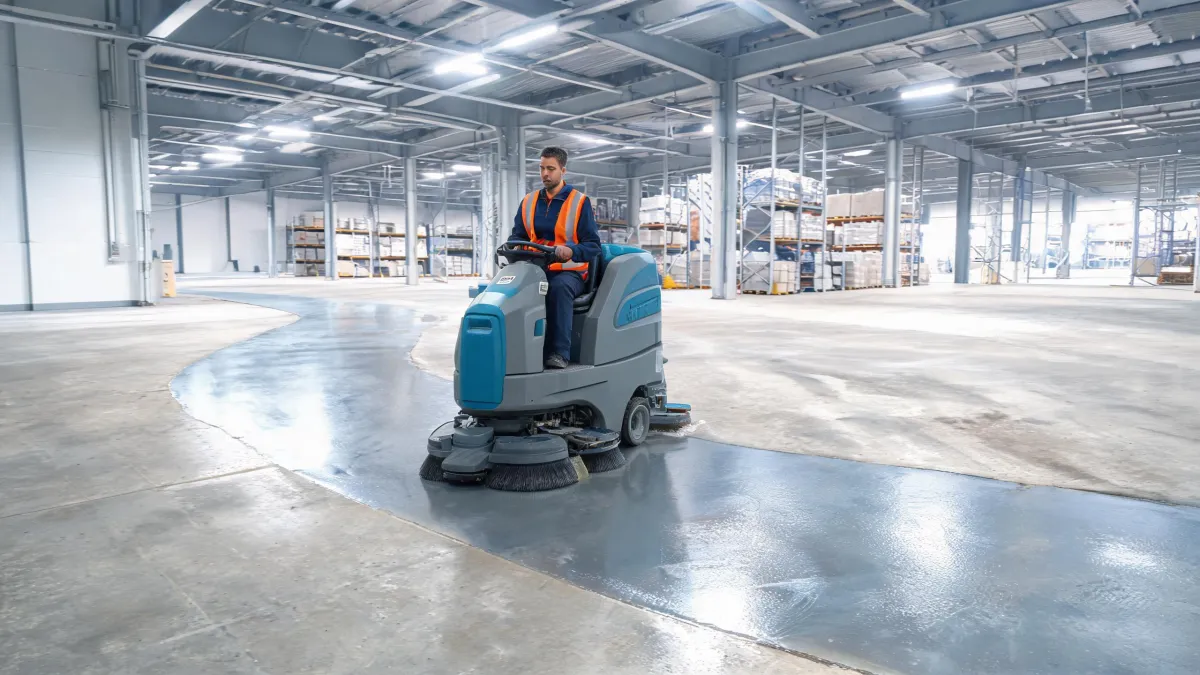
- Walk-Behind vs. Robotic: It's Not About the Price Tag
- Dimension #1: Initial Capital and Setup
- Dimension #2: Operational Costs (The Daily Burn)
-
Dimension #3: Labor and Efficiency (The $50,000/hr Machine)
-
Dimension #4: Maintenance and Downtime (The Hidden Tax)
-
The TCO Showdown: Three-Year Comparison
-
So, Which One Should YOU Choose?
-
Final Takeaway
Walk-Behind vs. Robotic: It's Not About the Price Tag
If you're managing a facility and your team is asking for a new floor scrubber, you've probably looked at two options: a standard walk-behind machine and an autonomous robotic scrubber. The robot looks like the future. The walk-behind looks like... well, work.
But here's the thing: I've been handling procurement for a 500-person manufacturing plant for about six years now, managing an annual cleaning equipment budget of roughly $45,000. Over that time, I've compared quotes, tracked maintenance logs, and built a cost calculator I wish I'd had from day one. Let me walk you through what I found when I compared these two head-to-head—not on price alone, but on total cost of ownership (TCO).
"Most buyers focus on the machine price and completely miss the labor, training, and downtime costs."
The core question isn't "which is cheaper?" It's "which costs less over three years, given YOUR facility?" I've seen a $12,000 robot cost more than a $15,000 walk-behind in the long run. And I've seen the opposite happen too.
How We're Comparing Them
We'll break this down into four dimensions:
- Initial Capital and Setup—what you pay upfront
- Operational Costs—what it takes to run them every day
- Labor and Efficiency—the people cost
- Maintenance and Downtime—the hidden killer
Full disclosure: I work at a plant that uses both types now. But when my boss asked me to justify a robot investment back in 2023, I didn't want to be the guy who bought a shiny toy on the budget. I wanted data. Here's what that data looked like.
Dimension #1: Initial Capital and Setup
The Obvious: Walk-Behinds are Cheaper... Until They're Not
Walk-behind: You can get a solid, commercial-grade walk-behind scrubber (like the Nilfisk SC250 or similar) for $9,000 to $15,000. That's your all-in price. Plug it in, train a person for an hour, and you're done.
Robotic scrubber: A basic autonomous scrubber (like the Nilfisk Liberty SC50 or a similar competitor model) starts at $35,000 and goes up to $65,000+ for the advanced mapping and obstacle avoidance versions.
"So the robot is 3-5x more expensive. Walk-behind wins, right?"
Not so fast. Here's something vendors won't tell you: the first quote is almost never the final price for ongoing operations. I asked for a quote on a robotic scrubber in late 2023. The base price was $42,000. But when I dug into the fine print? They wanted $4,800 for site mapping and programming. Another $1,200 for initial training for my team. And the warranty had exclusions for bumper replacement and sensor recalibration.
The initial cost delta isn't 3x. It's closer to 4-5x once you factor in setup.
But that's not the whole story. Let's look at what happens AFTER you buy it.
Dimension #2: Operational Costs (The Daily Burn)
Consumables, Water, and Electricity
This one surprised me. I assumed the robot would use way less water and chemicals because it's more efficient. I was wrong about the magnitude of the difference.
Walk-behind:
- Water usage: ~12 gallons per hour of runtime
- Pads and brushes: Replace every 2-3 months (approx $80 per set)
- Battery (if not corded): Replace every 2 years (~$600 per battery for a typical 24V system)
- Annual consumable cost (excluding labor): ~$1,800 - $2,500
Robotic scrubber:
- Water usage: ~6 gallons per hour (40-50% less)
- Pads and brushes: Last up to 6 months because wear is more even (approx $120 per set)
- Li-ion battery: Lasts 5+ years, minimal degradation (included in purchase, but replacement is $1,800+)
- Annual consumable cost: ~$800 - $1,200
So the robot does win on consumables—by about $9,000 - $12,000 over 5 years. That's real. But it's not the headline, because the real cost difference is in labor.
Dimension #3: Labor and Efficiency (The $50,000/hr Machine)
Here's where the math gets interesting. Most people who buy a robot think they're hiring a free worker.
"The robot cleans overnight, so you don't need a person doing it. That's $40,000/year saved!"
Not quite. Here's what I've learned from tracking our own labor logs:
A walk-behind requires a dedicated operator. For a 100,000 sq. ft. facility, that's roughly 1.5-2 hours of cleaning per shift (assuming daily cleaning). If your labor is $20/hr (fully loaded), that's $14,600/year in direct cleaning labor.
A robot, on the other hand, needs supervision, not operation. My team spends about 30-45 minutes per day on the robot: checking its cleaning logs, clearing minor obstacles, refilling water, and sending it back to the dock. So that's ~$3,650/year in oversight time.
That's a direct labor savings of roughly $11,000/year.
But there's a catch: the robot doesn't clean corners, under overhangs, or tight spaces. You'll still need manual work in those areas. So the 2 hours of cleaning might become 1 hour of manual + 30 minutes of robot supervision. Total labor savings: about $8,000 - $9,000/year. Real, but not the "replace a full person" everyone claims.
Bottom line on labor: the robot saves you money, but don't bet on firing someone to fund it.
Dimension #4: Maintenance and Downtime (The Hidden Tax)
This is the dimension where most buyers get blindsided. If you only look at acquisition and consumables, you'll miss the biggest line item.
Walk-behind maintenance:
- Simple mechanics: a motor, a squeegee, a water valve.
- Your in-house maintenance guy can fix most things.
- Annual maintenance cost (parts + labor): $600 - $1,200 in year 2-5.
- Downtime risk: Low. If one machine breaks, you borrow an old one or rent.
Robotic scrubber maintenance:
- Complex sensors, LIDAR, GPS, Li-ion batteries, software updates.
- When something goes wrong, you can't fix it. You need a factory tech.
- Annual maintenance cost (service contract): $2,500 - $4,000/year.
- Downtime risk: High. If the robot is down for 3-4 days waiting for a part, you either do manual work or it doesn't get cleaned.
In my experience, the robot's service contract and downtime costs add about $2,000/year more than maintaining a walk-behind in-house. That's $10,000 over 5 years.
And that's assuming the robot is reliable. The first year of our robot's life, we had three sensor failures. Each one was a 48-hour turnaround for a service call. A walk-behind would've been fixed in 2 hours by our maintenance guy.
The TCO Showdown: Three-Year Comparison
Let's put it together. I'm using actual numbers from our 2023-2025 operations (slightly anonymized).
Walk-behind (Mid-range model, ~$12,000):
- Year 1: $12,000 (machine) + $2,000 (consumables) + $14,600 (labor) = $28,600
- Year 2: $2,200 (consumables + battery) + $15,200 (labor + maintenance) = $17,400
- Year 3: $2,000 (consumables) + $15,000 (labor + maintenance) = $17,000
- 3-Year TCO: $63,000
Robotic scrubber (Mid-range model, ~$48,000):
- Year 1: $48,000 (machine + setup) + $800 (consumables) + $3,650 (labor) = $52,450
- Year 2: $900 (consumables) + $3,800 (labor + service contract) = $4,700
- Year 3: $900 (consumables) + $3,800 (labor + service contract) = $4,700
- 3-Year TCO: $61,850
Difference: The robot is about $1,150 cheaper over 3 years.
But here's the kicker: that's highly dependent on labor rates. If your labor is $15/hr, the walk-behind is cheaper. If it's $30/hr, the robot pulls ahead significantly.
The real surprise? For our facility, with labor at $20/hr, the robot barely breaks even in 3 years. The payback period is 2.8 years. That's not the 18-month ROI the sales rep quoted.
So, Which One Should YOU Choose?
I'm not here to tell you one is universally better. I'm here to help you decide based on YOUR context.
Choose the walk-behind if:
- Your facility has lots of corners, tight aisles, or varying floor plans
- You have in-house maintenance staff who can do basic repairs
- Your labor cost is under $18/hr
- You need flexibility (move it between buildings, different floor types)
- Your budget is limited and you can't justify a $40k+ investment
Choose the robot if:
- You have a wide open facility with minimal obstacles
- Your labor is expensive ($25+/hr)
- You want consistent cleaning during off-hours (overnight, weekends)
- You can afford the upfront capital and have a service contract budgeted
- You're willing to accept some downtime risk for the labor savings
"I'm not saying robots are bad—they're great for the right spaces. But if your facility has tight corners or needs daily deep cleaning of kitchen grease, a walk-behind might serve you better. Knowing when NOT to recommend a robot... is exactly why people trust my recommendations in the first place."
In my case, we ended up buying one robot for the main production floor and kept our walk-behinds for the warehouse and break areas. We didn't save $18,000 on one decision. We saved it by matching the right tool to each space. That's the real win.
Final Takeaway
The next time a salesperson quotes you a robot, don't just ask the price. Ask for the 3-year TCO. Ask what's NOT included in the service contract. Ask about training costs. Ask about downtime history.
And if they tell you the robot will replace a full-time employee? Run the numbers yourself. Chances are, you'll end up with a smarter mix, not a single answer.
Trust me on this one. I've tracked every dollar for six years.

Elise Marceau
Elise Marceau is an LED display and digital-signage systems analyst covering LED video walls, modular screens, transparent LED, control processors, and indoor or outdoor signage. She applies IEC 62368-1 safety principles while comparing pixel pitch, luminance, contrast, refresh rate, colour uniformity, viewing angle, ingress protection, power density, module serviceability, and signal redundancy. Her specification guides help integrators, venue operators, retailers, and procurement teams align viewing distance, ambient light, content format, installation access, electrical load, and lifecycle support.