Small Facilities Overbuy Cleaning Equipment. I've Wasted the Money to Prove It.
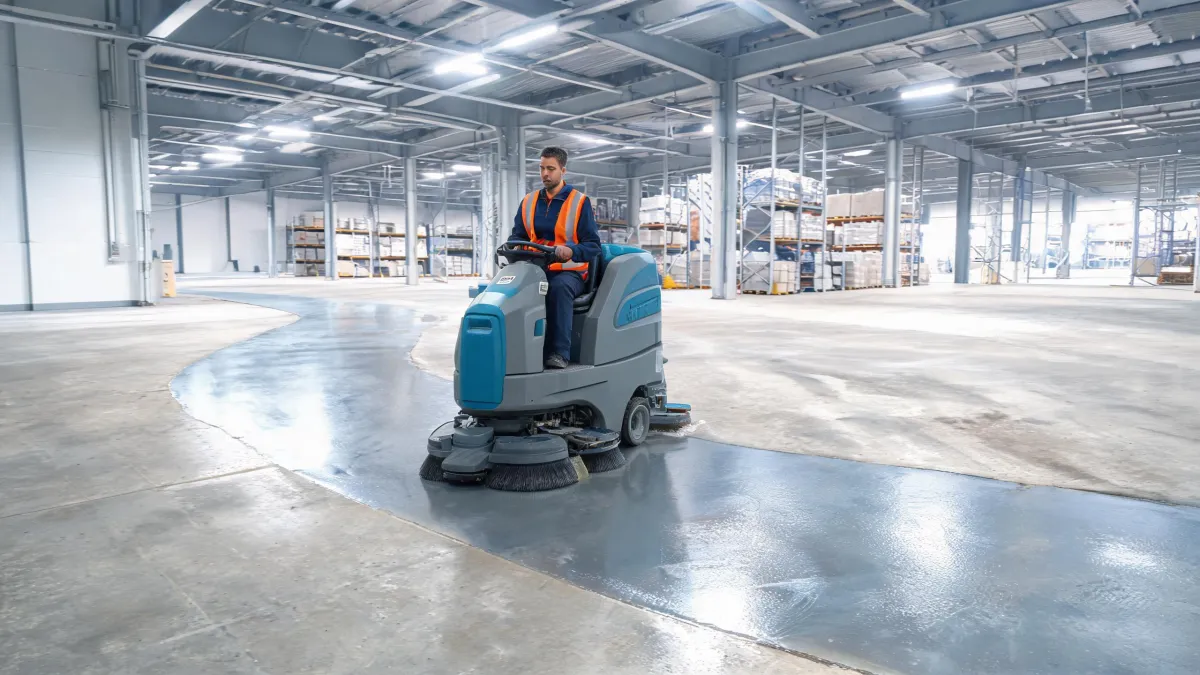
I manage facilities for a 90,000-square-foot distribution operation. For six years, I've been the one signing off on cleaning equipment purchases—and I've made mistakes that total roughly $18,000 in wasted budget. Actually, $18,400, by this morning's count in the maintenance log. I've documented every failure. And the pattern is clear: small and mid-sized facilities systematically overbuy their cleaning equipment. The vendors who are supposed to guide us? Most of them are happy to let us do it.
Here's the opinion I've earned the hard way: most small facilities should buy smaller equipment than they think they need, spend more on training and preventive maintenance, and choose a dealer who picks up the phone over a spec sheet with a bigger number. The largest machine is rarely the best investment. It's usually the most expensive mistake.
The Spec Sheet Trap
Everything I'd read about commercial floor scrubbers said to focus on battery runtime, cleaning width, and scrub pressure. In practice, those numbers told us almost nothing about how well a machine would work in our actual building.
In 2022, I ordered a nilfisk ride-on scrubber—a solid machine with specs that looked excellent on paper. The problem was our warehouse's 8-foot racking aisles. The scrubber's cleaning width turned every aisle end into an awkward three-point turn. The operator spent half their shift maneuvering instead of cleaning. Or rather—the machine was cleaning, it just wasn't covering enough ground per hour to justify its footprint. The capability was real. The fit was wrong.
The surprise wasn't the equipment quality. It was that nobody—not me, not the dealer—had measured the turning radius against our actual aisle dimensions before we signed the purchase order. (Note to self: check the turning radius spec against the real floor plan. Always.)
We returned the machine after three weeks. Restocking plus freight: $1,900. That mistake wasn't the vendor's fault. It was mine, for trusting a data sheet over a tape measure.
The "Below the Line" Costs: Maintenance and Repair
Most buyers calculate the cost of a machine as the price on the invoice. That's wrong. The real cost is the invoice plus everything that happens after you start running it.
Our nilfisk 120 pressure washer—which, to be fair, is a workhorse and I'd buy it again—started vibrating in July 2024. I knew I should inspect the pump, but we were in peak season. "What are the odds it's just a minor imbalance?" The odds caught up with us in September, when a frayed belt took out the pump valve. $890 in parts, two days of downtime, and one very quiet maintenance team. All because I skipped a 30-minute check.
Same story with our walk-behind unit. The floor scrubber motor began making a grinding noise—the kind you can hear beneath normal conversation. We had three weeks of heavy workload, so we pushed it aside. That noise, it turns out, was the motor bearings scoring the shaft. The repair quote: $2,400. If we'd caught it in time: $320. I still think about that $2,080 difference.
And if you think stationary equipment is exempt, think again. Our industrial dust collector repair bill from October 2023 was $4,850 because a blown filter was ignored after we skipped its scheduled replacement. A new filter would have cost $210.
I have mixed feelings about extended warranties. On one hand, they offer peace of mind. On the other, they create a false sense that "the dealer will handle it." In practice, most warranties don't cover neglect, and none of them reimburse your downtime. A preventive maintenance schedule is the only real guarantee.
Support Matters More Than Price
I used to compare quotes the way most people do: lowest number wins. Then we bought a budget-brand floor scrubber and saved $700. It worked fine for about eight months. Then the brush deck alignment failed, and the dealer—three states away—took four business days to respond. Parts took another week. Our team was back to mopping by hand while we waited. That "savings" vanished in a single service event.
(Should mention: we evaluated a Hotsy pressure washer alongside the Nilfisk unit when we replaced that budget scrubber. Both brands have solid reputations. What decided it for us was that one had a local dealer with parts in stock.)
If the phrase "hotsy floor scrubber" brought you here, one quick clarification: Hotsy is known primarily for pressure washers, not floor scrubbers. Their commercial pressure washer line is solid. But if you're genuinely searching for a floor scrubber, you're comparing options like the nilfisk ride-on scrubber against other scrubber specialists. Either way, the buying principles above apply—match the machine type to your actual facility, not to a brand name you've heard somewhere.
Here's where the small-customer angle becomes real. The vendors who treated our $2,000 orders with the same seriousness as a bigger operation's $40,000 orders are the ones we now give our $40,000 orders to. Not because we're sentimental. Because they proved they'd support us when we were small, before we trusted them with something big. Small doesn't mean unimportant. It means you're evaluating a vendor's actual behavior at low risk.
What About "You Get What You Pay For"?
I can already hear the objection: "premium equipment pays for itself over time." I have mixed feelings about that one, too.
It's true for our daily-use ride-on scrubber now. The right machine—with the right dealer and a maintenance habit—has paid for itself multiple times. But "premium" often becomes an excuse for overbuying. A 90,000-square-foot facility doesn't need a machine rated for 150,000 square feet. A 5,000-square-foot workshop doesn't need a ride-on at all. It needs a nilfisk 120 pressure washer, a good walk-behind scrubber, and a maintenance schedule that someone actually follows.
According to ISSA, the cleaning industry's global trade association, maintenance and repair typically account for 20-25% of a machine's total cost of ownership over a five-year lifecycle—if you follow the recommended maintenance schedule. Skip that schedule, and the number climbs steeply. (Source: ISSA equipment lifecycle benchmarks, accessed January 2025; verify current data at issa.com.)
For a small facility, that stat isn't academic. One repair that's a rounding error for a large enterprise can wipe out a quarter's savings for a small operation. That's why "match the machine to your actual workload" isn't a compromise. It's risk management.
The Checklist I Wish I Had in 2019
After the third equipment mistake in Q1 2024, I built a pre-purchase checklist for our team. It's now part of how we buy anything that rolls, sprays, or sucks:
- Measure first. Not the clean aisle. The tightest turn, the door clearance, the elevator dimensions. If the machine can't get to the area it's supposed to clean, its specs are irrelevant.
- Define the duty cycle. How many hours per day, how many days per week? A machine running twenty hours a week has very different needs than one running eighty.
- Price the consumables before the machine. Belts, brushes, filters, pads. If the dealer can't give you pricing and lead times, walk away.
- Call the service number. Before you sign. Time how long it takes to reach a human who can talk about your specific model. That's the best predictor of what a breakdown will feel like.
- Budget the maintenance. If you aren't ready to set aside 10-15% of the purchase price per year for upkeep, the machine is too expensive for your operation—no matter how good the initial price was.
That checklist caught 12 potential bad purchases in the past 18 months. I track that number deliberately. The most recent catch was a rider scrubber whose advertised runtime would have run out mid-shift, based on our duty-cycle calculation. The "smaller" alternative cost less, fit our schedule, and has been running without issues. (Finally—a purchase that made it into the log for the right reasons.)
Bottom Line
Small facilities don't need to buy less than they need. They need to buy the right size, buy support rather than just specs, and actually maintain what they buy. That's what "small customer friendly" really means in this industry: treating a small budget with the same respect as a big one, and making decisions that survive contact with real-world operation.
The vendors who treat small orders as a nuisance are missing the bigger picture. Today's $2,000 buyer is often tomorrow's $40,000 buyer. And the small facility that learns this lesson gains real leverage—it can be faster, more flexible, and more disciplined with capital than any large enterprise. But only if it stops buying based on the emotional pull of a spec sheet and starts buying based on floor plan measurements, duty-cycle math, and a dealer's actual response time.
I still spend real money on cleaning equipment. I just buy it for reasons that would survive an audit of my maintenance log, not for reasons that sounded persuasive in a sales brochure. That's the difference between buying a tool and buying a trophy. Our floors, our budget, and our operators all know the difference.

Elise Marceau
Elise Marceau is an LED display and digital-signage systems analyst covering LED video walls, modular screens, transparent LED, control processors, and indoor or outdoor signage. She applies IEC 62368-1 safety principles while comparing pixel pitch, luminance, contrast, refresh rate, colour uniformity, viewing angle, ingress protection, power density, module serviceability, and signal redundancy. Her specification guides help integrators, venue operators, retailers, and procurement teams align viewing distance, ambient light, content format, installation access, electrical load, and lifecycle support.